
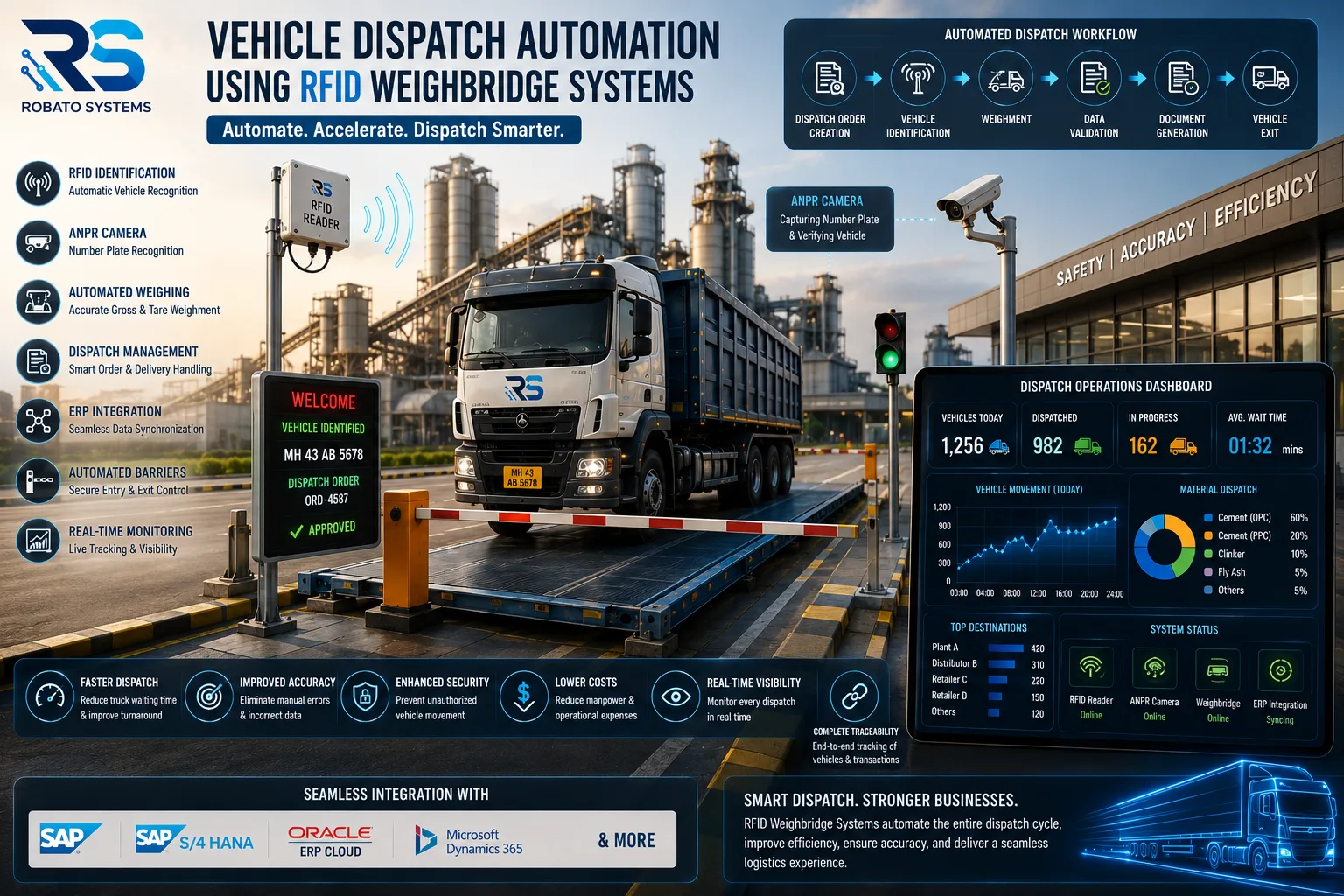
Vehicle Dispatch Automation Using RFID Weighbridge Systems
Introduction
Efficient dispatch operations are the backbone of industries that rely on continuous movement of raw materials and finished goods. Whether it is a cement manufacturing plant dispatching bulk cement, a mining company transporting minerals, or a steel plant moving heavy loads, delays in vehicle dispatch directly impact production schedules, transportation costs, and customer satisfaction.
Traditional dispatch methods often involve manual vehicle verification, paperwork, and disconnected systems, resulting in longer waiting times, operational errors, and poor visibility. Modern industries are replacing these outdated processes with Vehicle Dispatch Automation, where RFID technology, weighbridge automation, ANPR cameras, and ERP integration work together to create a seamless and intelligent dispatch workflow.
By automating the complete dispatch cycle—from vehicle identification to weighment and gate exit—organizations can improve efficiency, strengthen security, and reduce operational costs while ensuring faster vehicle turnaround.
What is Vehicle Dispatch Automation?
Vehicle Dispatch Automation is the process of digitizing and automating vehicle dispatch activities using intelligent hardware and software technologies.
Instead of relying on operators to manually verify vehicles and prepare dispatch documents, an automated system performs these tasks electronically and in real time.
A modern dispatch automation solution typically includes:
RFID Vehicle Identification
Automated Weighbridge Software
ANPR Camera Integration
Boom Barrier Automation
Traffic Signal Management
ERP & SAP Integration
Digital Gate Pass Generation
Centralized Monitoring Dashboard
Together, these technologies eliminate manual intervention and ensure every dispatched vehicle follows a secure and standardized workflow.
Why Manual Vehicle Dispatch Creates Operational Challenges
Although many industries have modernized their production lines, dispatch operations are still handled manually in several facilities. This creates multiple challenges that affect efficiency and profitability.
Long Vehicle Waiting Time
Manual verification and document processing slow down truck movement, causing long queues at entry and exit gates.
Human Errors
Incorrect dispatch entries, duplicate records, and paperwork mistakes can lead to shipment delays and customer complaints.
Limited Visibility
Without centralized monitoring, managers cannot track vehicle movement or dispatch progress in real time.
Unauthorized Vehicle Movement
Manual verification increases the possibility of unauthorized trucks entering or leaving the premises.
Higher Operating Costs
Paper-based workflows require more manpower, increase administrative work, and slow down dispatch operations.
How Vehicle Dispatch Automation Works
Step 1: Dispatch Order Creation
The dispatch order is generated within the ERP or dispatch management software, containing customer details, material information, and vehicle assignment.
Step 2: Vehicle Identification
As the truck approaches the facility, RFID readers automatically identify the registered vehicle.
Simultaneously, ANPR cameras verify the vehicle registration number for additional security.
Step 3: Entry Authorization
If the vehicle details match the dispatch schedule, the boom barrier opens automatically, allowing the truck to enter without operator intervention.
Step 4: Automated Weighment
The truck moves onto the weighbridge where gross or tare weight is captured automatically.
The weight data is instantly transferred to the dispatch software.
Step 5: Dispatch Validation
The software validates:
Vehicle Information
Material Details
Customer Order
Dispatch Quantity
Weight Information
Only verified vehicles are allowed to proceed.
Step 6: Digital Document Generation
The system automatically generates:
Weight Slip
Delivery Challan
Gate Pass
Dispatch Note
Invoice Information
All documents are digitally stored for future reference.
Step 7: Vehicle Exit
Once verification is complete, the boom barrier opens automatically, allowing the truck to exit without unnecessary delays.
Key Components of a Vehicle Dispatch Automation System
RFID Vehicle Identification
RFID technology identifies registered vehicles instantly without requiring manual verification.
ANPR Cameras
Automatic Number Plate Recognition cameras provide an additional layer of security by verifying vehicle registration numbers.
Weighbridge Automation Software
The software records weight transactions, validates dispatch information, and synchronizes data with ERP systems.
Boom Barrier System
Automated barriers regulate vehicle entry and exit based on system authorization.
Dispatch Management Software
Coordinates dispatch schedules, vehicle allocation, and documentation.
Synchronizes dispatch operations with inventory, finance, production, and warehouse management systems.
Central Monitoring Dashboard
Provides real-time visibility into vehicle movement, dispatch status, and operational performance.
Benefits of Vehicle Dispatch Automation
Faster Truck Turnaround Time
Automated verification and weighment significantly reduce vehicle waiting time.
Improved Dispatch Accuracy
Digital processing eliminates manual data entry errors and ensures accurate dispatch records.
Enhanced Operational Efficiency
Automated workflows streamline dispatch operations and improve productivity.
Better Inventory Synchronization
Dispatch quantities are automatically updated within ERP and inventory management systems.
Improved Security
RFID and ANPR technologies prevent unauthorized vehicle movement and fraudulent transactions.
Reduced Paperwork
Digital documentation minimizes manual paperwork and simplifies record management.
Lower Operational Costs
Automation reduces manpower requirements while improving overall process efficiency.
Real-Time Monitoring
Managers gain complete visibility over dispatch activities through centralized dashboards.
Industries That Benefit from Vehicle Dispatch Automation
Cement Manufacturing
Automate bulk cement dispatch and reduce truck congestion during peak operations.
Improve dispatch accuracy while minimizing material losses.
Steel Plants
Manage high-volume vehicle movement efficiently and securely.
Logistics & Warehousing
Optimize fleet scheduling and improve shipment visibility.
Manufacturing Plants
Automate finished goods dispatch while improving warehouse coordination.
Power Plants
Efficiently manage fuel and coal transportation.
Chemical Industries
Ensure accurate dispatch records and regulatory compliance for hazardous material transportation.
Advanced Features of Modern Dispatch Automation Systems
Cloud-Based Monitoring
Monitor dispatch activities across multiple plants from a centralized dashboard.
Mobile Accessibility
Access dispatch reports and live vehicle information from smartphones and tablets.
GPS Integration
Track dispatched vehicles even after leaving the facility.
Real-Time Analytics
Generate reports on vehicle turnaround time, dispatch efficiency, and operational performance.
Multi-Plant Management
Manage dispatch operations across multiple manufacturing units using one platform.
Automated Notifications
Send SMS and email notifications to drivers, customers, and logistics teams regarding dispatch status.
Best Practices for Implementing Vehicle Dispatch Automation
To maximize the benefits of automation, industries should:
Use RFID-based vehicle identification.
Integrate ANPR cameras for dual verification.
Connect dispatch software with ERP and inventory systems.
Automate weighbridge operations.
Replace paper-based documentation with digital records.
Continuously monitor dispatch KPIs using centralized dashboards.
Regularly audit dispatch workflows to identify improvement opportunities.
Future of Vehicle Dispatch Automation
As industries continue adopting Industry 4.0 technologies, dispatch systems are becoming increasingly intelligent.
Future developments include:
Artificial Intelligence (AI)
AI-powered systems will optimize dispatch scheduling and predict operational bottlenecks.
Internet of Things (IoT)
Connected sensors will provide real-time vehicle and equipment monitoring.
Cloud-Based Dispatch Platforms
Organizations will manage multiple facilities through centralized cloud dashboards.
Predictive Analytics
Advanced analytics will improve fleet utilization and dispatch planning.
Paperless Logistics
Digital documentation will replace traditional paperwork, improving sustainability and operational efficiency.
Conclusion
Vehicle Dispatch Automation has become an essential solution for industries seeking to improve logistics efficiency, reduce operational costs, and accelerate vehicle movement. By integrating RFID technology, ANPR cameras, weighbridge automation software, and ERP systems, organizations can automate the entire dispatch process while ensuring greater accuracy, transparency, and security.
As businesses continue embracing digital transformation, automated dispatch solutions will play a critical role in building smarter supply chains, improving customer satisfaction, and enhancing overall operational performance.
Frequently Asked Questions (FAQs)
What is Vehicle Dispatch Automation?
Vehicle Dispatch Automation is a technology-driven system that automates vehicle identification, weighment, documentation, and gate management to streamline dispatch operations.
How does RFID improve dispatch operations?
RFID automatically identifies vehicles, reducing manual verification and improving truck turnaround time.
Can Vehicle Dispatch Automation integrate with ERP software?
Yes. Modern dispatch automation systems integrate with ERP platforms such as SAP, Oracle, Microsoft Dynamics, and other enterprise systems.
Which industries benefit from Vehicle Dispatch Automation?
Manufacturing, cement, mining, steel, logistics, warehousing, power plants, and chemical industries commonly use automated dispatch solutions.
What are the major benefits of dispatch automation?
The primary benefits include faster dispatch, improved security, reduced paperwork, better inventory management, lower operational costs, and real-time monitoring.