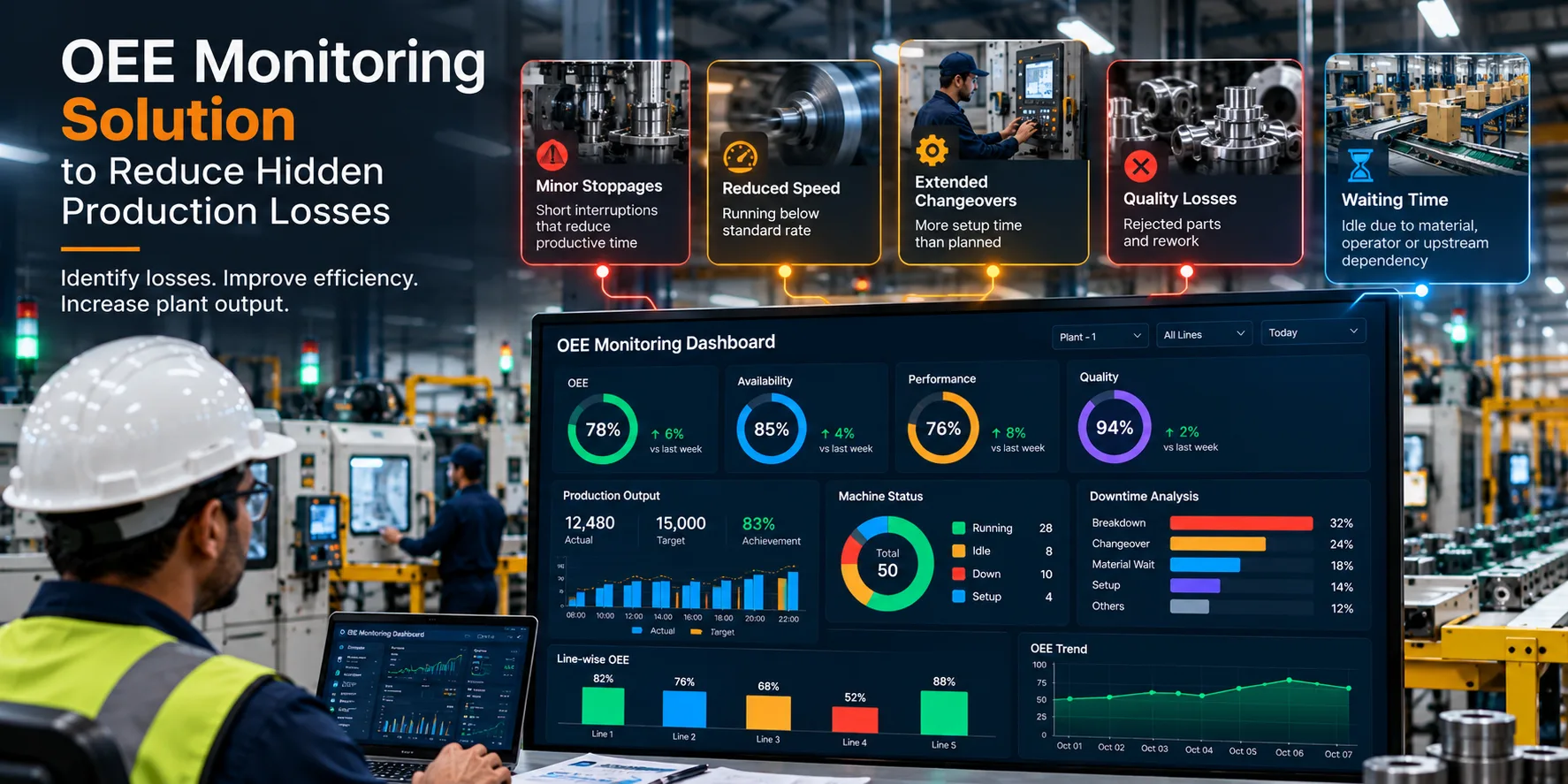
OEE Monitoring Solution to Reduce Hidden Production Losses
Manufacturing losses are not always caused by major equipment breakdowns or obvious production failures. In many factories, a considerable amount of productive capacity can be lost through small, recurring interruptions, slower machine cycles, extended changeovers and quality problems that are not consistently measured.
A machine may stop for a few minutes several times during a shift. Another may continue running but operate below its expected production rate. A production line may meet its daily output target while still losing valuable time that could have been used more effectively.
When these issues are not recorded and analyzed systematically, their cumulative impact can remain difficult to quantify.
An OEE monitoring solution helps manufacturers bring these losses into view by connecting machine performance, production output, downtime and quality information within a structured monitoring environment.
For operations leaders, the objective is not simply to collect more production data. It is to understand where production capacity is being lost, determine which problems deserve attention and measure the results of improvement initiatives.
What Is an OEE Monitoring Solution?
An OEE monitoring solution is a manufacturing monitoring system designed to measure Overall Equipment Effectiveness and provide visibility into equipment performance.
OEE stands for Overall Equipment Effectiveness. It combines three factors:
OEE = Availability × Performance × Quality
Each factor measures a different type of production loss.
Availability: Measures how much of the planned production time equipment was available for production.
Performance: Measures how closely the equipment operated against its expected production rate.
Quality: Measures the proportion of output that meets the required quality standard.
An OEE monitoring solution can collect the information needed to calculate these metrics and display the results through dashboards, reports and historical analytics.
Depending on the implementation, it may also provide machine status monitoring, downtime categorization, shift-wise reporting and production target tracking.
This allows manufacturing teams to investigate not only whether performance has changed, but also which component may be contributing to the change.
What Are Hidden Production Losses?
Hidden production losses are inefficiencies that are not always apparent in routine production reporting.
Some losses are easy to identify, such as a major breakdown that stops an entire production line. Others are less obvious because they occur repeatedly, last only a short time or are not recorded consistently.
Common examples include:
Minor Machine Stoppages
A machine may stop briefly because of sensor interruptions, material feeding problems, component positioning or other operating conditions.
Individual stoppages may appear insignificant, but repeated events can consume substantial production time.
Reduced Operating Speed
Equipment can remain operational while producing below its ideal or expected cycle rate.
Without reliable cycle-time and production-count data, the difference may not be immediately visible.
Extended Changeovers
Setup and changeover activities may take longer than planned, reducing the time available for productive operation.
Quality Losses
Rejected components, scrap and rework can reduce the amount of usable output generated from the available production time.
Waiting Time
Machines may remain idle while waiting for materials, operators, upstream processes or other required resources.
Repeated Downtime Events
Recurring equipment interruptions may be recorded individually without being analyzed as a pattern.
An OEE monitoring solution can help make these losses measurable so that teams can investigate their causes.
Why Traditional Production Reporting Can Miss Production Losses
Traditional production reports often focus on total output, completed orders and shift-level performance.
These measurements are useful, but they may not explain everything that happened during production.
For example, a machine might achieve its target quantity despite experiencing numerous short stoppages. Another might miss its target because of reduced operating speed rather than a major breakdown.
If the report records only total output, the underlying causes can remain unclear.
Common limitations of manual or fragmented reporting include:
Incomplete downtime records
Delayed identification of production issues
Inconsistent calculations between shifts
Limited visibility into short stoppages
Difficulty comparing machine performance
Missing context behind production shortfalls
Time-consuming consolidation of production information
An OEE monitoring solution can address some of these limitations by providing standardized calculations and a more consistent view of machine performance.
The quality of the results still depends on the accuracy and completeness of the data collected.
How an OEE Monitoring Solution Identifies Hidden Losses
A structured monitoring process connects machine activity with measurable production performance.
Machine Data → Production Monitoring → OEE Calculation → Loss Identification → Root Cause Investigation → Improvement
Step 1: Collect Machine and Production Data
Depending on the equipment, data may be collected from PLCs, machine controllers, sensors, production counters or other available sources.
Relevant information can include machine state, production quantity, cycle time and downtime events.
Step 2: Calculate Performance Metrics
The system processes the data using configured production rules, including planned production time, ideal cycle times and quality information.
Step 3: Identify Performance Gaps
Dashboards and reports help teams identify machines or production lines where OEE, availability, performance or quality is below expectations.
Step 4: Investigate the Underlying Causes
Production teams can examine downtime records, operating conditions, maintenance information and operator feedback to understand why the losses occur.
Step 5: Measure Improvement
After corrective action, the same metrics can be reviewed to determine whether the change has produced a measurable result.
This process turns monitoring into a repeatable improvement activity.
Use OEE to Understand Different Types of Production Loss
OEE provides a useful framework because it separates equipment effectiveness into three components.
Availability Losses
Availability losses occur when equipment is not available during planned production time.
Potential causes include:
Equipment breakdowns
Setup and changeovers
Unplanned maintenance
Material shortages
Other production interruptions
An OEE monitoring solution can help quantify these losses and identify recurring downtime patterns.
Performance Losses
Performance losses occur when equipment produces below its expected rate while operating.
Potential causes include:
Reduced machine speed
Minor stoppages
Longer cycle times
Inconsistent operating conditions
Machine performance monitoring can help teams determine where production rates differ from the configured standard.
Quality Losses
Quality losses occur when output does not meet the required specification.
Examples include:
Rejected components
Defective products
Scrap
Rework
Tracking quality alongside availability and performance provides a more complete view of effective production output.
Real-Time Monitoring for Faster Production Decisions
Historical production reports help explain what happened. Real-time monitoring can help teams recognize issues while production is still underway.
A real-time OEE dashboard may display:
Current machine status
Production quantity
Production target
OEE
Availability
Performance
Quality
Active downtime
Shift progress
When an unexpected stoppage occurs, the relevant team can investigate it closer to the time of occurrence.
Similarly, if production begins falling behind the planned target, managers can review machine status, operating speed and downtime information.
The main advantage is improved visibility. Faster decisions still depend on clear responsibilities, effective communication and the ability to resolve the underlying problem.
Downtime Monitoring: A Critical Part of Loss Reduction
Downtime is one of the most important contributors to lost production capacity.
However, recording total downtime alone may not provide enough information for effective improvement.
Manufacturers should understand both how long equipment remains unavailable and why the interruptions occur.
A structured downtime monitoring system can help capture:
Start and end times
Duration
Machine or production line
Downtime category
Frequency of events
Shift information
Historical trends
Where appropriate, operators can provide additional context about the reason for a stoppage.
Over time, this information can help identify recurring problems and prioritize corrective actions.
For example, frequent short stops may require a different investigation from occasional long breakdowns. Both can affect production, but their causes and potential remedies may differ.
Identify Which Production Losses Deserve Attention First
Manufacturing teams often have more improvement opportunities than they have time or resources to address simultaneously.
An OEE monitoring solution can help prioritize these opportunities using measurable information.
Teams may evaluate losses according to:
Total lost production time
Frequency of occurrence
Number of affected machines
Impact on production targets
Quality consequences
Cost of lost output
Recurrence over time
For example, a machine experiencing repeated short stoppages may accumulate more lost production time than a machine experiencing one isolated interruption.
Similarly, a quality issue affecting a high-volume product may deserve priority even if its downtime impact is limited.
The best priority depends on the operational and financial consequences of each loss.
Compare Machine Performance Across Production Lines
When several machines perform similar operations, comparing their results can help identify differences in performance.
An OEE dashboard can provide machine-wise or line-wise views of:
OEE
Availability
Performance
Quality
Downtime
Production quantity
Target achievement
These figures are illustrative and are not industry benchmarks.
Line B's lower availability suggests that downtime or other availability losses may warrant investigation. However, managers should review the underlying events before concluding what caused the difference.
Comparisons are most meaningful when machines have comparable operating conditions and consistent KPI definitions.
Production Loss Analysis for Continuous Improvement
Identifying a loss is only the beginning.
Continuous improvement requires teams to investigate the reasons behind the loss and verify whether corrective action works.
A practical improvement cycle is:
Measure → Identify → Investigate → Correct → Verify
For example, a plant may identify that a machine repeatedly loses time during material feeding.
The team can examine the feeding mechanism, material presentation, sensor signals and operating procedures to identify the actual cause.
After implementing a corrective action, the team can compare the relevant downtime and production metrics before and after the change.
An OEE monitoring solution provides the measurements needed to support this process, but it does not automatically identify every root cause.
Operational expertise and proper investigation remain essential.
How an OEE Monitoring Solution Can Support Production Targets
Production targets depend on available time, machine capability, cycle times, product requirements and operating conditions.
When actual output falls below plan, managers need to understand the reasons behind the shortfall.
An OEE monitoring solution can help connect production target achievement with:
Machine availability
Operating speed
Quality performance
Downtime events
Shift production
Actual cycle time
This helps teams determine whether a production shortfall is associated with equipment losses, process conditions or other operational constraints.
It also provides a more consistent basis for reviewing production performance across shifts and production lines.
The Business Impact of Reducing Hidden Production Losses
Hidden losses can affect manufacturing performance in several ways.
More Productive Use of Existing Equipment
Reducing avoidable stoppages or speed losses may allow a plant to obtain more output from its existing equipment, depending on demand and operating constraints.
Better Production Planning
Historical machine performance can help planners understand actual production capability more accurately.
Improved Quality Visibility
Monitoring good and rejected quantities helps teams understand the impact of quality losses on effective output.
More Efficient Performance Reviews
Automated dashboards and reports can reduce the effort required to consolidate production information manually.
Better Improvement Prioritization
Quantified losses can help teams decide which problems warrant investigation first.
These benefits should be measured against the plant's actual operating conditions rather than assumed from the presence of monitoring software alone.
Calculating the Potential Financial Impact of Production Losses
Manufacturers can build a practical business case by estimating the cost of measurable losses.
For downtime, one simple approach is:
Estimated Downtime Impact = Lost Production Hours × Expected Contribution per Production Hour
This is a simplified estimate. The actual financial impact depends on whether the lost output could have been produced or sold, available capacity elsewhere, demand, product mix and variable costs.
For quality losses, teams can evaluate scrap, rework, material usage and other relevant costs.
For manual reporting, organizations can estimate the staff time spent collecting and consolidating production information.
These estimates can help compare potential benefits with the cost of software, integration, training and ongoing support.
Avoid counting the same benefit twice. For example, increased output and recovered downtime may describe overlapping improvements.
What Features Should You Look for in an OEE Monitoring Solution?
The right solution should match the plant's production environment and improvement goals.
Important capabilities may include:
Real-Time Machine Monitoring: Visibility into machine states and production activity.
OEE Calculation: Consistent availability, performance and quality measurements.
Downtime Monitoring: Recording and analyzing stoppages.
Production Analytics: Historical performance and loss analysis.
Machine-Wise Dashboards: Visibility across machines and production lines.
Shift-Wise Reporting: Performance summaries based on production schedules.
Production Target Tracking: Comparison of planned and actual output.
Quality Monitoring: Tracking accepted and rejected quantities.
Data Integration: Suitable connectivity with PLCs, sensors, machine controllers and other available sources.
Historical Trends: Analysis of recurring losses and improvement results.
Scalability: Support for additional machines or production lines as monitoring requirements expand.
Before selecting a platform, manufacturers should confirm that the system supports the required data sources and calculation rules.
Integrating an OEE Monitoring Solution with Existing Equipment
Manufacturers do not necessarily need to replace existing machines to introduce OEE monitoring.
Depending on the equipment, production data may be collected through existing PLCs, controllers, sensors, counters or suitable external data collection devices.
A practical integration assessment should establish:
Which machines need monitoring
Which signals are available
Whether production counts can be captured reliably
How machine states will be defined
How downtime reasons will be recorded
Which quality data is available
How the information will reach the monitoring platform
Older machines may require additional sensors or data collection hardware.
A pilot implementation on selected machines can help validate data quality and operational value before expanding across the plant.
Common Mistakes When Reducing Production Losses
Focusing Only on Overall OEE
An OEE percentage can highlight a performance gap, but the underlying availability, performance and quality figures are needed to investigate it.
Ignoring Minor Stoppages
Short interruptions can accumulate into meaningful losses if they occur frequently.
Using Inconsistent Machine Standards
Incorrect cycle times or inconsistent production rules can make performance comparisons unreliable.
Assuming Every Downtime Event Has the Same Cause
Different interruptions require different investigation and corrective actions.
Collecting Data Without Assigning Responsibility
Monitoring should be supported by clear ownership for reviewing, investigating and resolving production issues.
Expecting Software to Deliver Improvement Automatically
Software makes production information more accessible. Improvement depends on the actions taken in response to the information.
How to Implement an OEE Monitoring Solution Successfully
A phased implementation helps establish a reliable foundation.
Step 1: Identify the Main Production Problems
Start with known issues such as recurring downtime, missed production targets or inconsistent performance reporting.
Step 2: Select Critical Machines
Choose equipment where better visibility could help address meaningful production losses.
Step 3: Assess Data Availability
Confirm which machine states, production counts and quality measurements can be captured.
Step 4: Establish Measurement Rules
Define planned production time, cycle times, quality calculations and downtime categories.
Step 5: Validate the Results
Compare system data with verified production records and investigate discrepancies.
Step 6: Review the Losses
Use the collected information to prioritize areas for further investigation.
Step 7: Measure Improvement
Track the same metrics after corrective actions to evaluate whether the intended changes occurred.
Step 8: Expand the Monitoring Scope
Extend the system to additional equipment after validating the initial implementation.
This approach helps ensure that monitoring remains connected to actual manufacturing priorities.
Frequently Asked Questions
What is an OEE monitoring solution?
An OEE monitoring solution measures equipment effectiveness using availability, performance and quality. It can provide dashboards and reports to help manufacturers understand machine performance, downtime and production losses.
How does OEE monitoring help identify hidden production losses?
It provides structured visibility into machine status, production speed, downtime and quality. This can help teams identify recurring losses that may be difficult to recognize through total production figures alone.
Can OEE monitoring work with existing machines?
In many cases, yes. Data may be collected from available PLCs, controllers, sensors, production counters or additional devices. Compatibility depends on the equipment and required information.
Does OEE monitoring automatically reduce downtime?
No. Monitoring helps identify and quantify downtime. Actual reductions require investigation, corrective action and follow-up measurement.
Which production losses should manufacturers monitor first?
A practical starting point is to focus on losses that significantly affect production targets, productive time, quality or operational costs. The appropriate priorities depend on the plant's conditions.
How can a COO evaluate the value of an OEE monitoring solution?
A COO can evaluate the solution against measurable objectives such as improved production visibility, reduced reporting effort, better downtime analysis, increased equipment utilization and verified reductions in production losses.
Final Thoughts
Hidden production losses can accumulate through minor stoppages, reduced machine speed, extended changeovers, equipment downtime and quality problems. Without consistent measurement, these losses can be difficult to quantify and prioritize.
An OEE Monitoring Solution provides a structured way to connect machine performance, availability, production output and quality within a common monitoring environment.
For manufacturing leaders, the most important benefit is the ability to identify where production capacity is being lost and direct attention toward the problems that matter most.
When supported by accurate data, consistent KPI definitions and disciplined follow-up, OEE monitoring can become an important part of a factory's continuous improvement strategy.
Find and Address Hidden Production Losses
If your manufacturing operation needs better visibility into machine performance, downtime and production efficiency, a structured OEE monitoring assessment can help identify the information you need and the areas worth investigating.
Request an Assessment to discuss your manufacturing environment, monitoring requirements and production performance objectives.