Manufacturing teams need accurate and timely production data to understand what is happening on the shop floor. When machine performance is monitored manually through spreadsheets, paper records, or delayed reports, production losses can remain hidden until the end of a shift or production day.
OEE Monitoring Software provides a digital way to track machine and production performance in real time. By bringing availability, performance, and quality data into a centralized system, plant teams can identify losses faster and make more informed production decisions.
For manufacturers looking to improve machine utilization and production efficiency, OEE monitoring can become an important part of a modern production management system.
What Is OEE Monitoring Software?
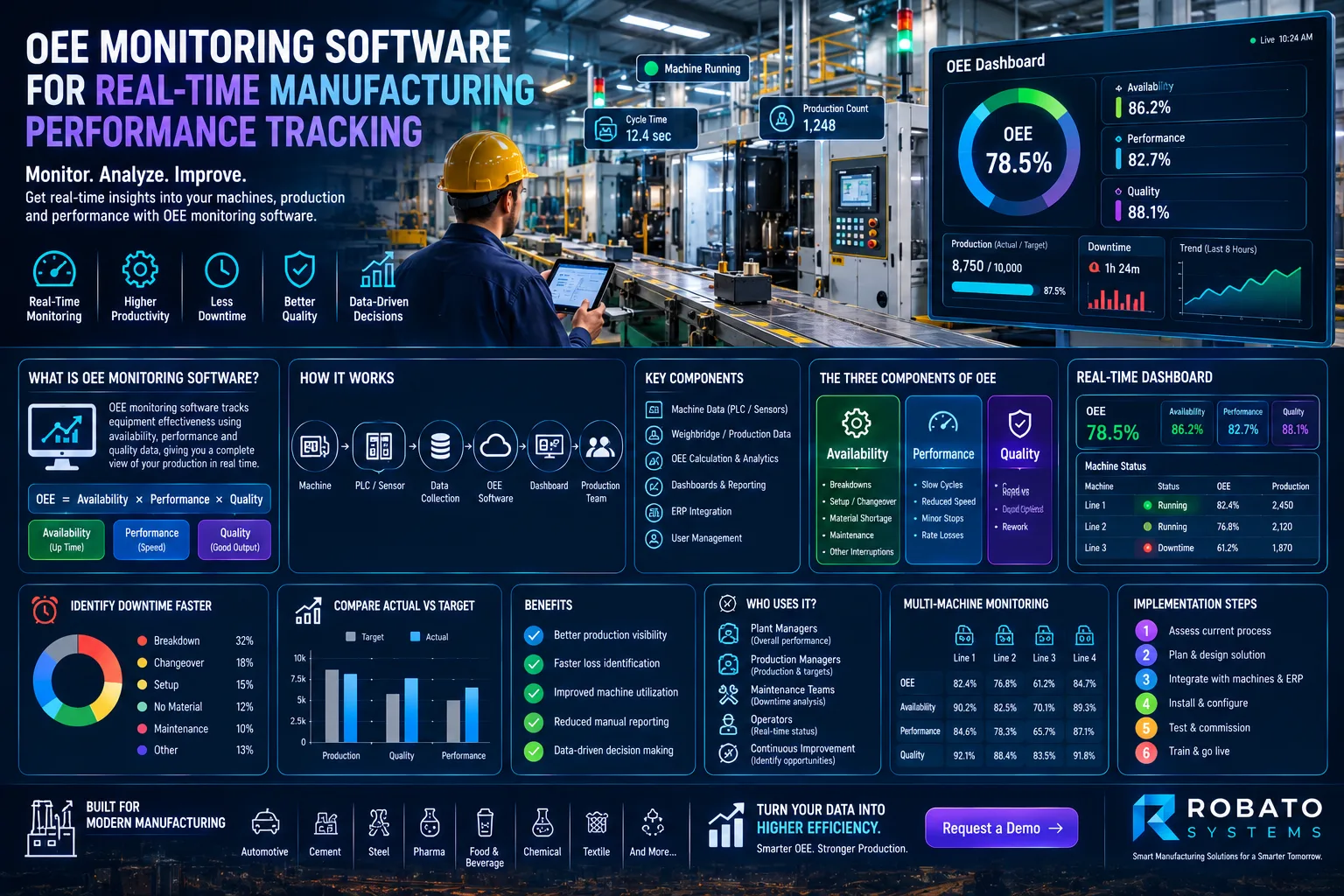
OEE stands for Overall Equipment Effectiveness. It is a commonly used manufacturing metric that evaluates equipment performance through three primary factors:
Availability
Performance
Quality
The basic OEE calculation is:
OEE = Availability × Performance × Quality
OEE Monitoring Software automatically collects and processes production information to help teams understand these three factors and identify where production losses are occurring.
Why Real-Time OEE Monitoring Matters
Traditional production reports often show what happened after a shift has already finished.
By that time, production teams may have limited opportunity to address the problem.
Real-time monitoring provides a different approach.
A production team can see information such as:
Current machine status
Running time
Downtime
Production quantity
Target quantity
Rejected quantity
Production rate
OEE percentage
Availability
Performance
Quality
This gives supervisors and plant managers greater visibility into ongoing production.
How OEE Monitoring Software Works
An OEE monitoring system generally connects machine-level data with production monitoring software.
A typical workflow can be:
Machine → PLC/Sensor → Data Collection → OEE Software → Dashboard → Production Team
The system can collect machine and production signals and convert them into meaningful production information.
Depending on the machine and plant infrastructure, data may come from PLCs, sensors, counters, industrial devices, or other connected equipment.
The Three Core Components of OEE
1. Availability
Availability measures how much of the planned production time the machine was actually available for production.
Downtime can result from factors such as:
Machine breakdown
Changeover
Setup
Material shortage
Operator availability
Maintenance
Other production interruptions
Tracking downtime helps production teams understand why planned production time is being lost.
2. Performance
Performance looks at how efficiently the machine operates compared with its expected production rate.
A machine may technically be running but producing below its ideal speed.
Performance monitoring can help identify:
Slow cycles
Reduced machine speed
Minor stops
Production rate losses
3. Quality
Quality measures the proportion of production that meets the required standards.
Monitoring good and rejected quantities allows teams to understand the impact of quality losses on overall equipment effectiveness.
Real-Time Production Dashboard
A centralized OEE dashboard can present important production information in a format that plant teams can quickly understand.
The exact dashboard design can be customized according to the plant's requirements.
Identify Downtime Faster
One of the major advantages of OEE monitoring is improved visibility into downtime.
Instead of simply knowing that a machine produced less than expected, the production team can investigate the downtime associated with the machine.
Common downtime categories may include:
Breakdown
Setup
Changeover
No material
Maintenance
Quality issue
Operator-related stoppage
Planned stoppage
This helps teams move from “production was low” to “production was low because specific losses occurred.”
Compare Actual Production with Target
OEE software can also help production teams compare planned production with actual output.
For example:
Target: 10,000 units
Actual: 8,750 units
The difference can then be investigated through availability, performance, quality, and downtime information.
This provides more context than looking at production quantity alone.
Benefits of OEE Monitoring Software
Better Production Visibility
Plant managers can monitor production information from a centralized dashboard instead of waiting for manually prepared reports.
Faster Identification of Losses
Real-time information can help teams identify downtime, slow production, and quality losses sooner.
Improved Machine Utilization
Understanding machine losses can help production teams identify opportunities to improve equipment utilization.
Reduced Manual Reporting
Automated data collection and reporting can reduce dependence on spreadsheets and manual production reports.
Data-Driven Decision Making
Historical and real-time production information can provide a stronger basis for production improvement initiatives.
Who Uses OEE Monitoring Software?
OEE monitoring can provide useful information to different teams across a manufacturing organization.
Plant Managers
Can monitor overall production performance and identify major production losses.
Production Managers
Can track machine performance, output, downtime, and shift results.
Maintenance Teams
Can use downtime information to understand recurring equipment-related losses.
Operators
Can view current production targets, output, machine status, and relevant production information.
Continuous Improvement Teams
Can use historical OEE and loss information to identify improvement opportunities.
OEE Monitoring Across Multiple Machines
Manufacturing plants rarely depend on a single machine.
A centralized system can monitor multiple machines or production lines from a common interface.
Management can compare:
Machine performance
Production lines
Shifts
Products
Downtime
OEE trends
This makes it easier to identify where attention may be required.
OEE Monitoring Should Go Beyond a Single Percentage
A common mistake is to focus only on the final OEE percentage.
For example, a machine may show a low OEE value, but the percentage alone does not explain the reason.
A useful OEE monitoring system should allow teams to drill into the underlying factors:
OEE → Availability → Downtime → Loss Reason
or
OEE → Performance → Production Rate → Speed Loss
This turns OEE from a simple KPI into a practical production improvement tool.
How Robato Systems Can Help
Robato Systems can help manufacturing organizations implement OEE Monitoring Software designed around their production environment.
Depending on the plant's requirements, the system can support areas such as:
Real-time machine monitoring
OEE calculation
Production tracking
Downtime monitoring
Target vs actual production
Quality tracking
Production dashboards
Historical reporting
Machine-level performance analysis
The system can be planned around existing manufacturing equipment and the plant's specific production monitoring requirements.
Final Thoughts
OEE Monitoring Software gives manufacturing teams a structured way to understand machine availability, production performance, quality, and losses.
Instead of relying only on end-of-shift reports, real-time production monitoring can provide visibility into what is happening on the shop floor while production is still running.
The real value of OEE monitoring comes from using the data to identify losses, investigate their causes, and continuously improve manufacturing performance.
Request a Demo
Want real-time visibility into your plant's machine and production performance? Request a demo from Robato Systems to explore an OEE monitoring solution for your manufacturing environment.
FAQs
What is OEE Monitoring Software?
OEE Monitoring Software is a digital system used to monitor equipment effectiveness using availability, performance, and quality data.
What are the three components of OEE?
The three primary components are Availability, Performance, and Quality.
Can OEE software monitor multiple machines?
Yes. OEE systems can be designed to monitor multiple machines and production lines from a centralized dashboard, depending on the plant's requirements.
Can OEE software track downtime?
Yes. OEE monitoring systems can track machine downtime and categorize downtime reasons to help production teams understand production losses.
Can existing machines be connected to OEE software?
Depending on the machine's available PLCs, sensors, controllers, or communication interfaces, existing equipment can potentially be connected to an OEE monitoring system.