
Why a Smart Traffic Management System Is No Longer Optional for Modern Cities
Traffic congestion is not just an inconvenience. It costs economies billions every year in lost productivity, increased fuel consumption, and delayed emergency response times. The solution is no longer about building more roads or adding more lanes. It is about managing what already exists with greater intelligence. A well-implemented traffic management system uses real-time data, smart sensors, and connected software to keep vehicles moving safely and efficiently through any environment, from busy urban intersections to sprawling industrial campuses and airport terminals. This article explains how it works and why more organizations are investing in it right now.
The Problem With Traditional Traffic Management
For decades, traffic management relied on fixed-cycle traffic signals, painted road markings, and manual supervision at busy junctions. These approaches worked reasonably well when traffic volumes were predictable and lower. In today's world, they create more problems than they solve.
A fixed-cycle traffic light has no awareness of actual traffic conditions. It turns red and green on a schedule, regardless of whether there are fifty vehicles waiting on one side or none at all. The result is unnecessary congestion, wasted time, and frustrated drivers who can see the road is clear but are still sitting at a red light. A smart traffic management system replaces this rigid approach with a dynamic one that responds to real conditions in real time.
How a Smart Traffic Management System Works
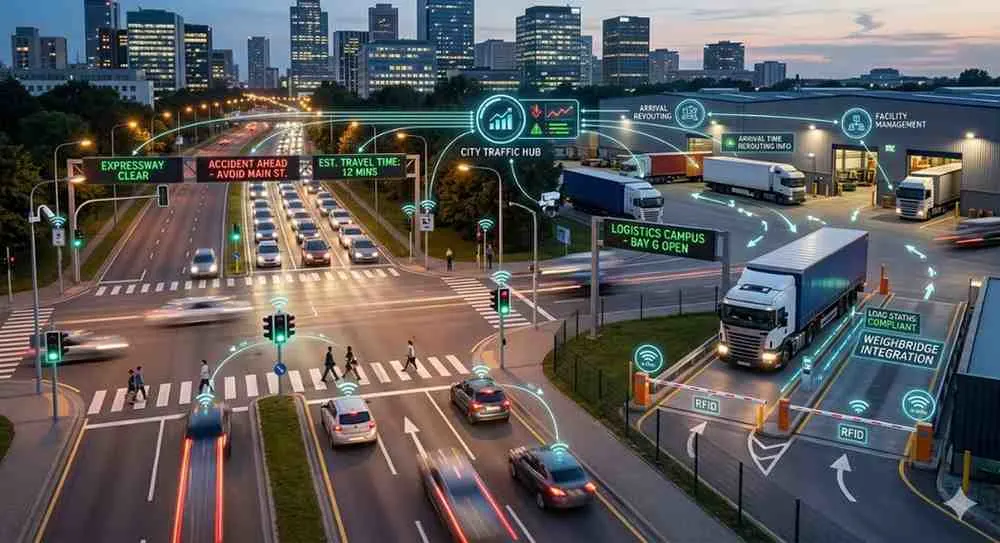
A modern traffic management system is built on three core layers working together continuously. The first layer is data collection. Sensors, cameras, radar devices, and vehicle detection units placed at key points across the road network capture live information about vehicle volumes, speeds, queue lengths, and occupancy at every monitored location. This data feeds into the system continuously, creating a real-time picture of traffic conditions across the entire network.
The second layer is processing and analysis. The system's software processes the incoming data using predefined rules and algorithms, identifying where congestion is building, where signal timing needs to adjust, and where an incident has occurred that requires an immediate response. The third layer is action. The system responds by adjusting signal timings, activating variable message signs, rerouting vehicles through alternate paths, and alerting operators or emergency services where needed, all automatically and in real time.
Inside Facility Traffic Management: A Growing Priority
While city-level traffic management gets most of the attention, traffic management systems are equally critical within private facilities. Large industrial campuses, airports, hospitals, logistics hubs, and commercial complexes all have their own internal road networks where vehicle flow, access control, and safety must be managed carefully every day.
Robato Systems brings the same intelligence of city-level traffic management into these private facility environments. RFID-based vehicle identification allows authorized vehicles to move through controlled access points without stopping. Boom barriers and automatic gate systems regulate entry and exit at precise intervals. LED variable message signs direct vehicles to designated areas, loading bays, parking zones, and emergency evacuation routes clearly and in real time.
For facilities handling heavy vehicles like trucks and tankers, axle load monitoring and weighbridge integration add another layer of control, ensuring that vehicles meet load compliance requirements before entering restricted road sections within the facility.
Variable Message Signs: The Voice of the Road
One of the most visible and effective components of any traffic management system is the variable message sign. These LED display boards positioned at strategic points along road networks communicate live information directly to drivers at the moment they need it most.
In a city environment, variable message signs warn drivers of accidents ahead, display alternate route suggestions, show estimated travel times, and broadcast emergency alerts. In a private facility environment, they direct trucks to the correct entry gate, inform drivers of weighbridge availability, display speed limits for restricted zones, and provide safety warnings near pedestrian crossing points.
The ability to update these signs instantly through centralized software means that drivers always receive accurate, relevant information regardless of how quickly conditions change. A message that takes minutes to display on a traditional static sign can be pushed to every variable message board across a network in seconds.
Safety, Compliance, and Environmental Benefits
Beyond improving traffic flow, smart traffic management systems deliver measurable safety and environmental benefits. Fewer stop-start cycles at congested junctions mean lower fuel consumption and reduced carbon emissions. Faster emergency vehicle response times result from signal priority systems that clear a green corridor for ambulances and fire engines automatically. Incident detection cameras identify accidents, wrong-way drivers, and stalled vehicles within seconds, triggering faster response times from traffic operators and emergency services.
For industrial and logistics facilities, compliance benefits are equally significant. Automatic recording of vehicle entry and exit times, load data, and access credentials creates a complete, auditable log of every vehicle movement within the facility, supporting both internal governance and external regulatory requirements.
The Future Is Connected and Predictive
The next generation of traffic management systems is moving beyond reactive control into predictive intelligence. By analyzing historical traffic patterns alongside live sensor data, advanced systems can anticipate congestion before it forms and adjust signal timings and routing recommendations proactively rather than in response to problems that have already developed.
For any organization managing a road network, whether a city authority, an airport operator, an industrial campus, or a logistics hub, investing in a smart traffic management system is no longer a future consideration. It is the foundation of a safer, more efficient, and more sustainable operation today.