Truck congestion around weighbridges is a common challenge in manufacturing plants, warehouses, mining sites , cement plants , power plants, and other industrial facilities. When multiple vehicles arrive at the same time, manual queue management can quickly become difficult.
Long queues not only delay dispatch operations but also increase fuel consumption, driver waiting time, yard congestion, and overall logistics costs.
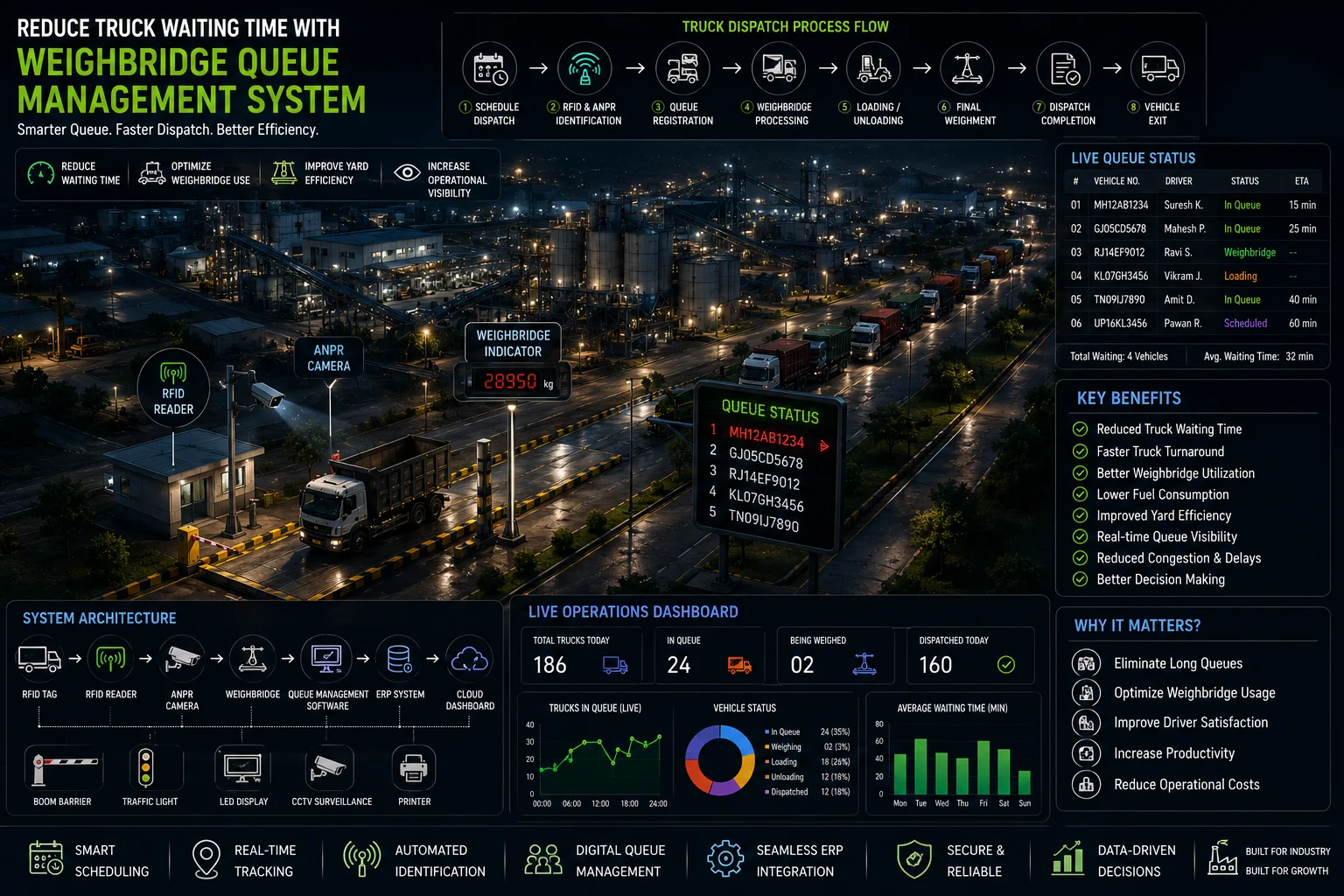
A Weighbridge Queue Management System helps industries organize vehicle movement by digitally managing truck arrivals, scheduling, weighbridge allocation, loading or unloading activities, and final dispatch. When combined with RFID, ANPR, automated boom barriers, and dispatch software, the system provides complete visibility over the vehicle queue.
What is a Weighbridge Queue Management System?
A Weighbridge Queue Management System is a software-based solution designed to control and optimize truck movement around industrial weighbridges.
Instead of allowing vehicles to wait randomly, the system creates an organized digital queue based on factors such as:
Dispatch Order
Vehicle Arrival
Scheduled Time
Material Type
Customer Priority
Weighbridge Availability
Loading or Unloading Status
The system can integrate with:
ANPR Cameras
Automatic Boom Barriers
ERP Software
Dispatch Management Software
Yard Management Systems
Digital Display Boards
This creates a structured workflow from vehicle arrival to final exit.
Why Do Trucks Wait at Weighbridges?
Truck waiting time can increase because of several operational issues:
Unplanned vehicle arrivals
Manual vehicle verification
Limited weighbridge capacity
Paper-based documentation
Slow operator processing
Poor queue visibility
Delayed loading or unloading
Communication gaps between departments
Multiple vehicles arriving simultaneously
Manual dispatch approvals
A digital queue management system helps address these problems by providing real-time information about vehicle status and weighbridge availability.
How a Weighbridge Queue Management System Works
Step 1: Vehicle Scheduling
The logistics team schedules vehicles based on dispatch requirements and available plant capacity.
Each vehicle can be assigned:
Vehicle Number
RFID Tag
Transporter
Material
Customer
Dispatch Order
Planned Arrival Time
Step 2: Vehicle Arrival
When the truck reaches the facility, RFID automatically identifies the vehicle.
An ANPR camera can also capture and verify the vehicle number.
The system checks whether the vehicle has an active schedule or dispatch order.
Step 3: Queue Registration
If the weighbridge is occupied, the vehicle is added to the digital queue.
The operator can see:
Vehicles Waiting
Vehicles Being Weighed
Vehicles Loading
Vehicles Ready for Exit
Estimated Queue Position
Step 4: Vehicle Call Forward
When the weighbridge becomes available, the system calls the next eligible vehicle.
The vehicle can be notified through:
LED Display
Digital Token
Mobile Notification
Yard Display
Operator Dashboard
Step 5: Automated Weighment
The selected truck enters the weighbridge and its weight is automatically captured.
The transaction is linked to the vehicle and dispatch order.
Step 6: Loading or Unloading
The truck moves to the designated area for material loading or unloading.
Its status is updated in the system.
Step 7: Final Weighment and Exit
The vehicle returns for final weighing when required.
The system calculates:
Net Weight = Gross Weight − Tare Weight
After the transaction is completed, the vehicle receives dispatch clearance and exits the facility.
Key Features of a Weighbridge Queue Management System
Digital Truck Queue
Maintain a real-time digital queue instead of relying on manual registers or verbal instructions.
RFID Vehicle Identification
Automatically recognize registered vehicles as they approach the plant.
Vehicle Call Forward
Automatically notify the next vehicle when a weighbridge becomes available.
ANPR Integration
Verify vehicle numbers automatically using cameras.
Weighbridge Allocation
For facilities with multiple weighbridges, vehicles can be directed to the appropriate weighing point.
Real-Time Dashboard
Monitor:
Waiting Trucks
Active Weighments
Queue Length
Vehicle Status
Weighbridge Utilization
Average Waiting Time
Truck Turnaround Time
ERP Integration
Connect queue and weighment information with dispatch, inventory, billing, and ERP systems.
Benefits of Weighbridge Queue Management
Reduced Truck Waiting Time
Organized vehicle movement helps prevent unnecessary waiting around the weighbridge.
Faster Truck Turnaround
A structured process allows vehicles to move through the facility more efficiently.
Lower Fuel Consumption
Reducing idle time can help minimize fuel consumption caused by trucks waiting in queues.
Better Yard Utilization
Controlled vehicle movement reduces unnecessary congestion inside the plant.
Improved Weighbridge Utilization
Vehicles can be allocated efficiently based on weighbridge availability.
Better Logistics Visibility
Operations teams can monitor every vehicle from arrival to exit.
Reduced Manual Work
Automated identification, queue management, and status updates reduce operator intervention.
Applications
A Weighbridge Queue Management System is suitable for:
Manufacturing Plants
Cement Plants
Steel Plants
Mining Sites
Power Plants
Coal Handling Plants
Fertilizer Plants
Chemical Plants
Warehouses
Scrap Yards
RMC Plants
Ports
Bulk Material Handling Facilities
RFID and Queue Management Integration
RFID makes queue management more efficient by automatically identifying vehicles.
For example:
Scheduled → RFID Identified → Queue → Called Forward → Weighed → Loading/Unloading → Final Weighment → Exit
This removes the need for operators to manually search through vehicle lists or verify every truck using paperwork.
ERP Integration
A queue management system can exchange information with ERP software for:
Sales Orders
Purchase Orders
Dispatch Orders
Inventory
Customer Information
Vehicle Details
Weighment Transactions
Billing
This ensures that the queue management process is connected with the organization's wider logistics workflow.
How to Improve Truck Turnaround Time
Businesses can improve truck turnaround time by:
Scheduling vehicle arrivals
Using RFID-based identification
Automating weighbridge operations
Implementing digital queues
Using automatic call-forward systems
Monitoring loading and unloading times
Integrating ERP and dispatch systems
Tracking average waiting time
Identifying process bottlenecks through reports
The goal is not simply to move trucks faster but to create a predictable and organized vehicle movement process.
Common Challenges
High Peak Traffic
Multiple trucks may arrive simultaneously during dispatch peaks, requiring dynamic queue management.
Multiple Weighbridges
Facilities with several weighbridges need intelligent allocation to prevent one weighbridge from becoming overloaded while another remains underutilized.
Manual Loading Processes
Even with automated weighing, slow loading or unloading can create downstream queues.
Unscheduled Vehicles
The system should have workflows for handling vehicles that arrive without a valid schedule or dispatch order.
Future of Weighbridge Queue Management
The next generation of queue management systems is moving toward intelligent logistics automation using:
AI-Based Truck Scheduling
Predictive Arrival Times
GPS Vehicle Tracking
Dynamic Queue Allocation
Automated Weighbridge Assignment
Cloud-Based Monitoring
Mobile Notifications
Advanced Logistics Analytics
These technologies can help industrial facilities predict congestion and optimize vehicle movement before bottlenecks occur.
Why Choose Robato Systems?
Robato Systems provides Weighbridge Queue Management Systems designed to help industrial facilities control truck movement and reduce unnecessary waiting.
The solution can combine RFID vehicle identification, truck scheduling, weighbridge automation, queue management, ANPR, boom barriers, ERP integration, and real-time dashboards into a single platform.
By digitizing the vehicle queue, businesses can gain better control over truck arrivals, improve weighbridge utilization, reduce congestion, and create a more efficient dispatch workflow.
Conclusion
Long truck queues can significantly affect industrial logistics efficiency. Manual queue management makes it difficult to know which vehicle should be processed next, how long trucks have been waiting, and where bottlenecks are occurring.
A Weighbridge Queue Management System provides a structured digital approach to vehicle scheduling, queue control, weighbridge allocation, and dispatch management. When integrated with RFID, ANPR, ERP, and automated weighbridge systems, it creates a connected workflow that improves truck turnaround and operational visibility.
For high-volume industrial facilities, automating weighbridge queue management can be an important step toward reducing waiting time, improving logistics efficiency, and creating a smarter vehicle movement process.
Frequently Asked Questions
What is a Weighbridge Queue Management System?
It is a digital system that manages and controls truck queues around weighbridges by scheduling vehicles, monitoring their status, and calling them forward when weighing capacity becomes available.
How does it reduce truck waiting time?
It organizes vehicle arrivals, maintains a digital queue, and automatically calls eligible vehicles when the weighbridge is ready.
Can RFID be integrated with queue management?
Yes. RFID can automatically identify registered trucks and connect their vehicle information with the digital queue.
Can the system work with multiple weighbridges?
Yes. The system can allocate vehicles to available weighbridges to improve overall utilization.
Can it integrate with ERP software?
Yes. Queue, vehicle, weighment, dispatch, inventory, and billing information can be connected with ERP systems.
Can the system track truck turnaround time?
Yes. The system can record vehicle arrival, queue, weighing, loading or unloading, and exit timestamps to calculate waiting and turnaround times.