Introduction
Industrial facilities are under constant pressure to move vehicles quickly while maintaining accuracy and security. Manufacturing plants, logistics hubs, warehouses, mining sites, cement factories, and steel industries often process hundreds of trucks every day. Traditional weighbridge operations rely heavily on operators to verify documents, enter data, issue weighment slips, and manage vehicle movement. As vehicle traffic increases, these manual processes become slower, more expensive, and more prone to errors.
A Weighbridge Kiosk System addresses these challenges by allowing drivers to complete weighment transactions independently through an interactive self-service terminal. Integrated with RFID technology, ANPR cameras, automated boom barriers, weighbridge software, and ERP systems, the kiosk automates the complete vehicle weighing process while minimizing human intervention.
The result is faster truck processing, reduced operational costs, improved data accuracy, and uninterrupted 24/7 weighbridge operations.
What is a Weighbridge Kiosk System?
A Weighbridge Kiosk System is a self-service terminal installed near a weighbridge that enables drivers to complete weighment activities without assistance from an operator.
Using a touchscreen interface, drivers can verify shipment details, authenticate themselves, confirm transactions, print weighment slips, and continue their journey without entering a weighbridge office.
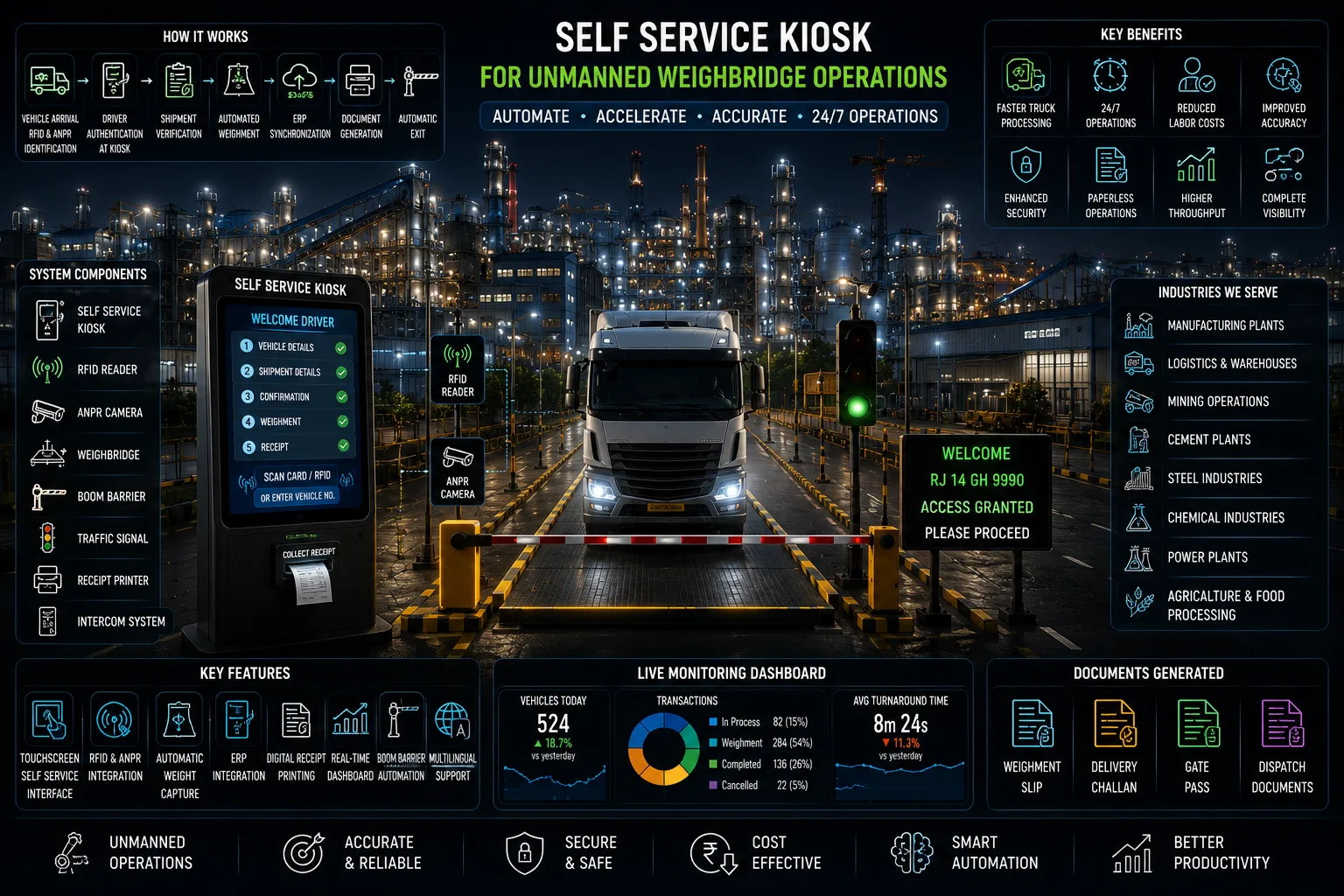
A complete weighbridge kiosk solution generally includes:
Self-Service Touchscreen Kiosk
RFID Reader
ANPR Camera
Automated Weighbridge
Boom Barrier Control
Traffic Signal System
ERP Integration
Receipt Printer
Intercom or Voice Assistance
Centralized Monitoring Dashboard
These technologies work together to create a fully automated weighbridge environment.
Challenges with Conventional Weighbridge Operations
Many industries still depend on manual weighbridge processes, leading to operational inefficiencies.
Long Truck Waiting Time
Drivers spend valuable time waiting for document verification and operator assistance.
High Manpower Requirements
Dedicated weighbridge operators are required during every shift.
Manual Data Entry Errors
Incorrect vehicle details and weighment records can affect billing and inventory.
Limited Working Hours
Manual operations often depend on staff availability, especially during night shifts.
Higher Operating Costs
Paperwork and manual supervision increase administrative expenses.
How a Weighbridge Kiosk System Works
Step 1: Vehicle Identification
The arriving vehicle is identified automatically using RFID tags and ANPR cameras.
The system verifies authorization before allowing the vehicle to proceed.
Step 2: Driver Interaction
The driver uses the touchscreen kiosk to:
Enter vehicle details
Verify transport information
Select transaction type
Confirm shipment details
Step 3: Automated Weighment
The vehicle moves onto the weighbridge where weight information is captured automatically.
No manual weight entry is required.
Step 4: System Validation
The software verifies:
Vehicle Information
Driver Details
Purchase Order
Dispatch Order
Material Information
Customer Details
Step 5: ERP Synchronization
Transaction information is automatically updated in:
ERP
Inventory
Dispatch
Billing
Procurement
Logistics Systems
Step 6: Document Generation
The kiosk automatically prints or digitally shares:
Weighment Slip
Delivery Challan
Gate Pass
Dispatch Documents
Step 7: Vehicle Exit
After successful processing, the boom barrier opens automatically and the vehicle exits the facility.
Key Features of a Weighbridge Kiosk System
Touchscreen Self-Service Interface
Simple and intuitive interface allowing drivers to complete transactions independently.
RFID Vehicle Identification
Automatically identifies registered vehicles upon arrival.
ANPR Verification
Provides an additional security layer through automatic number plate recognition.
Automatic Weight Capture
Transfers weighment data directly into the software without manual input.
Receipt Printing
Generates instant weighment slips and gate passes.
ERP Integration
Synchronizes transaction data with procurement, inventory, finance, and logistics systems.
Multilingual Support
Supports multiple languages for easy driver interaction.
Live Dashboard
Monitor kiosk activities, truck movement, weighment status, and operational performance from a centralized dashboard.
Benefits of a Weighbridge Kiosk System
Faster Vehicle Processing
Reduce truck waiting time by eliminating manual documentation.
24/7 Operations
Support continuous weighbridge operations without depending on operator availability.
Reduced Labor Costs
Lower manpower requirements while increasing operational efficiency.
Improved Accuracy
Eliminate manual data entry errors during weighment.
Better Driver Experience
Drivers complete the weighing process quickly with minimal waiting.
Enhanced Security
RFID and ANPR ensure only authorized vehicles complete transactions.
Paperless Operations
Digitize weighment documentation and reduce paperwork.
Increased Throughput
Handle more vehicles each day without expanding infrastructure.
Industries That Benefit from Weighbridge Kiosk Systems
Manufacturing Plants
Automate inbound and outbound logistics.
Logistics Companies
Improve fleet turnaround time and dispatch efficiency.
Warehouses
Streamline goods receiving and dispatch operations.
Mining Operations
Manage heavy truck traffic efficiently.
Cement Plants
Automate raw material receiving and finished goods dispatch.
Steel Industries
Improve truck weighing and logistics management.
Chemical Industries
Ensure secure and accurate transportation of hazardous materials.
Agriculture & Food Processing
Automate vehicle weighing for bulk commodity transportation.
Best Practices for Successful Implementation
For maximum performance:
Install user-friendly touchscreen kiosks.
Integrate RFID and ANPR technologies.
Connect the kiosk with ERP software.
Automate boom barrier operations.
Enable multilingual driver support.
Perform routine equipment maintenance.
Train transport partners before deployment.
Future Trends in Weighbridge Kiosk Systems
Artificial Intelligence
AI will assist in traffic management, anomaly detection, and predictive maintenance.
Voice-Guided Kiosks
Voice instructions will simplify operation for drivers from different regions.
Mobile Connectivity
Drivers will receive weighment slips and notifications directly on their smartphones.
Cloud-Based Monitoring
Organizations will manage kiosk operations across multiple facilities from centralized dashboards.
Smart Industrial Automation
Weighbridge kiosks will integrate with warehouse management systems, production planning, fleet management, and Industrial IoT platforms.
Why Businesses Should Invest in Weighbridge Kiosk Systems
Industries seeking higher productivity and lower operational costs are increasingly adopting self-service weighbridge kiosks. These systems eliminate bottlenecks, reduce dependency on manpower, and provide a faster and more accurate weighing process.
Organizations implementing weighbridge kiosk systems typically achieve:
Faster truck turnaround
Increased weighbridge utilization
Lower labor costs
Better customer experience
Improved operational accuracy
Reduced paperwork
Enhanced security
Complete operational visibility
Conclusion
A Weighbridge Kiosk System is a key component of modern unmanned weighbridge operations. By enabling drivers to complete weighing transactions independently, organizations can improve efficiency, reduce operational costs, and increase vehicle throughput without compromising security or accuracy.
Integrated with RFID, ANPR, ERP systems, and automated boom barriers, self-service kiosks provide a seamless weighing experience while supporting the digital transformation of industrial logistics. Businesses looking to modernize their weighbridge operations will benefit from improved productivity, better compliance, and real-time operational visibility.
Frequently Asked Questions (FAQs)
What is a Weighbridge Kiosk System?
A Weighbridge Kiosk System is a self-service terminal that enables truck drivers to complete weighment transactions independently without operator assistance.
How does a weighbridge kiosk work?
The driver interacts with a touchscreen kiosk, verifies shipment details, completes automated weighing, receives digital or printed documents, and exits through an automated boom barrier.
Can a weighbridge kiosk integrate with ERP software?
Yes. It integrates with ERP systems, RFID readers, ANPR cameras, inventory software, dispatch systems, and weighbridge automation software.
Which industries use weighbridge kiosk systems?
Manufacturing, logistics, mining, warehouses, cement, steel, chemical, agriculture, and food processing industries commonly implement these systems.
What are the benefits of a weighbridge kiosk system?
Benefits include faster truck processing, 24/7 operations, reduced labor costs, improved accuracy, paperless documentation, enhanced security, and higher operational efficiency.