Manufacturing plants handle a continuous flow of raw materials, finished goods, suppliers, transporters, and vehicles. In many facilities, the weighbridge is one of the most important points where this material movement is recorded.
Traditional weighbridge operations often depend on manual vehicle identification, operator entries, printed documents, and separate systems. While these processes may work at lower volumes, they can become difficult to manage as vehicle traffic increases.
Weighbridge digital transformation brings these processes together using automation, vehicle identification, system integration, and data analytics.
The goal is not simply to automate weighing. It is to create a connected process from vehicle arrival to final exit.
What Is Weighbridge Digital Transformation?
Weighbridge digital transformation means replacing disconnected or highly manual weighing processes with an integrated digital workflow.
A modern system can connect:
Weighbridge indicators
RFID
ANPR cameras
Boom barriers
Traffic lights
Vehicle sensors
CCTV
ERP systems
Dispatch systems
Inventory systems
Reporting dashboards
Analytics platforms
This creates a centralized flow of information and reduces unnecessary manual intervention.
Why Manufacturing Plants Need Digital Weighbridge Operations
Manual weighbridge processes can create several operational challenges:
Long vehicle queues
Repeated data entry
Incorrect vehicle identification
Paper-based documentation
Delayed dispatch processing
Difficulty tracking transactions
Limited management visibility
Difficult historical data analysis
Digital transformation can address these challenges by connecting vehicle movement, weighing, material information, and business systems.
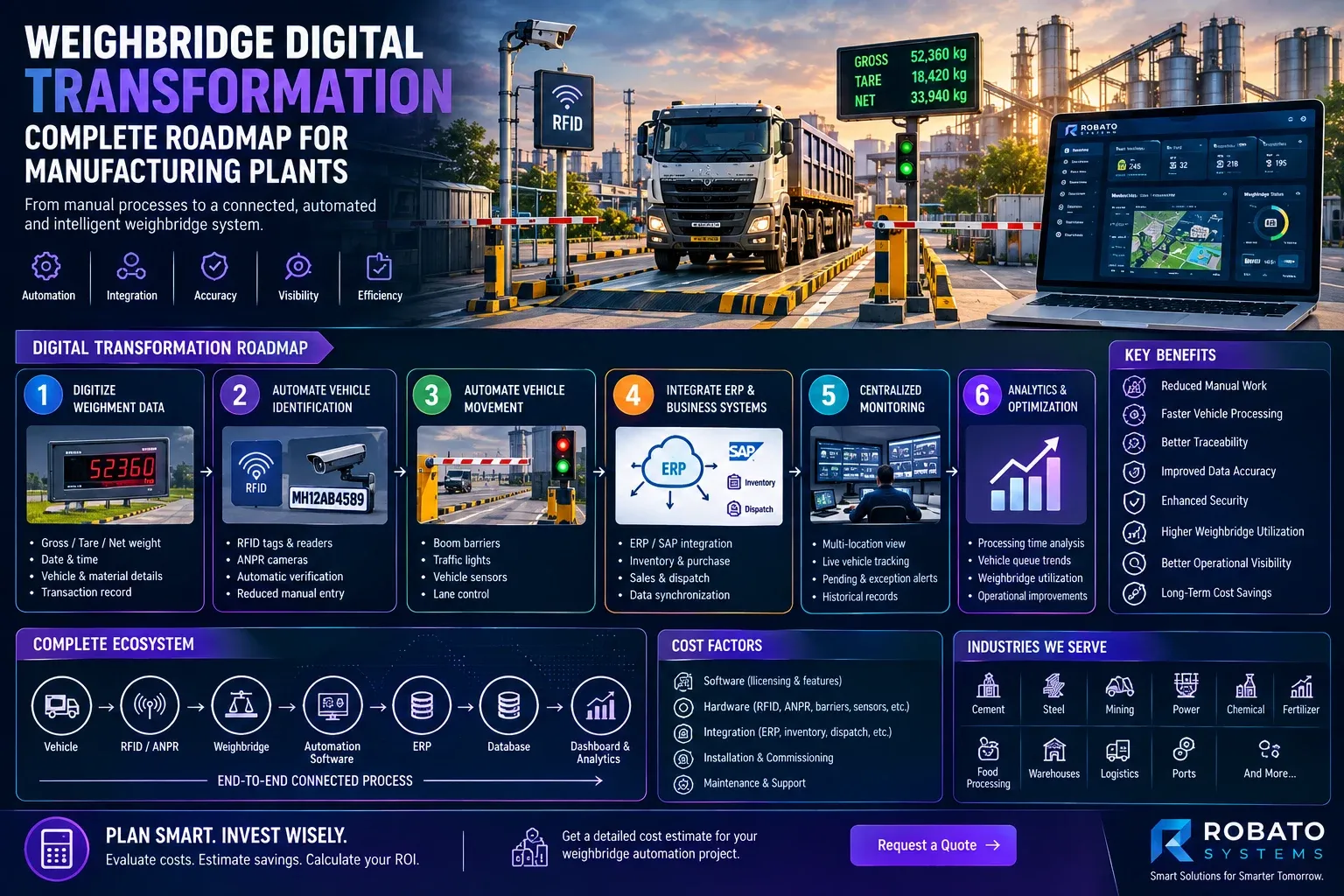
A Practical Weighbridge Digital Transformation Roadmap
Digital transformation does not need to happen all at once. A phased approach can make implementation easier and more manageable.
Phase 1: Digitize Weighment Data
The first step is to capture weighing information electronically.
Instead of manually entering weights, the system can communicate with the weighing indicator and automatically record:
Gross weight
Tare weight
Net weight
Date and time
Vehicle details
Material details
Transaction information
This establishes a reliable digital foundation for further automation.
Phase 2: Automate Vehicle Identification
The next step is to reduce manual vehicle identification.
Technologies such as RFID can identify registered vehicles automatically.
ANPR can also capture vehicle registration numbers through cameras.
A plant can choose RFID, ANPR, or a combination depending on its security and operational requirements.
Phase 3: Automate Vehicle Movement
After identification, the system can control the movement of vehicles through the weighbridge area.
Automation can include:
Boom barriers
Traffic lights
Vehicle sensors
Lane controls
Automated entry permissions
Exit controls
This can create a structured vehicle movement process and help reduce unnecessary waiting.
Phase 4: Integrate ERP and Business Systems
Once the weighbridge is digitally capturing transactions, the next step is connecting it with business applications.
Depending on the organization, integration may involve:
ERP
SAP
Inventory management
Purchase systems
Sales systems
Warehouse management
Dispatch management
Fleet systems
For example, a dispatch transaction can be associated with the vehicle, material, order, and weighment information without requiring operators to repeatedly enter the same data.
Phase 5: Introduce Centralized Monitoring
For organizations operating multiple weighbridges or plants, centralized monitoring can provide a broader view of operations.
Management can potentially monitor:
Weighbridge activity
Vehicle transactions
Material movement
Pending vehicles
Dispatch activity
Exceptions
Historical records
This becomes particularly useful when operational teams need visibility across multiple locations.
Phase 6: Add Analytics and Optimization
The final stage is using the collected data for operational improvement.
Analytics can help identify:
Peak vehicle arrival periods
Average processing times
Vehicle waiting patterns
Weighbridge utilization
Material movement trends
Dispatch volumes
Operational bottlenecks
Instead of simply storing weighment records, organizations can use the information to improve logistics processes.
RFID + ERP + Analytics: A Connected Approach
A strong digital transformation strategy connects multiple systems rather than automating each component separately.
A typical architecture could look like:
Vehicle → RFID/ANPR → Weighbridge → Automation Software → ERP → Database → Dashboard & Analytics
Each stage contributes information to the overall process.
RFID or ANPR identifies the vehicle.
The weighbridge captures the weight.
The automation software manages the transaction.
ERP provides business information.
The database stores operational records.
Analytics turns those records into useful insights.
Benefits of Weighbridge Digital Transformation
Reduced Manual Work
Automated vehicle identification and weight capture can reduce repetitive operator activities.
Faster Vehicle Processing
A structured automated workflow can help reduce unnecessary steps during vehicle entry, weighing, and exit.
Better Traceability
Digital records make it easier to search and review historical transactions.
Improved Data Accuracy
Direct integration with weighing equipment can reduce manual transcription errors.
Better Security
Vehicle identification, access controls, cameras, and transaction logs can provide additional operational controls.
Improved Management Visibility
Dashboards can provide management with information about vehicle and material movement without depending entirely on manual reports.
Don't Automate Everything Without a Plan
One common mistake is purchasing multiple technologies without defining the actual workflow.
For example, installing RFID, ANPR, CCTV, barriers, and software does not automatically create an effective digital system.
The technologies need to work together.
Before implementation, define:
How does the vehicle enter?
How is it identified?
How is the transaction validated?
How is the material verified?
How is the weight captured?
How is the transaction sent to the ERP?
How is the vehicle authorized to exit?
How are exceptions handled?
Where is the data stored?
What information does management need?
This process-first approach can make the transformation more effective.
Measuring the Success of Digital Transformation
Manufacturing plants should define measurable objectives before implementation.
Useful metrics may include:
Vehicle processing time
Average waiting time
Daily vehicle throughput
Manual transactions
Weighment errors
Transaction processing time
System availability
Dispatch turnaround time
These metrics can help organizations evaluate whether the transformation is delivering the expected operational improvements.
Common Challenges
Digital transformation projects can face challenges such as:
Legacy weighing equipment
Different systems at different plants
Complex ERP integration
Poor network connectivity
Inconsistent master data
Operator resistance
Hardware maintenance
Different vehicle workflows
A detailed site assessment and phased implementation can help address these challenges.
How Robato Systems Can Help
Robato Systems can help manufacturing and industrial organizations plan a weighbridge digital transformation based on their existing infrastructure and operational requirements.
The solution can be designed around areas such as:
Automated weighment
RFID vehicle identification
ANPR
Vehicle movement automation
ERP integration
Dispatch workflows
Centralized monitoring
Digital reporting
Operational analytics
The transformation can be planned in stages, allowing organizations to prioritize their most important requirements before expanding into additional automation and analytics capabilities.
Final Thoughts
Weighbridge digital transformation is about much more than replacing manual weighing with software.
It is about connecting the complete vehicle and material movement process—from identification and weighing to ERP integration, monitoring, and analytics.
For manufacturing plants, a phased roadmap can provide a practical way to move from basic digital weighment toward a fully connected logistics operation.
The right transformation strategy should be based on the plant's existing infrastructure, vehicle volume, business processes, integration requirements, and future scalability.
Book a Strategy Session
Planning to modernize your weighbridge operations? Book a strategy session with Robato Systems to evaluate your current process and identify the right roadmap for RFID, ERP integration, automation, and analytics.
FAQs
What is weighbridge digital transformation?
It is the process of converting manual or disconnected weighbridge operations into an integrated digital workflow using automation, vehicle identification, system integration, monitoring, and analytics.
What technologies are used in digital weighbridge transformation?
Common technologies include RFID, ANPR, digital weighing indicators, boom barriers, traffic lights, CCTV, ERP integration, databases, dashboards, and analytics.
Can an existing weighbridge be digitally transformed?
In many cases, existing weighbridge infrastructure can be integrated with automation software, depending on the weighing indicator, communication interfaces, and overall system configuration.
Is ERP integration necessary?
It is not mandatory for every plant, but ERP integration can be valuable for organizations that want weighbridge transactions connected directly with purchasing, inventory, sales, dispatch, or other business processes.
Should digital transformation be implemented in phases?
Yes. A phased approach can allow a plant to first digitize weighing, then add vehicle identification, movement automation, ERP integration, centralized monitoring, and analytics according to its priorities.