Investing in weighbridge automation is an important decision for industrial facilities handling large volumes of vehicles and materials. While automation can improve efficiency and reduce manual work, plant managers and decision-makers also need to understand whether the investment can deliver measurable financial returns.
A Weighbridge Automation ROI Calculator can help businesses estimate the potential return on investment by comparing the cost of implementing automation with the savings and operational improvements it can generate.
Instead of looking only at the software or hardware purchase price, businesses should consider the complete financial impact of automated vehicle identification, weighment, dispatch, queue management, reporting, and reduced manual intervention.
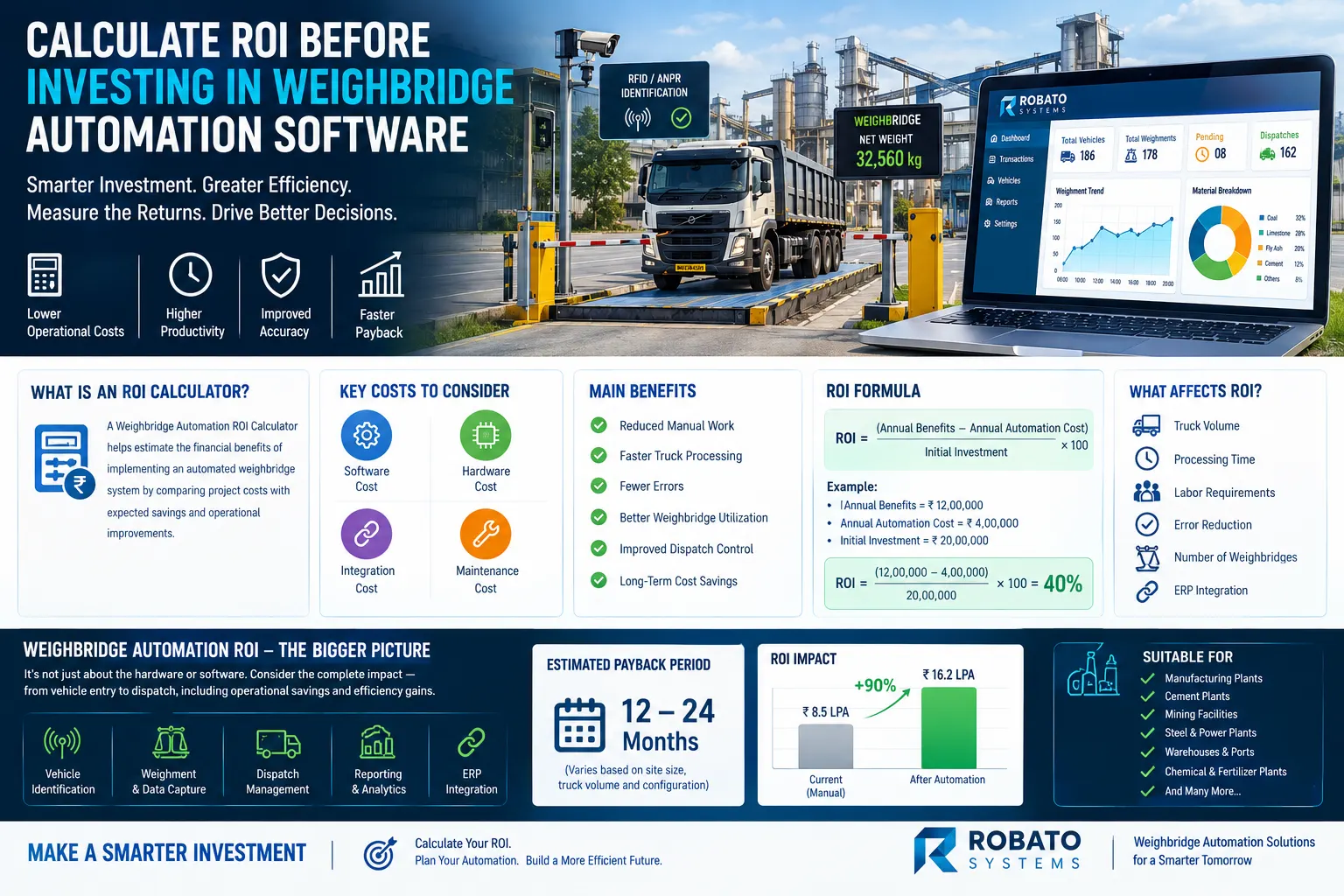
What is a Weighbridge Automation ROI Calculator?
A Weighbridge Automation ROI Calculator is a tool or calculation framework used to estimate the financial benefits of implementing an automated weighbridge system.
It can consider factors such as:
Number of trucks processed
Current processing time
Operator costs
Manual documentation
Vehicle waiting time
Data-entry errors
Weighbridge utilization
Automation investment
Maintenance costs
Expected operational savings
The result provides an estimated view of how quickly the investment may recover its cost.
Why Calculate ROI Before Weighbridge Automation?
Every industrial automation project should be evaluated from both an operational and financial perspective.
A proper ROI assessment can help management understand:
Expected investment
Potential annual savings
Reduction in manual work
Faster vehicle processing
Possible reduction in errors
Improvement in weighbridge utilization
Estimated payback period
This makes it easier to compare automation investment with the current cost of manual operations.
What Costs Should Be Considered?
A realistic ROI calculation should include the major costs associated with implementing the solution.
These may include:
Software Cost
The cost of weighbridge automation software, dashboards, reporting, and integrations.
Hardware Cost
Depending on the solution, hardware may include:
RFID Readers
RFID Tags
LED Displays
Boom Barriers
Sensors
Industrial Computers
Weighbridge Interfaces
Integration Cost
Integration with ERP, dispatch, inventory, or other existing systems may also form part of the project investment.
Maintenance Cost
Annual support, software maintenance, hardware servicing, and other recurring expenses should be included.
What Benefits Should Be Included?
The potential return from weighbridge automation is not limited to direct labor savings.
Important benefits can include:
Reduced manual data entry
Faster truck processing
Reduced vehicle waiting time
Lower paperwork requirements
Fewer transaction errors
Better vehicle tracking
Improved weighbridge utilization
Faster dispatch
Better auditability
Improved operational visibility
How to Calculate Weighbridge Automation ROI
A simple ROI calculation can be represented as:
ROI = (Annual Benefits − Annual Automation Cost) ÷ Initial Investment × 100
For example, if a plant invests in automation and generates measurable savings through reduced manual work, faster processing, and lower operational losses, these benefits can be compared with the project investment.
The actual ROI will depend on factors such as truck volume, current operating costs, automation scope, and implementation requirements.
Example of a Weighbridge ROI Assessment
Consider an industrial facility processing a high number of trucks every day.
Before automation, the plant may spend significant time on:
Manual vehicle entry
Weight recording
Documentation
Driver verification
Dispatch coordination
Report preparation
After automation, RFID vehicle identification, digital weighment, automated reports, and ERP integration can reduce many of these manual activities.
The business can then compare the annual operational savings against the implementation cost to estimate its payback period.
Key Factors Affecting Weighbridge ROI
Truck Volume
Facilities processing more vehicles generally have more opportunities to benefit from automation.
Processing Time
Reducing the time required for each vehicle can increase weighbridge capacity and reduce queues.
Labor Requirements
Automation can reduce repetitive administrative work and allow staff to focus on higher-value activities.
Error Reduction
Reducing incorrect entries and transaction mismatches can prevent operational and financial losses.
Number of Weighbridges
Facilities operating multiple weighbridges may gain additional value from centralized monitoring and automation.
ERP Integration
Connecting weighbridge transactions with ERP systems can reduce duplicate data entry and improve process efficiency.
Benefits of Using a Weighbridge Automation ROI Calculator
Better Investment Decisions
Management can evaluate the financial feasibility of a proposed automation project.
Clearer Cost Planning
A calculator helps identify the different costs that should be considered before implementation.
Payback Estimation
Businesses can estimate how long it may take for the project to recover its initial investment.
Easier Management Approval
A structured ROI assessment can help present the financial case for automation to management.
Project Comparison
Different automation approaches can be compared based on their expected costs and benefits.
Beyond Direct Cost Savings
Some automation benefits may not be immediately reflected as direct financial savings.
For example, better transaction traceability can improve audit readiness, while real-time dashboards can help managers identify operational bottlenecks.
Similarly, automated vehicle identification and digital records can provide better control over dispatch operations.
Therefore, an ROI assessment should consider both direct financial savings and measurable operational improvements.
Applications
Weighbridge automation ROI analysis is useful for:
Manufacturing Plants
Steel Plants
Power Plants
Coal Handling Plants
Chemical Plants
Fertilizer Plants
Aggregate Plants
RMC Plants
Warehouses
Ports
Scrap Yards
Bulk Material Handling Facilities
How Robato Systems Can Help
Robato Systems provides Weighbridge Automation Solutions that can be configured around the operational requirements of industrial facilities.
The solution can combine RFID vehicle identification, automated weighment, ANPR, queue management, vehicle call-forward, ERP integration, dispatch automation, and centralized reporting.
Before implementation, businesses can evaluate their existing vehicle volume, manual processes, processing time, and operational costs to understand where automation can deliver measurable improvements.
Best Practices for ROI Calculation
Use actual vehicle processing data.
Include both initial and recurring project costs.
Measure current manual processing time.
Estimate savings conservatively.
Consider both direct and indirect benefits.
Include ERP and hardware integration costs.
Review the calculation periodically after implementation.
Compare expected results with actual operational improvements.
Conclusion
Weighbridge automation is a significant investment, and businesses should understand its potential financial impact before starting a project.
A Weighbridge Automation ROI Calculator provides a structured way to evaluate investment costs against potential savings from reduced manual work, faster truck processing, fewer errors, improved utilization, and better operational control.
By analyzing current operations and estimating realistic automation benefits, plant managers and directors can make more informed investment decisions and identify whether a weighbridge automation project can deliver a suitable return.
Frequently Asked Questions
What is a Weighbridge Automation ROI Calculator?
It is a tool or calculation method used to estimate the financial return of implementing automated weighbridge software and related systems.
What factors affect weighbridge automation ROI?
Truck volume, labor costs, processing time, current manual work, automation investment, integration requirements, and expected operational savings can all affect ROI.
Can faster truck processing improve ROI?
Yes. Faster processing can increase weighbridge throughput and reduce vehicle waiting time, potentially improving the overall financial benefit.
Should hardware costs be included in ROI calculations?
Yes. RFID readers, ANPR cameras, displays, barriers, sensors, and other required hardware should be included when calculating the total project investment.
Can ERP integration affect ROI?
Yes. ERP integration can reduce duplicate data entry and improve the flow of weighment and dispatch information, contributing to operational savings.
How can a business calculate its weighbridge automation payback period?
The estimated initial investment can be compared with the expected annual financial benefits to estimate how long it may take to recover the project cost.