Industrial plants, warehouses, mining facilities, cement plants , power plants, and bulk material handling facilities often manage a large number of trucks every day. When several vehicles arrive at the weighbridge simultaneously, manually controlling their movement can become difficult.
Drivers may not know when their vehicle should move to the weighbridge, security teams may need to communicate with drivers manually, and operators may struggle to maintain an accurate queue. These issues can create congestion, increase waiting time, and slow down dispatch operations.
A Vehicle Call Forward System for Weighbridges provides a digital solution for managing truck movement. It allows authorized vehicles to be called forward in the correct sequence when a weighbridge becomes available.
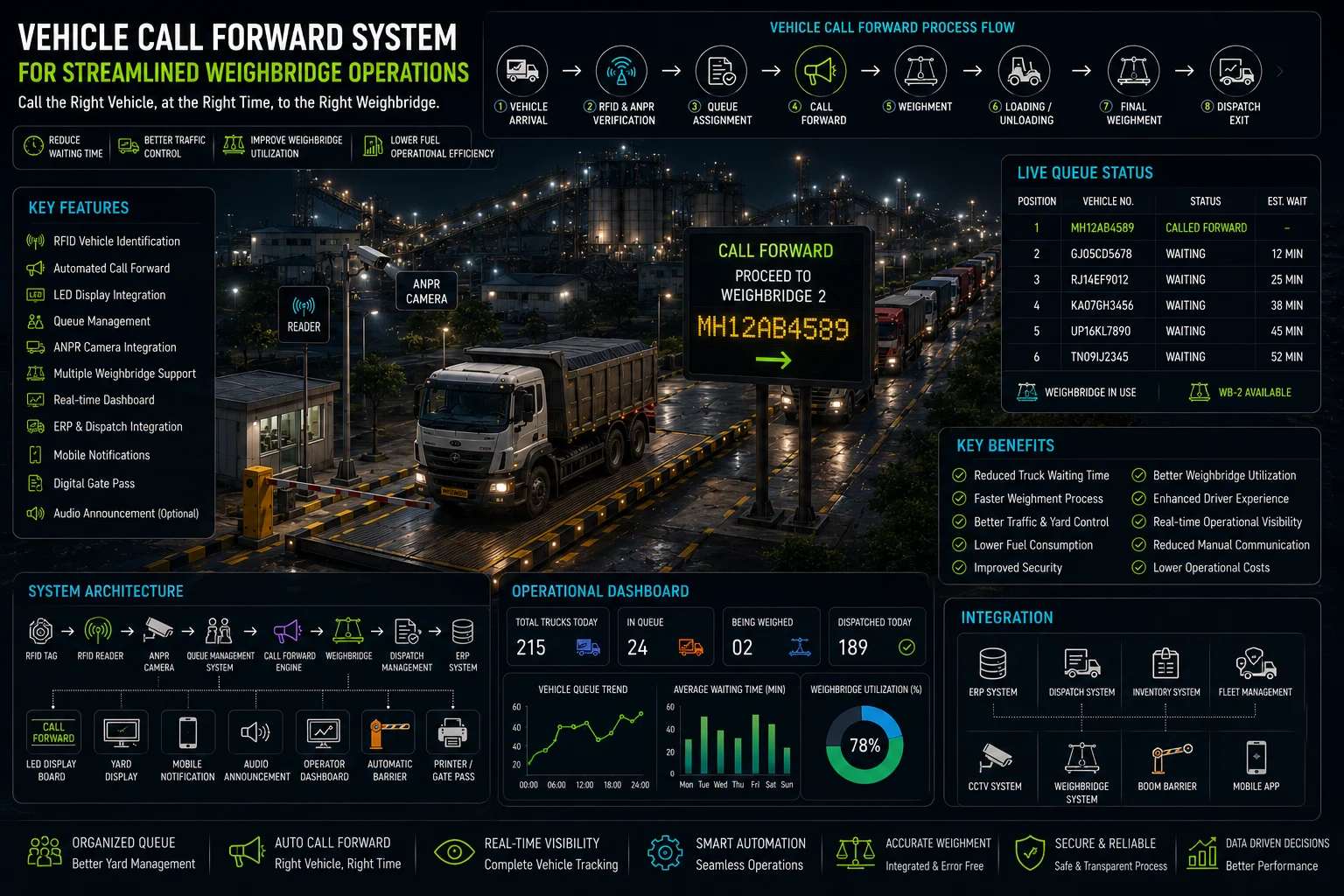
When integrated with RFID, queue management, ANPR, LED displays, and weighbridge automation, the system creates a more organized and efficient vehicle movement process.
What is a Vehicle Call Forward System?
A Vehicle Call Forward System is a digital solution that controls the movement of waiting trucks by notifying the appropriate vehicle when it is ready for the next stage of the process.
The system can identify vehicles using:
Vehicle Numbers
Digital Tokens
Dispatch Orders
Once a vehicle becomes eligible for processing, the system can display or communicate a call-forward instruction through:
LED Display Boards
Digital Token Displays
Yard Screens
Mobile Notifications
Operator Dashboards
Audio Announcements
This eliminates the need for security personnel or weighbridge operators to manually call every truck.
Why Weighbridges Need Vehicle Call Forward Automation
Manual vehicle calling can create several problems when truck volumes are high, including:
Unorganized queues
Driver confusion
Long waiting times
Unnecessary vehicle movement
Congestion near weighbridges
Manual communication errors
Delayed weighment
Poor visibility of vehicle status
Increased security workload
A call-forward system provides a structured way to control which vehicle should move next.
How a Vehicle Call Forward System Works
Step 1: Vehicle Registration
Vehicles are registered in the system with information such as:
Vehicle Number
RFID Tag
Driver Details
Transporter
Material
Customer
Dispatch Order
Step 2: Vehicle Arrival
When the truck reaches the facility, the RFID reader identifies the vehicle.
An ANPR camera can also verify the vehicle number.
The system checks the vehicle's authorization and dispatch status.
Step 3: Queue Assignment
If the weighbridge is occupied, the vehicle is added to the digital queue.
The system records the vehicle's position and waiting status.
Step 4: Weighbridge Becomes Available
When the current transaction is completed, the system identifies the next eligible vehicle.
Instead of manually searching for the truck, the system automatically calls it forward.
Step 5: Vehicle Call Forward
The driver's vehicle number or token number can be displayed on an LED screen.
For example:
Vehicle MH 12 AB 4589 — Proceed to Weighbridge 2
This gives the driver clear instructions without requiring manual communication.
Step 6: Weighment
The called vehicle moves to the assigned weighbridge.
RFID identifies the truck and the weighment transaction is automatically linked with its dispatch information.
Step 7: Transaction Completion
After weighing and other required processes are completed, the vehicle moves to the next stage or exits the facility.
The system then calls the next eligible vehicle.
Key Features of Vehicle Call Forward System
Automated Vehicle Calling
Automatically calls the next eligible vehicle when the weighbridge becomes available.
RFID Integration
Identifies vehicles automatically and connects them with their scheduled transactions.
LED Display Integration
Displays vehicle numbers, token numbers, and weighbridge instructions to drivers.
Queue Management
Maintains a real-time queue of vehicles waiting for processing.
ANPR Integration
Provides additional vehicle verification using automatic number plate recognition.
Multiple Weighbridge Support
For facilities with multiple weighbridges, vehicles can be directed to the appropriate available weighbridge.
Real-Time Dashboard
Operations teams can monitor:
Waiting Vehicles
Called Vehicles
Active Weighments
Completed Transactions
Queue Length
Weighbridge Status
Vehicle Waiting Time
Benefits of Vehicle Call Forward Automation
Reduced Truck Waiting Time
Vehicles are called forward as soon as the required processing point becomes available.
Better Traffic Control
The system prevents unnecessary movement and congestion around the weighbridge.
Faster Weighbridge Processing
Operators can process vehicles in an organized sequence.
Reduced Manual Communication
Security teams and operators no longer need to manually locate and call individual drivers.
Improved Driver Experience
Drivers receive clear information about when and where they need to move.
Better Weighbridge Utilization
Vehicles can be allocated efficiently across available weighbridges.
Increased Operational Visibility
Plant teams can monitor the complete vehicle queue and movement status from a centralized dashboard.
Applications
Vehicle Call Forward Systems are suitable for:
Manufacturing Plants
Cement Plants
Steel Plants
Mining Sites
Coal Handling Plants
Power Plants
Chemical Plants
Fertilizer Plants
Warehouses
Scrap Yards
RMC Plants
Ports
Bulk Material Handling Facilities
Integration with RFID Weighbridge Automation
A Vehicle Call Forward System becomes more effective when integrated with RFID-based weighbridge automation.
The complete workflow can be:
Vehicle Scheduled → RFID Identification → Queue → Call Forward → Weighbridge → Loading/Unloading → Final Weighment → Exit
Each stage is digitally recorded, providing better traceability and operational control.
Integration with ERP and Dispatch Systems
The call-forward system can be connected with ERP and dispatch software to verify vehicle eligibility before calling it to the weighbridge.
The system can use information such as:
Dispatch Order
Vehicle Number
Customer
Material
Quantity
Transporter
Weighment Status
This helps ensure that only authorized vehicles are called forward.
Best Practices
Register regular vehicles with RFID tags.
Display clear vehicle instructions on LED boards.
Integrate call-forward logic with the weighbridge.
Maintain an accurate digital vehicle queue.
Use ANPR for additional vehicle verification.
Monitor average truck waiting time.
Support multiple weighbridges where required.
Keep operators informed through real-time dashboards.
Common Challenges
High Truck Volume
Large numbers of vehicles require an efficient queue and call-forward sequence.
Driver Communication
Drivers need clear and visible instructions, especially in large yards.
Multiple Weighbridges
Facilities with multiple weighbridges need intelligent vehicle allocation.
Unscheduled Vehicles
The system should have an exception process for vehicles arriving without valid dispatch authorization.
Future of Vehicle Call Forward Systems
Vehicle movement management is becoming increasingly intelligent through technologies such as:
AI-Based Truck Scheduling
Dynamic Queue Allocation
GPS Vehicle Tracking
Predictive Arrival Management
Automated Weighbridge Allocation
Mobile Driver Notifications
Cloud-Based Monitoring
Advanced Logistics Analytics
These technologies can help plants further reduce congestion and optimize vehicle movement.
Why Choose Robato Systems?
Robato Systems provides Vehicle Call Forward Systems for Weighbridges that help industrial facilities automate truck movement and queue control.
The solution can integrate RFID vehicle identification, weighbridge automation, queue management, ANPR cameras, LED displays, boom barriers, ERP integration, and real-time dashboards into a centralized platform.
By automating vehicle call-forward operations, businesses can reduce waiting time, improve weighbridge utilization, minimize manual communication, and create a smoother vehicle movement process.
Conclusion
Managing truck movement manually becomes increasingly difficult as vehicle volumes grow. Drivers may wait unnecessarily, weighbridges may remain underutilized, and security teams may spend significant time coordinating vehicle movement.
A Vehicle Call Forward System for Weighbridges provides a structured way to manage waiting trucks and call the right vehicle at the right time. When combined with RFID, queue management, ANPR, and weighbridge automation, it creates a faster and more organized logistics workflow.
For industrial facilities looking to reduce truck waiting time and improve vehicle movement control, automated call-forward technology can be an important part of a modern weighbridge automation strategy.
Frequently Asked Questions
What is a Vehicle Call Forward System?
It is a digital system that automatically calls the next eligible vehicle when a weighbridge or processing point becomes available.
How does it reduce truck waiting time?
It eliminates manual vehicle calling and ensures that the next vehicle in the queue receives a timely instruction to proceed.
Can RFID be integrated with the system?
Yes. RFID can automatically identify vehicles and connect them with their queue and weighment transactions.
Can the system work with multiple weighbridges?
Yes. Vehicles can be directed to the appropriate available weighbridge based on configured rules.
Can drivers see the call-forward instructions?
Yes. Vehicle numbers or token information can be displayed on LED boards or other digital communication systems.
Can it integrate with ERP software?
Yes. The system can use dispatch, vehicle, customer, material, and weighment information from ERP and logistics platforms.