
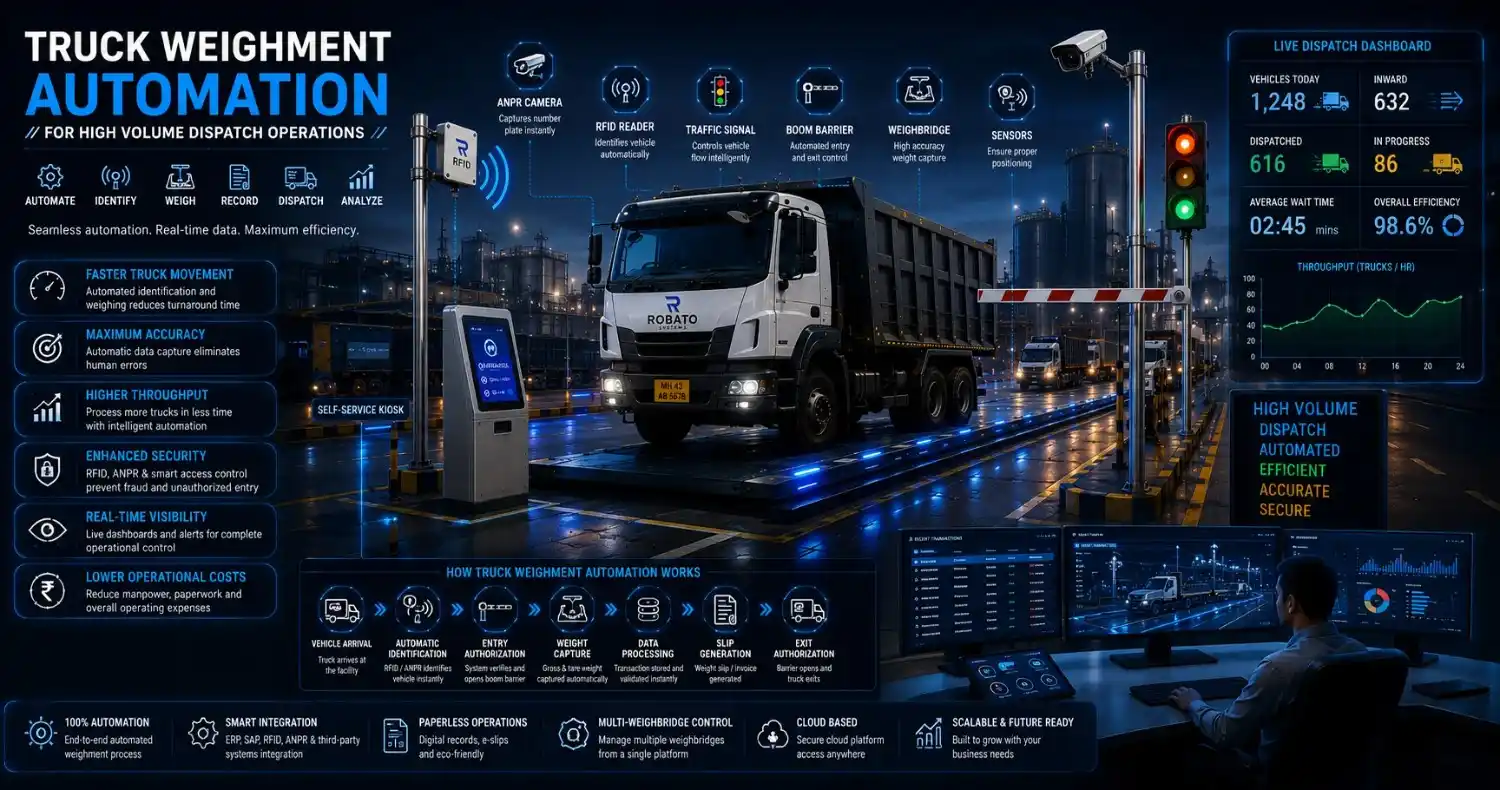
Truck Weighment Automation for High Volume Dispatch Operations
Introduction
Industries such as cement, steel, mining, logistics, power generation, and manufacturing plants often handle hundreds or even thousands of trucks every day. Efficient dispatch operations are critical to maintaining production schedules and ensuring timely deliveries. However, traditional weighment processes involving manual intervention can create bottlenecks, long queues, and operational inefficiencies.
Truck Weighment Automation helps industries streamline vehicle weighing processes by integrating technologies such as RFID, ANPR cameras, weighbridge software, boom barriers, and self-service kiosks. By eliminating manual dependency and automating vehicle identification and weight recording, businesses can achieve faster truck turnaround times and improve overall logistics performance.
As industries move toward Industry 4.0, automated truck weighing systems are becoming essential for managing high-volume dispatch operations efficiently.
What is Truck Weighment Automation?
Truck Weighment Automation is a technology-driven solution that automates the weighing and movement of vehicles entering and leaving industrial facilities.
The system integrates:
RFID Technology
ANPR Cameras
Weighbridge Automation Software
Boom Barriers
Traffic Signal Systems
Sensors and Indicators
ERP and SAP Integration
Self-Service Kiosks
Together, these components provide accurate and efficient weighment operations while minimizing human intervention.
Challenges in High Volume Dispatch Operations
Managing a large number of vehicles manually creates several challenges.
Long Vehicle Queues
Manual verification and data entry increase waiting times and slow dispatch operations.
Human Errors
Incorrect data entry can lead to billing discrepancies and inventory mismatches.
Increased Operational Costs
Continuous operator involvement raises manpower expenses.
Fraud and Unauthorized Activities
Duplicate weighments and unauthorized vehicle entries can result in material losses.
Lack of Real-Time Visibility
Manual processes make it difficult to monitor vehicle movement and dispatch performance.
Truck weighment automation addresses these challenges by introducing intelligent and automated workflows.
How Truck Weighment Automation Works
Step 1: Vehicle Identification
RFID readers or ANPR cameras automatically identify the incoming truck.
Step 2: Vehicle Authentication
The system verifies vehicle information against the database.
Step 3: Automated Entry
Boom barriers and traffic signals regulate vehicle movement.
Step 4: Weight Capture
The weighbridge records gross and tare weights automatically.
Step 5: Transaction Processing
Weight details are stored and linked with dispatch information.
Step 6: Slip Generation
Weight slips and invoices are generated automatically.
Step 7: Vehicle Exit
Authorized vehicles exit through automated barriers.
Key Components of a Truck Weighment Automation System
RFID Readers
Enable automatic identification of registered vehicles.
ANPR Cameras
Capture vehicle number plates for additional verification.
Weighbridge Software
Manages weighment transactions and reporting.
Boom Barriers
Control vehicle entry and exit.
Traffic Signal Systems
Ensure smooth and safe truck movement.
Sensors and Indicators
Guide proper vehicle positioning on the weighbridge.
ERP Integration
Synchronizes weighment data with enterprise systems.
Centralized Dashboard
Provides real-time monitoring and analytics.
Benefits of Truck Weighment Automation
Faster Truck Turnaround Time
Automated processing reduces waiting periods and improves dispatch efficiency.
Improved Accuracy
Automatic weight capture eliminates manual errors.
Increased Throughput
More vehicles can be processed in less time.
Reduced Manpower Dependency
Automation minimizes the need for operators.
Enhanced Security
RFID and ANPR technologies prevent unauthorized activities.
Better Material Tracking
Complete transaction records improve traceability.
Real-Time Monitoring
Managers gain visibility into vehicle movement and dispatch operations.
Lower Operational Costs
Reduced delays and labor requirements lead to cost savings.
Industries That Benefit from Truck Weighment Automation
Cement Industry
Supports high-volume dispatch and improves truck turnaround times.
Steel Plants
Ensures accurate weighing and smooth logistics operations.
Mining Industry
Prevents overloading and enhances material tracking.
Manufacturing Plants
Automates raw material inward and finished goods outward processes.
Logistics and Warehousing
Improves fleet movement and dispatch efficiency.
Power Plants
Tracks coal transportation and fuel movement.
Chemical Industries
Maintains accurate inventory and shipment records.
Features to Look for in Truck Weighment Automation Software
When selecting a solution, industries should consider:
RFID Integration
For automatic vehicle identification.
ANPR Support
For enhanced security and verification.
ERP and SAP Integration
For seamless information flow.
Cloud-Based Monitoring
For remote access and management.
Real-Time Dashboard
For instant operational visibility.
Multi-Weighbridge Management
For centralized control across multiple sites.
Mobile Accessibility
For monitoring operations from anywhere.
Reporting and Analytics
For performance evaluation and decision-making.
Why High Volume Dispatch Operations Need Automation
Modern industries require:
Faster vehicle processing
Reduced truck congestion
Improved logistics efficiency
Real-time visibility
Better compliance
Reduced operational costs
Higher customer satisfaction
Truck Weighment Automation enables organizations to achieve these goals while supporting business growth and digital transformation.
Future Trends in Truck Weighment Automation
Artificial Intelligence
AI-powered analytics optimize dispatch operations and identify bottlenecks.
IoT Integration
Connected devices provide predictive maintenance and real-time updates.
Cloud Platforms
Enable centralized monitoring across multiple facilities.
Mobile Applications
Allow managers to access data anytime and anywhere.
Paperless Operations
Digital documentation improves efficiency and sustainability.
Multi-Site Management
Centralized systems simplify operations across multiple plants.
Conclusion
Truck Weighment Automation has become a critical solution for industries handling high-volume dispatch operations. By automating vehicle identification, weight capture, and reporting processes, organizations can significantly improve efficiency, reduce delays, and enhance operational accuracy.
With technologies such as RFID, ANPR, and integrated weighbridge software, industries can achieve faster truck turnaround, better material tracking, and lower operating costs. As digital transformation continues to accelerate, automated truck weighing systems will play an increasingly important role in optimizing logistics and supply chain operations.
Frequently Asked Questions (FAQs)
What is Truck Weighment Automation?
Truck Weighment Automation is a system that automates vehicle identification, weighing, and transaction processing to improve dispatch efficiency.
How does truck weighment automation improve dispatch operations?
It reduces waiting times, eliminates manual errors, and increases vehicle throughput.
Which technologies are used in truck weighment automation?
RFID readers, ANPR cameras, boom barriers, weighbridge software , sensors, and ERP integration are commonly used.
Which industries benefit from automated truck weighing systems?
Cement, steel, mining, logistics, manufacturing, power plants, and chemical industries widely use these systems.
Can truck weighment automation integrate with ERP software?
Yes, modern systems support integration with ERP, SAP, inventory, and dispatch management solutions.