Smart Traffic Management: How Technology Is Fixing the Way We Move
Traffic congestion is not just a daily frustration for commuters. It is a measurable economic problem that costs cities, businesses, and individuals billions every year in lost time, wasted fuel, and delayed supply chains. Building more roads is rarely the answer. The smarter solution is using the infrastructure that already exists far more intelligently. Smart traffic management is exactly that solution. It combines real-time data, connected sensors, AI-driven software, and responsive signage to create a transportation environment that adapts continuously to actual conditions rather than operating on a fixed, outdated schedule.
Why Traditional Traffic Systems Are Falling Behind
The traffic signal systems that most cities and facilities still rely on were designed for a very different era. Fixed-cycle signals switch between green and red on a preset timer, completely unaware of whether there are two hundred vehicles waiting on one approach or none at all. Static signs cannot reroute drivers when a road ahead is blocked. Manual supervision at busy junctions cannot scale to the volume and complexity of modern traffic flows.
These limitations create predictable results: congestion builds at peak hours, emergency vehicles are delayed, fuel is burned by idling engines, and carbon emissions rise unnecessarily. Smart traffic management addresses every one of these problems simultaneously by replacing fixed logic with live, data-driven decision-making.
The Technology That Powers Smart Traffic Management
Smart traffic management systems work by collecting real-time data from multiple sources and using that data to make immediate, intelligent adjustments to the traffic environment. The technology layer behind this includes several core components working together continuously.
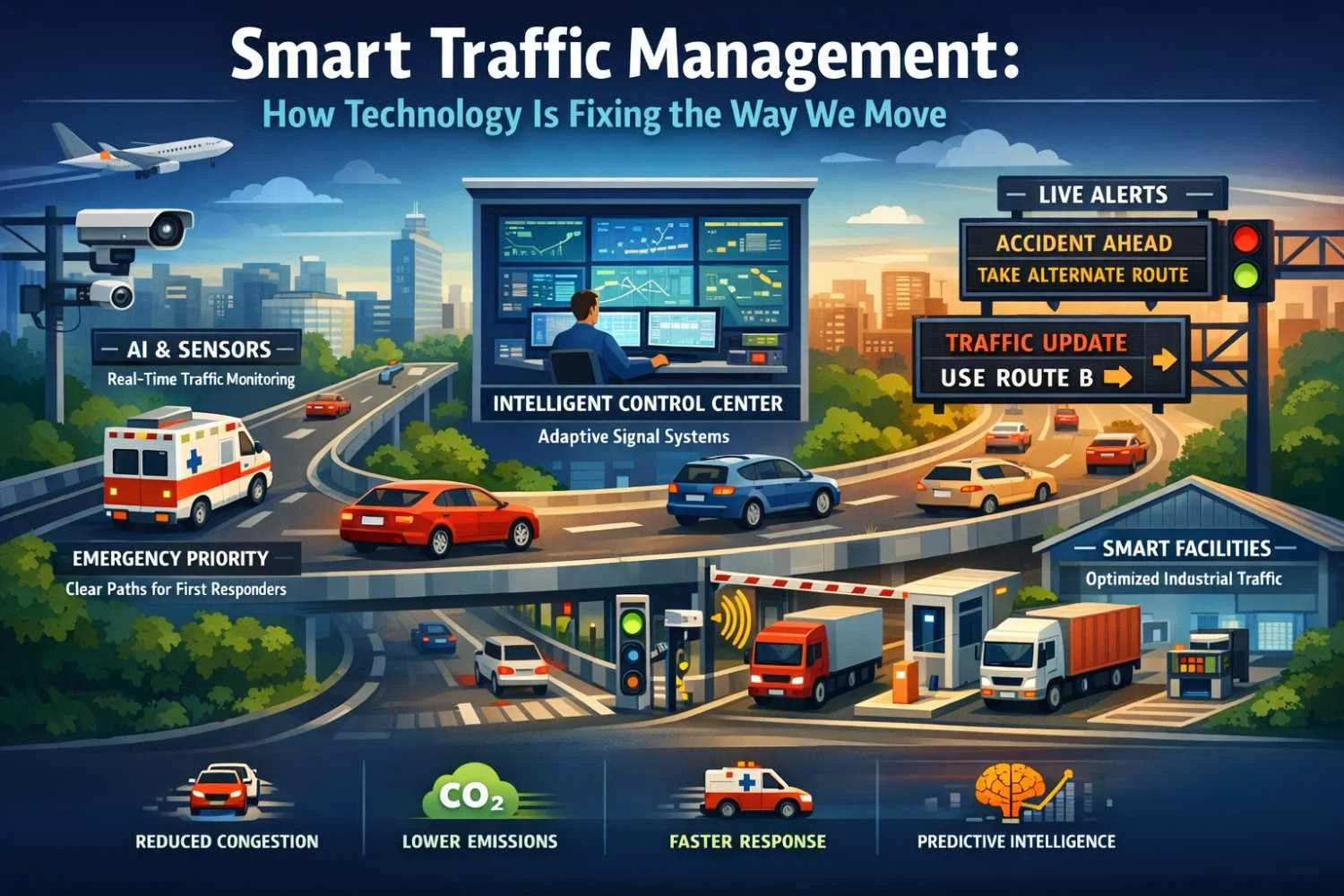
Vehicle detection sensors and cameras installed at intersections, road entry points, and facility access zones monitor traffic density, vehicle counts, queue lengths, and speeds in real time. This live data feeds into a centralized software platform that analyzes conditions and triggers appropriate responses automatically.
Adaptive signal control technology uses this real-time data to adjust traffic light timings dynamically based on actual traffic volumes rather than a preset schedule. An approach with heavy traffic gets more green time. A clear road does not hold vehicles unnecessarily. The result is a measurable improvement in throughput at every controlled junction.
Variable message signs placed at strategic points across the road network communicate live information to drivers the moment it is relevant. Alternate route suggestions, congestion warnings, speed advisories, lane control instructions, and emergency alerts are all delivered in real time, giving drivers the information they need to make better decisions before they reach a problem rather than after.
Smart Traffic Management Inside Private Facilities
While the concept is most commonly associated with city roads, smart traffic management delivers equally significant value within private facilities. Airports, industrial campuses, hospital complexes, logistics hubs, and large commercial developments all have internal road networks where vehicle flow, safety, and access control are critical daily operational concerns.
Robato Systems brings intelligent traffic management technology to these private facility environments through a combination of RFID-based vehicle identification, automated boom barrier systems, LED variable message signs, and centralized management software. Authorized vehicles move through controlled access points without stopping. Trucks are directed to the correct loading bays, weighbridges, or parking zones through live LED signage. Unauthorized vehicles are denied entry automatically, and every access event is logged with a precise timestamp for security and compliance purposes.
For heavy vehicle environments, integration with weighbridge systems adds another layer of control, ensuring that trucks meet load compliance requirements before entering restricted road sections within the facility.
Predictive Intelligence: The Next Level of Control
The most advanced smart traffic management systems are moving beyond reactive responses into predictive intelligence. By analyzing historical traffic patterns alongside live sensor data, these systems can anticipate where congestion is likely to form and take preventive action before it develops.
Traffic signal timings can be pre-adjusted ahead of a known peak period. Alternative routes can be activated before an incident causes a bottleneck. Emergency vehicle corridors can be pre-cleared automatically when a response is dispatched. This shift from reactive to predictive management reduces congestion, improves safety response times, and makes the entire road network more reliable for every user.
Environmental and Safety Benefits That Matter
Beyond improving traffic flow, smart traffic management delivers significant environmental and safety outcomes. Fewer stop-start cycles at congested junctions mean lower fuel consumption and reduced carbon emissions across the vehicle fleet. Incident detection cameras identify accidents, stalled vehicles, and wrong-way drivers within seconds of an event occurring, triggering faster response times from traffic operators and emergency services.
For private facilities, the safety benefits extend to pedestrian protection, with smart warning signs alerting pedestrians to approaching vehicles at blind corners and in loading areas where the risk of collision is highest.
A System That Pays for Itself
The return on investment from smart traffic management is visible across multiple areas simultaneously. Throughput increases, congestion decreases, fuel costs reduce, compliance improves, and the operational efficiency gains compound over time as the system learns from the data it collects. For any organization responsible for managing vehicle movement, whether a city authority, an airport, an industrial campus, or a logistics hub, smart traffic management is the foundation of a safer, more efficient, and more sustainable operation.