
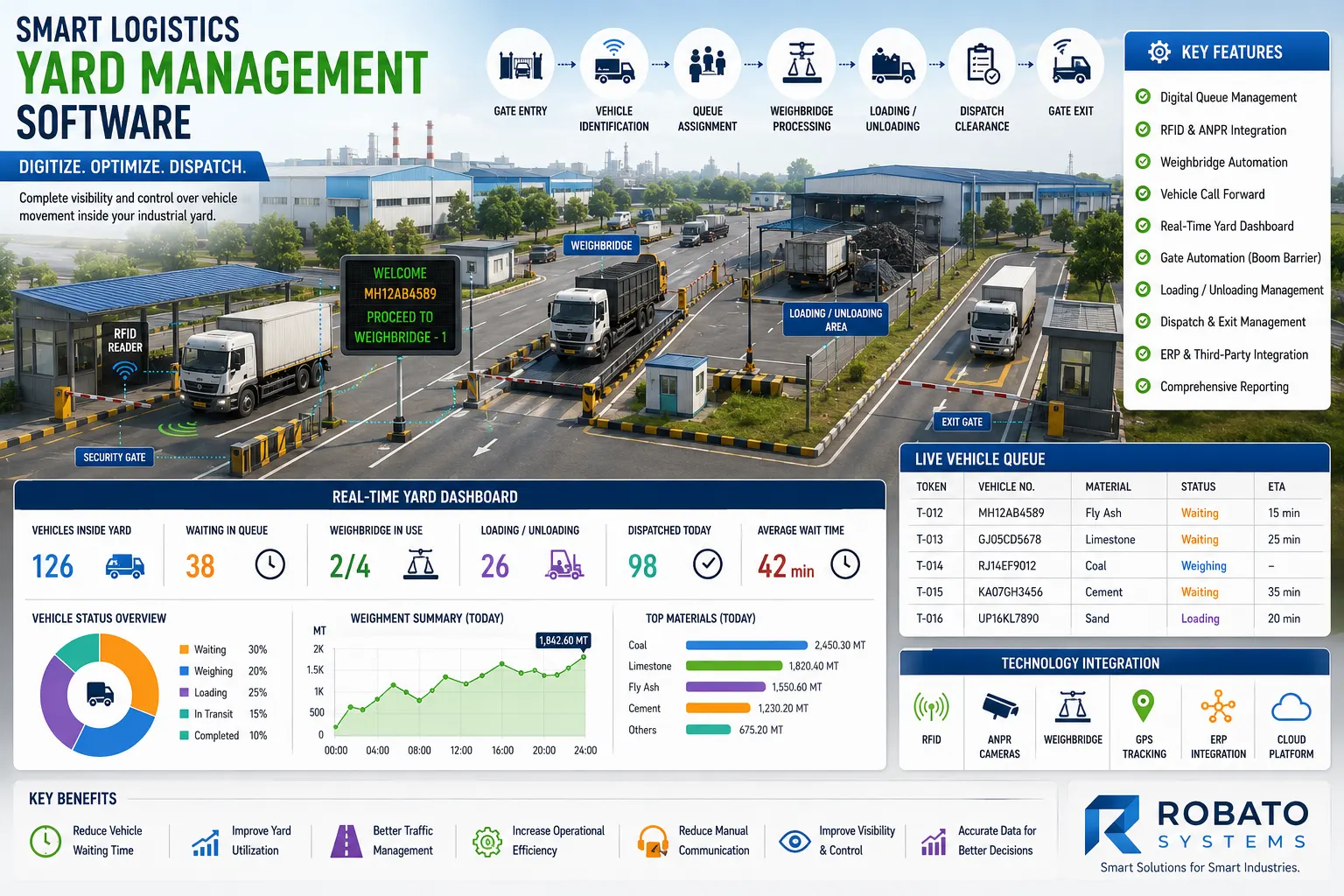
Managing trucks inside a large industrial facility can be challenging when hundreds of vehicles arrive for loading, unloading, weighing, and dispatch every day. Without proper coordination, vehicles can remain idle, queues can grow, and different operational teams may struggle to understand the current status of each truck.
Smart Logistics Yard Management Software provides a centralized way to manage vehicle movement and logistics activities inside industrial facilities. It connects truck arrivals, queue management, weighbridge operations, loading and unloading activities, and dispatch processes into a structured digital workflow.
By combining yard management with technologies such as RFID, ANPR, weighbridge automation, GPS tracking, and digital dashboards, businesses can improve vehicle flow and gain better visibility over their logistics operations.
What is Smart Logistics Yard Management Software?
Smart Logistics Yard Management Software is a digital system designed to manage and monitor vehicles while they are inside an industrial yard.
The system can track different stages of a vehicle's journey, including:
Gate Entry
Vehicle Registration
Queue Assignment
Weighbridge Processing
Loading or Unloading
Dispatch
Gate Exit
Instead of relying on manual registers, phone calls, and spreadsheets, operations teams can monitor vehicle activity through a centralized system.
Why Industrial Facilities Need Yard Management
Large industrial yards often face problems when vehicle movement is managed manually.
Common challenges include:
Long truck queues
Congestion near weighbridges
Unorganized vehicle movement
Driver communication problems
Manual vehicle verification
Delayed loading and unloading
Poor visibility of truck status
Inefficient dispatch coordination
A smart yard management system helps organize these activities and provides real-time visibility into vehicle movement.
How Smart Yard Management Software Works
Step 1: Vehicle Arrival
When a truck reaches the facility, the system identifies the vehicle using RFID, ANPR, or manual registration where required.
The vehicle information is recorded in the system.
Step 2: Vehicle Validation
The system checks the vehicle against the relevant order or scheduled activity.
It can verify:
Vehicle Number
Transporter
Customer
Material
Dispatch Order
Appointment
Vehicle Status
Step 3: Queue Assignment
If the required processing area is occupied, the vehicle is added to the appropriate digital queue.
The system can maintain separate queues for different operations.
Step 4: Vehicle Call Forward
When a processing point becomes available, the system can call the appropriate vehicle forward.
The vehicle number or token can be displayed through an LED display or other communication system.
Step 5: Weighbridge Processing
The vehicle moves to the assigned weighbridge.
RFID or ANPR can automatically identify the vehicle, while the weighbridge captures the required weight information.
Step 6: Loading or Unloading
After weighment, the vehicle is directed to its designated loading or unloading area.
Its status is updated within the system.
Step 7: Dispatch and Exit
Once the required activities are completed, the vehicle is cleared for dispatch and exits the facility.
The complete movement history remains available digitally.
Key Features of Smart Logistics Yard Management Software
Digital Vehicle Queue Management
Create and manage organized queues for vehicles waiting for weighing, loading, unloading, or dispatch.
RFID Vehicle Identification
Automatically identify registered trucks when they arrive at the facility.
ANPR Integration
Capture vehicle registration numbers using automatic number plate recognition.
Weighbridge Integration
Connect vehicle movement with automated weighment transactions.
Vehicle Call Forward
Automatically notify the next eligible vehicle when a processing point becomes available.
Real-Time Yard Dashboard
Operations teams can monitor:
Vehicles Inside Yard
Waiting Vehicles
Active Vehicles
Loading Status
Weighbridge Status
Dispatch Status
Completed Vehicles
Gate Automation
Integrate vehicle identification and authorization with boom barriers and access control systems.
ERP Integration
Connect yard operations with dispatch, inventory, purchase, sales, and other business processes.
Benefits of Smart Yard Management
Reduced Truck Waiting Time
Organized queues and automated vehicle calling can reduce unnecessary waiting inside the facility.
Better Traffic Flow
The system helps coordinate vehicle movement and reduces congestion around important operational areas.
Improved Yard Visibility
Operations teams can see the current status of vehicles from a centralized dashboard.
Faster Dispatch
Connecting weighing, loading, and dispatch activities creates a smoother vehicle workflow.
Reduced Manual Communication
Drivers can receive instructions through digital displays and automated notifications instead of depending entirely on manual communication.
Better Vehicle Utilization
Improved coordination can help reduce unnecessary idle time for trucks.
Improved Operational Control
Managers can monitor vehicle activity and identify delays or bottlenecks more easily.
Integration with Weighbridge Automation
A smart yard management platform can connect directly with weighbridge systems.
A typical workflow can be:
Gate Entry → Vehicle Identification → Queue → Weighbridge → Loading/Unloading → Final Weighment → Dispatch → Exit
This allows the weighbridge to become part of the complete yard management process rather than operating as an isolated system.
RFID and ANPR Integration
RFID can automatically identify registered vehicles, while ANPR can capture and verify vehicle registration numbers.
Using both technologies provides additional vehicle identification and verification capabilities.
For example:
RFID Identification + ANPR Verification → Yard Authorization → Weighbridge → Dispatch
This can reduce manual vehicle entry and improve traceability.
ERP Integration
Smart yard management software can integrate with ERP and logistics systems to exchange information such as:
Purchase Orders
Sales Orders
Dispatch Orders
Vehicle Details
Customer Details
Supplier Details
Material Information
Weighment Data
Inventory
Gate Pass
This helps connect physical vehicle movement with the organization's business processes.
Applications
Smart logistics yard management software can be used in:
Manufacturing Plants
Cement Plants
Steel Plants
Mining Facilities
Power Plants
Chemical Plants
Fertilizer Plants
Warehouses
Ports
Scrap Yards
RMC Plants
Aggregate Plants
Bulk Material Handling Facilities
Best Practices for Industrial Yard Management
Digitize vehicle entry and exit processes.
Use RFID or ANPR for automatic identification.
Maintain a real-time digital vehicle queue.
Integrate weighbridges with yard management.
Use LED displays for driver instructions.
Monitor vehicle waiting and processing times.
Connect yard operations with ERP and dispatch systems.
Define clear workflows for exceptions and unauthorized vehicles.
Common Challenges
High Vehicle Volume
Facilities with large truck volumes need an efficient queue and scheduling mechanism to prevent congestion.
Multiple Operational Areas
Vehicles may need to visit different loading, unloading, weighing, or inspection points, making coordination important.
Legacy Systems
Existing weighbridges and gate systems may require integration before they can communicate with modern yard software.
Driver Communication
Large yards need clear instructions so drivers know when and where they should move.
Future of Smart Yard Management
Industrial yard management is moving toward increasingly connected and intelligent logistics operations.
Future systems can incorporate:
AI-Based Truck Scheduling
GPS Vehicle Tracking
Automated Route Assignment
Predictive Queue Management
AI-Based Vehicle Verification
Cloud-Based Yard Dashboards
Automated Dispatch Planning
Logistics Performance Analytics
These technologies can help facilities move from basic vehicle monitoring toward intelligent yard optimization.
Why Choose Robato Systems?
Robato Systems provides Smart Logistics Yard Management Software for industrial facilities that need better control over truck movement, queues, weighbridge operations, and dispatch activities.
The solution can integrate RFID vehicle identification, ANPR, weighbridge automation, queue management, vehicle call-forward systems, boom barriers, ERP integration, and centralized dashboards.
This creates a connected logistics workflow that helps businesses improve vehicle visibility, reduce manual coordination, and manage high-volume truck movement more efficiently.
Conclusion
Efficient yard management is essential for industrial facilities handling a large number of trucks every day. When vehicle entry, queues, weighment, loading, and dispatch are managed separately, delays and congestion can quickly affect overall logistics performance.
Smart Logistics Yard Management Software connects these activities into a centralized digital workflow. With RFID, ANPR, weighbridge integration, queue management, and real-time monitoring, businesses can gain better control over vehicle movement throughout the facility.
For industrial organizations looking to reduce truck waiting time, improve yard visibility, and streamline dispatch operations, smart yard management provides a practical foundation for modern logistics automation.
Frequently Asked Questions
What is Smart Logistics Yard Management Software?
It is a digital platform used to manage and monitor truck movement, queues, weighbridges, loading, unloading, and dispatch activities within an industrial facility.
Can yard management software integrate with weighbridges?
Yes. Weighbridge transactions can be connected directly with vehicle and yard management workflows.
Can RFID be used for vehicle identification?
Yes. RFID can automatically identify registered vehicles at gates and other points within the facility.
Can the system manage truck queues?
Yes. The software can maintain digital queues and call vehicles forward when processing areas become available.
Can it integrate with ERP systems?
Yes. Vehicle, dispatch, material, customer, inventory, and weighment information can be exchanged with ERP systems.
Is smart yard management suitable for large industrial facilities?
Yes. It is particularly useful for facilities handling high volumes of trucks and multiple stages of vehicle processing.