
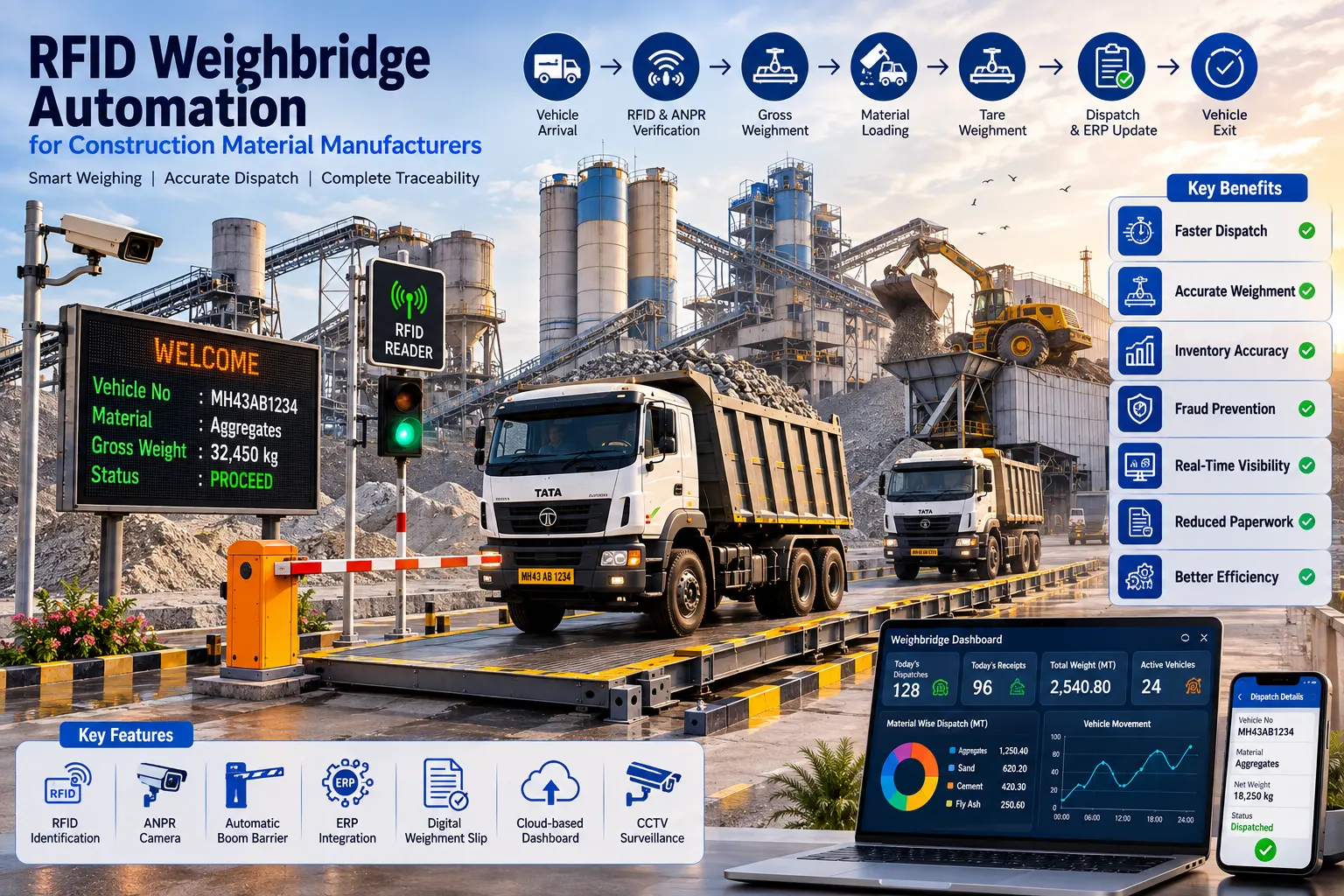
Construction material manufacturers handle thousands of tonnes of aggregates, sand, cement, fly ash, crushed stone, gravel, and other building materials every day. These materials are transported through a constant flow of trucks entering and leaving the plant. Managing this movement manually often leads to long vehicle queues, weighing errors, dispatch delays, and inventory mismatches.
Traditional weighbridge operations depend on manual vehicle verification, handwritten weighment slips, and paper-based dispatch records. These processes reduce operational efficiency, increase paperwork, and make it difficult to maintain accurate material traceability.
RFID Weighbridge Automation for Construction Material Manufacturers digitizes the complete vehicle handling process by integrating RFID technology, automatic weighbridges, ANPR cameras, boom barriers, ERP software, and cloud dashboards. This enables faster truck movement, accurate material dispatch, real-time inventory updates, and complete operational visibility.
What is RFID Weighbridge Automation for Construction Material Plants?
RFID Weighbridge Automation is an intelligent solution that automates vehicle identification, weighing, dispatch verification, inventory updates, and reporting for construction material manufacturing plants.
The system integrates:
Digital Weighbridge Indicators
Automatic Boom Barriers
ANPR Cameras
ERP Integration
Dispatch Management Software
CCTV Surveillance
Cloud Dashboard
Digital Weighment Slips
This integrated platform ensures smooth material movement while minimizing manual intervention.
Why Construction Material Plants Need Weighbridge Automation
Construction material manufacturers process hundreds of trucks every day. Manual weighbridge operations often create challenges such as:
Long truck waiting times
Manual weighing errors
Incorrect dispatch quantities
Inventory mismatches
Unauthorized vehicle entry
Paper-based documentation
Slow dispatch approvals
Material theft
Limited logistics visibility
Higher operational costs
RFID automation helps eliminate these challenges while improving dispatch speed and inventory accuracy.
How RFID Weighbridge Automation Works
Step 1: Vehicle Registration
Each transport vehicle is registered with an RFID tag linked to:
Vehicle Number
Driver Details
Customer Information
Material Type
Dispatch Order
Destination
Step 2: Automatic Vehicle Identification
When the truck arrives at the plant:
RFID reader identifies the vehicle.
ANPR camera verifies the number plate.
The software validates the dispatch order.
Boom barrier opens automatically.
Only authorized vehicles are allowed to enter.
Step 3: Gross Weighment
The loaded vehicle enters the weighbridge where the system automatically records:
Gross Weight
Vehicle Details
Material Type
Date & Time
Transaction ID
The information is stored digitally in real time.
Step 4: Material Loading or Unloading
The vehicle proceeds to the assigned loading or unloading point while every movement is digitally monitored.
Step 5: Tare Weighment
After loading or unloading, the truck returns to the weighbridge.
The software automatically calculates:
Net Weight = Gross Weight − Tare Weight
The transaction is instantly synchronized with ERP and inventory systems.
Step 6: Dispatch Completion
Digital weighment slips, invoices, and gate passes are generated automatically before the vehicle exits the facility.
Key Features of RFID Weighbridge Automation
RFID Vehicle Identification
Automatically identifies registered vehicles for faster processing.
Automatic Boom Barrier
Allows only authorized vehicles to enter and exit the plant.
ANPR Camera Integration
Automatically verifies vehicle number plates to strengthen security.
ERP Integration
Synchronizes weighment data with inventory, dispatch, billing, and production systems.
Digital Weighment Slips
Automatically generates secure digital records for every weighment transaction.
Live Monitoring Dashboard
Monitor:
Incoming Vehicles
Outgoing Dispatches
Material Inventory
Truck Queue Status
Daily Weighment Records
Dispatch Performance
Dispatch Automation
Automatically validates dispatch orders and generates digital gate passes.
Benefits of RFID Weighbridge Automation
Faster Dispatch Operations
RFID identification reduces truck waiting time and improves dispatch efficiency.
Accurate Material Tracking
Every incoming and outgoing material transaction is digitally recorded.
Better Inventory Control
ERP integration automatically updates stock after every dispatch.
Improved Security
RFID, ANPR cameras, CCTV, and boom barriers prevent unauthorized vehicle movement.
Fraud Prevention
The system prevents duplicate weighments, weight manipulation, and unauthorized dispatches.
Reduced Paperwork
Digital documentation minimizes manual record keeping and speeds up audits.
Higher Plant Productivity
Automation enables faster truck turnaround and smoother logistics operations.
Applications
RFID Weighbridge Automation is suitable for:
Stone Crusher Plants
Aggregate Manufacturing Units
Sand Processing Plants
Ready Mix Concrete Plants
Fly Ash Processing Plants
Asphalt Plants
Quarry Operations
Building Material Manufacturing Units
Industry 4.0 Integration
Construction material manufacturers are increasingly adopting Industry 4.0 technologies.
The system integrates with:
Industrial IoT (IIoT)
ERP Software
Inventory Management Systems
Fleet Management Software
GPS Vehicle Tracking
RFID Tracking
Cloud Dashboards
CCTV Monitoring
Mobile Applications
These integrations provide centralized monitoring and data-driven logistics management.
Best Practices
Register every transport vehicle with RFID tags.
Integrate the weighbridge with ERP software.
Perform regular weighbridge calibration.
Install ANPR cameras at all entry and exit points.
Monitor truck turnaround time using dashboards.
Maintain RFID readers and weighbridge equipment regularly.
Train operators on automated dispatch workflows.
Common Challenges
High Truck Traffic
Busy dispatch periods require efficient queue management to avoid congestion.
Dust and Harsh Conditions
Construction material plants require industrial-grade RFID and weighbridge equipment capable of operating in dusty environments.
Legacy Equipment
Existing weighbridges may require hardware upgrades for automation.
Network Reliability
Stable connectivity is essential for real-time synchronization with ERP systems.
Future Trends
Construction material logistics is becoming more intelligent through technologies such as:
AI-powered truck scheduling
IoT-enabled smart weighbridges
Predictive maintenance
Cloud-based dispatch monitoring
GPS-integrated fleet tracking
Mobile dispatch approvals
Digital transport documentation
Advanced logistics analytics
These innovations help manufacturers improve dispatch efficiency, reduce operational costs, and enhance customer service.
Why Choose Robato Systems for RFID Weighbridge Automation?
Robato Systems provides advanced RFID Weighbridge Automation for Construction Material Manufacturers that simplifies vehicle identification, weighment, dispatch management, inventory tracking, and logistics operations. Our solution combines RFID technology, automated weighbridges, ANPR cameras, ERP integration, cloud dashboards, and digital documentation into one intelligent platform.
Our systems help manufacturers reduce truck waiting time, improve inventory accuracy, eliminate manual errors, prevent weighment fraud, and gain complete visibility across material movement. Whether you operate a cement plant, aggregate unit, crusher plant, or quarry, Robato Systems delivers scalable automation solutions tailored to your business.
Conclusion
Construction material manufacturers depend on efficient logistics to ensure timely deliveries and maintain production schedules. Manual weighbridge operations often create delays, inaccurate records, inventory discrepancies, and unnecessary operational costs.
By implementing RFID Weighbridge Automation for Construction Material Plants, businesses can automate vehicle identification, weighment, inventory synchronization, and dispatch management while improving operational efficiency and security. The result is faster truck movement, accurate material tracking, reduced paperwork, and complete visibility across the entire dispatch process.
As the construction industry continues moving toward digital transformation, RFID-enabled weighbridge automation has become an essential investment for achieving smarter, faster, and more reliable logistics operations.
Frequently Asked Questions (FAQs)
What is RFID Weighbridge Automation for Construction Material Plants?
It is an automated solution that manages vehicle identification, weighing, dispatch, and inventory tracking using RFID technology and ERP integration.
How does RFID improve construction material logistics?
RFID automatically identifies vehicles, speeds up weighbridge operations, reduces manual verification, and improves material traceability.
Can the system integrate with ERP software?
Yes. It integrates with SAP, Oracle, Microsoft Dynamics, Tally, and other ERP platforms for inventory, billing, production, and dispatch management.
Does RFID Weighbridge Automation reduce truck waiting time?
Yes. Automated vehicle identification and digital weighment significantly improve truck turnaround time and dispatch speed.
Is the solution suitable for high-volume construction material plants?
Yes. It is designed to efficiently manage large numbers of trucks and bulk material dispatch operations.
Can multiple manufacturing plants be monitored from one dashboard?
Yes. Cloud-enabled software provides centralized monitoring and reporting across multiple construction material plants, quarries, and manufacturing facilities from a single dashboard.