
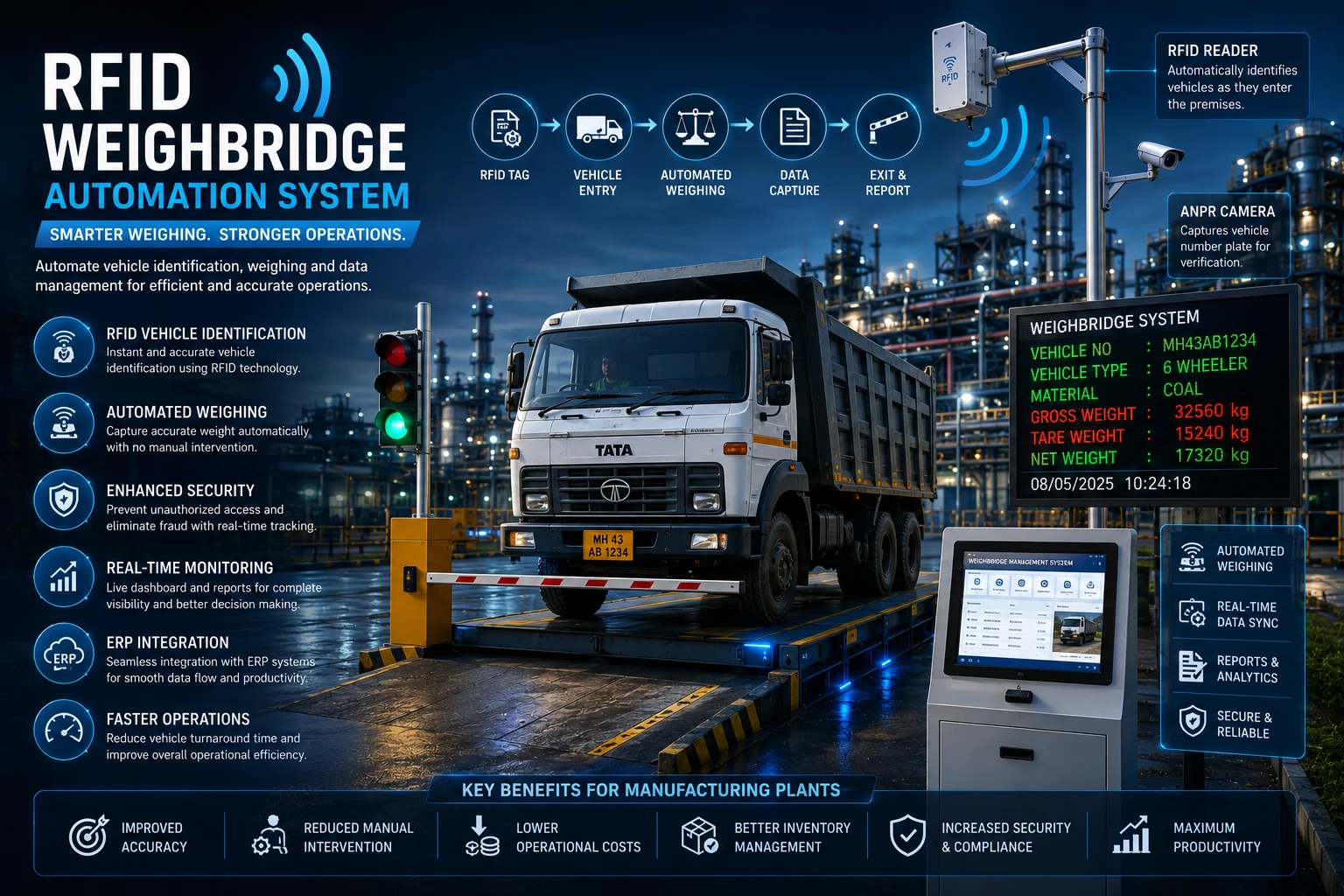
RFID Weighbridge Automation System for Manufacturing Plants
Efficient material movement is critical for every manufacturing plant. Whether it involves raw material inward operations or finished goods dispatch, accurate vehicle weighing plays a major role in maintaining productivity and inventory control. Traditional weighbridge operations often depend on manual processes, which can lead to delays, human errors, and security concerns. This is where an RFID Weighbridge Automation System provides a smarter and more efficient solution.
By combining RFID technology with automated vehicle weighing, manufacturing plants can achieve faster processing, better accuracy, and complete control over vehicle movement.
Why Manufacturing Plants Need Weighbridge Automation
Manufacturing facilities handle hundreds of vehicles every day. Managing these vehicles manually can create bottlenecks and affect overall operational efficiency. Manual data entry, operator dependency, and long waiting times not only slow down dispatch operations but also increase the risk of weighing discrepancies.
An RFID Weighbridge Automation System eliminates these challenges by automatically identifying vehicles, capturing weight information, and integrating data directly into the central software. This creates a seamless workflow that improves productivity and minimizes operational delays.
What Is an RFID Weighbridge Automation System
An RFID Weighbridge Automation System is an intelligent solution that combines RFID technology with weighbridge software to automate vehicle identification and weighing operations.
Every vehicle is assigned an RFID tag containing unique information. When the vehicle approaches the weighbridge, RFID readers automatically detect the tag and retrieve vehicle details. The system performs the weighing process without manual intervention and records all transaction data in real time.
This automated approach reduces dependency on operators while ensuring accurate and transparent weighing operations.
How the System Works
The RFID Weighbridge Automation System operates through multiple integrated components working together.
When a truck enters the plant premises, RFID readers installed near the weighbridge identify the vehicle instantly. The system verifies vehicle details and authorizes entry based on predefined rules.
Once the truck is positioned correctly, the weighbridge captures the vehicle weight automatically. Cameras and sensors can also validate the vehicle position to ensure accurate readings.
After the weighing process is completed, the software generates transaction records and can automatically trigger boom barriers, printers, and ERP systems. This entire sequence takes place within seconds, significantly reducing vehicle turnaround time.
Eliminating Manual Errors
Manual weighing operations often involve handwritten entries and operator-based decisions. Such processes are vulnerable to mistakes and can impact inventory accuracy.
An RFID Weighbridge Automation System removes manual data entry from the process. Vehicle identification, weight capture, and record generation happen automatically. This ensures consistent and reliable information for every transaction.
The result is higher accuracy and improved operational transparency.
Faster Vehicle Processing
Long vehicle queues are a common challenge in busy manufacturing plants. Waiting times affect dispatch schedules and increase fuel consumption.
With RFID-based truck automation, vehicles are identified instantly without requiring drivers to stop and provide information manually. The automated weighing process reduces transaction times and allows more vehicles to be processed within the same period.
Faster processing improves logistics efficiency and keeps production activities running smoothly.
Improved Security and Fraud Prevention
Weighbridge fraud can result in inventory losses and financial damage. Unauthorized vehicle access, duplicate entries, and weight manipulation are some of the common concerns faced by manufacturing facilities.
An RFID Weighbridge Automation System provides secure vehicle identification and transaction tracking. Every vehicle movement is recorded automatically, creating a complete audit trail.
The system can also integrate with ANPR cameras, boom barriers, and CCTV surveillance to strengthen security and prevent unauthorized activities.
Real-Time Monitoring and Data Visibility
Modern manufacturing plants require real-time visibility into material movement and logistics operations.
An RFID Weighbridge Automation System provides centralized dashboards that display vehicle transactions, weight records, dispatch status, and operational reports. Plant managers can monitor activities in real time and make informed decisions based on accurate data.
This visibility improves coordination between departments and enhances overall operational efficiency.
Integration with ERP Systems
Manufacturing operations rely heavily on ERP platforms for inventory and production management. Manual transfer of weighment data between systems can lead to discrepancies and delays.
RFID weighbridge solutions can integrate directly with ERP systems such as SAP, Oracle, and Microsoft Dynamics. Weight data is automatically synchronized with purchase orders, invoices, and inventory records.
This integration eliminates duplicate entries and ensures smooth information flow across the organization.
Better Inventory Management
Accurate material tracking is essential for maintaining inventory balance. Errors during inward or outward weighing can affect stock records and production planning.
By automating the weighing process, manufacturing plants gain precise information about incoming raw materials and outgoing finished products. This helps maintain accurate inventory levels and improves supply chain visibility.
Reliable inventory data supports better planning and reduces operational losses.
Reducing Operational Costs
Manual weighbridge operations require dedicated manpower for vehicle verification and record management. In high-volume environments, labor costs can become significant.
An RFID Weighbridge Automation System reduces operator dependency and minimizes paperwork. Faster vehicle movement also reduces idle time and fuel consumption.
These efficiencies contribute to lower operational expenses and improved profitability for manufacturing plants.
Scalable for Different Manufacturing Industries
RFID weighbridge automation can be implemented across various industries, including:
Cement manufacturing plants
Steel industries
Power plants
Mining operations
Chemical industries
Food processing facilities
Paper and packaging plants
FMCG manufacturing units
The system can be customized according to vehicle volume, operational requirements, and existing infrastructure, making it suitable for both medium and large-scale facilities.
Supporting Industry 4.0 and Smart Manufacturing
Industry 4.0 focuses on automation, connectivity, and real-time data exchange. An RFID Weighbridge Automation System aligns perfectly with these objectives.
By connecting weighbridge operations with ERP platforms, IoT devices, and analytics dashboards, manufacturers can build a smarter and more connected ecosystem.
Automated vehicle weighing becomes an integral part of digital transformation, enabling better decision-making and improved process efficiency.
Future-Proofing Manufacturing Operations
As production volumes continue to grow, traditional weighbridge processes become increasingly difficult to manage. Investing in automation ensures that manufacturing plants are prepared for future demands.
RFID technology offers scalability and flexibility, allowing organizations to expand operations without compromising accuracy or efficiency.
A future-ready weighbridge system helps manufacturers maintain competitiveness while improving operational performance.
Conclusion
An RFID Weighbridge Automation System has become an essential component of modern manufacturing plants. By automating vehicle identification and weighing operations, organizations can reduce manual intervention, improve accuracy, strengthen security, and accelerate material movement.
With real-time monitoring, ERP integration, and enhanced operational efficiency, RFID-based truck automation enables manufacturers to optimize their logistics processes and support digital transformation initiatives. As industries move toward smarter and more connected operations, RFID weighbridge automation provides a reliable foundation for achieving greater productivity and long-term growth.