RFID Vehicle Tracking System for Industrial Plants
Introduction
Managing vehicle movement efficiently is essential for manufacturing plants, mining sites, logistics hubs, warehouses, and large industrial facilities. Every day, trucks transport raw materials, finished goods, fuel, and equipment between different locations. Without a reliable tracking system, businesses often face long vehicle queues, delayed dispatches, unauthorized movement, and limited visibility into logistics operations.
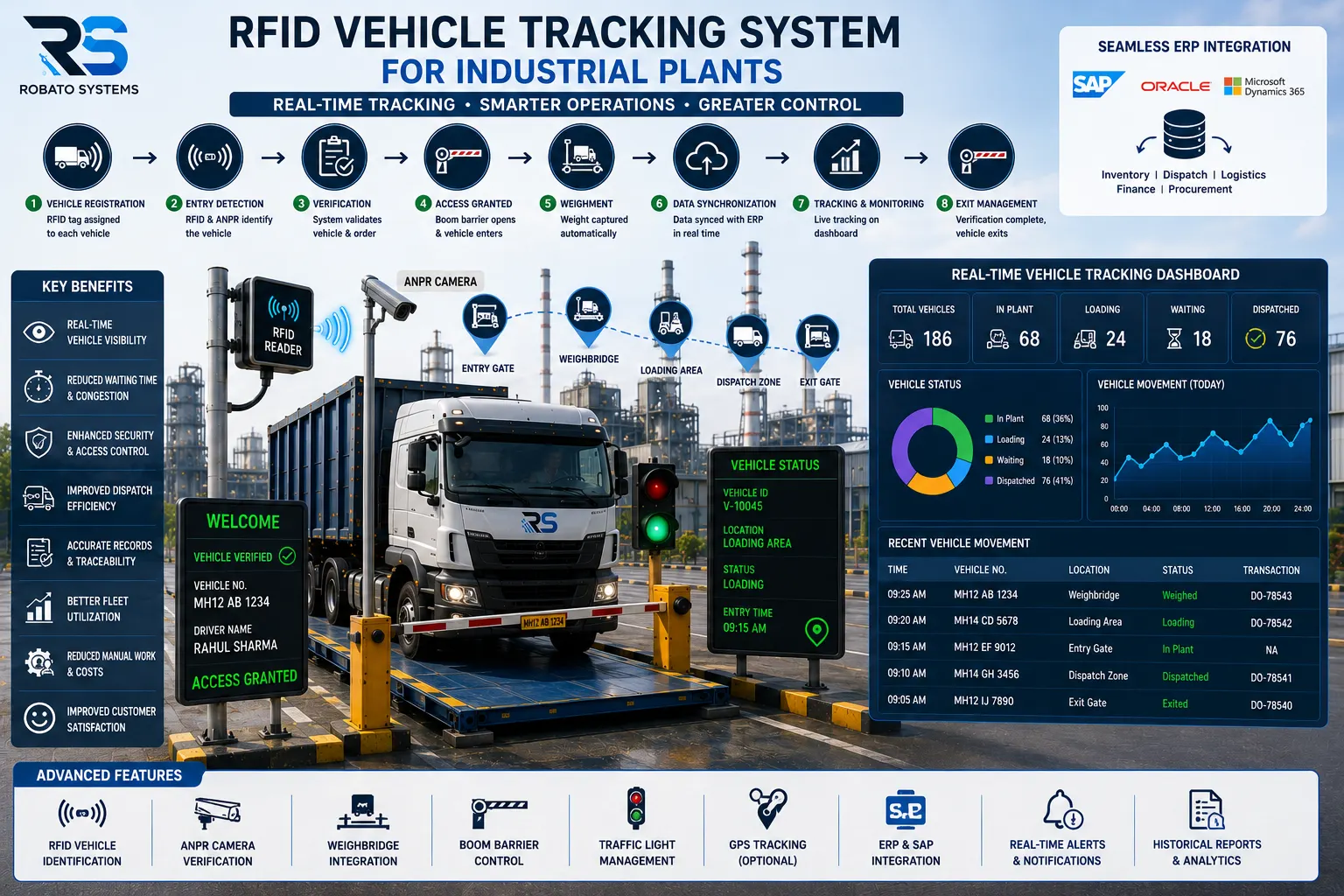
An RFID Vehicle Tracking System provides real-time visibility into every vehicle entering, moving within, and leaving an industrial facility. By combining RFID technology with weighbridge automation, ANPR cameras, boom barriers, GPS integration, and ERP software, organizations can automate vehicle tracking while improving operational efficiency and security.
Instead of relying on manual registers or verbal communication, businesses gain complete control over vehicle movement through a centralized digital platform.
What is an RFID Vehicle Tracking System?
An RFID Vehicle Tracking System is an automated solution that identifies, tracks, and monitors vehicles using RFID tags and strategically placed RFID readers across an industrial facility.
Every registered vehicle carries a unique RFID tag that stores identification information. As the vehicle passes through designated checkpoints such as entry gates, weighbridges, loading bays, unloading areas, and exit gates, RFID readers automatically detect the tag and update its location in real time.
A complete RFID vehicle tracking solution typically includes:
RFID Tags
RFID Readers
Automated Weighbridge Software
ANPR Camera Integration
Boom Barrier Control
GPS Integration (Optional)
ERP & SAP Integration
Centralized Monitoring Dashboard
Together, these technologies provide accurate and continuous tracking throughout the vehicle's journey.
Why Industrial Plants Need Vehicle Tracking
Modern industrial facilities often manage hundreds of vehicles every day. Without automation, tracking each vehicle manually becomes inefficient and error-prone.
Common operational challenges include:
Poor Vehicle Visibility
Managers cannot determine the exact location or status of vehicles in real time.
Traffic Congestion
Lack of coordination creates bottlenecks at gates, weighbridges, and loading areas.
Unauthorized Vehicle Movement
Vehicles may enter restricted zones without proper authorization.
Delayed Dispatch Operations
Manual communication slows loading and dispatch activities.
Inaccurate Operational Records
Paper-based logs make it difficult to audit vehicle movement.
How an RFID Vehicle Tracking System Works
Step 1: Vehicle Registration
Each truck is assigned a unique RFID tag linked to its vehicle information.
Step 2: Entry Detection
When the truck reaches the facility entrance, RFID readers identify the vehicle automatically.
ANPR cameras simultaneously verify the vehicle registration number for enhanced security.
Step 3: Vehicle Movement Tracking
As the truck moves through checkpoints, RFID readers continuously update its location.
Typical checkpoints include:
Entry Gate
Weighbridge
Loading Area
Warehouse
Dispatch Zone
Exit Gate
Step 4: Data Synchronization
Vehicle movement data is synchronized with the central server and ERP system.
Step 5: Real-Time Monitoring
Plant managers monitor every vehicle from a centralized dashboard.
Step 6: Digital Reporting
The software generates movement history, utilization reports, and operational analytics automatically.
Key Features of an RFID Vehicle Tracking System
Automated Vehicle Identification
Instantly recognize registered vehicles without manual verification.
Real-Time Vehicle Tracking
Monitor live vehicle locations throughout the facility.
Checkpoint Monitoring
Track vehicle movement at multiple operational checkpoints.
Weighbridge Integration
Synchronize vehicle tracking with weighment transactions.
ANPR Verification
Confirm vehicle identity using number plate recognition technology.
ERP Integration
Automatically update logistics, inventory, dispatch, and procurement systems.
Live Dashboard
Display vehicle status, waiting time, and operational performance.
Historical Tracking
Access complete vehicle movement history for audits and analysis.
Benefits of RFID Vehicle Tracking
Improved Operational Visibility
Track every vehicle from entry to exit in real time.
Reduced Waiting Time
Optimize traffic flow and reduce congestion around weighbridges and loading areas.
Enhanced Security
Prevent unauthorized vehicle movement and improve access control.
Faster Dispatch
Coordinate loading and dispatch activities more efficiently.
Accurate Movement Records
Maintain complete digital records of vehicle activity.
Better Fleet Utilization
Monitor vehicle utilization and identify operational inefficiencies.
Reduced Manual Work
Automate vehicle monitoring and eliminate manual logbooks.
Improved Customer Service
Provide customers with accurate dispatch status and estimated delivery updates.
Industries That Benefit from RFID Vehicle Tracking
Manufacturing Industry
Track raw material deliveries and finished goods dispatch efficiently.
Cement Plants
Monitor truck movement between production units, loading bays, and dispatch areas.
Mining Operations
Track ore transportation and vehicle movement across mining sites.
Steel Manufacturing
Manage high-volume truck traffic for inbound and outbound logistics.
Logistics & Warehousing
Improve fleet management and warehouse vehicle coordination.
Power Plants
Monitor coal transportation and fuel logistics.
Chemical Industry
Track hazardous material transportation securely.
Best Practices for Implementing RFID Vehicle Tracking
For maximum efficiency, organizations should:
Assign RFID tags to all authorized vehicles.
Install RFID readers at key operational checkpoints.
Integrate vehicle tracking with weighbridge automation software.
Enable ANPR verification for additional security.
Synchronize tracking data with ERP systems.
Monitor dashboards regularly to identify traffic bottlenecks.
Perform routine maintenance of RFID readers and network infrastructure.
Future Trends in RFID Vehicle Tracking
Artificial Intelligence
AI will analyze vehicle movement patterns to optimize traffic flow and reduce congestion.
Internet of Things (IoT)
Connected sensors will provide live updates on vehicle status and equipment health.
Cloud-Based Fleet Monitoring
Organizations will manage vehicle movement across multiple facilities through centralized cloud dashboards.
Predictive Analytics
Historical data will help forecast peak traffic periods and optimize logistics planning.
Digital Twin Technology
Virtual simulations will improve facility traffic planning and resource allocation.
Why Choose an RFID Vehicle Tracking System?
An RFID vehicle tracking solution provides more than simple location monitoring. It creates a connected logistics ecosystem where vehicle identification, weighment, access control, dispatch management, and ERP integration work together to improve operational efficiency.
Organizations implementing RFID vehicle tracking benefit from:
Faster vehicle processing
Better operational visibility
Improved facility security
Accurate logistics planning
Reduced operational costs
Enhanced customer satisfaction
Stronger compliance and audit readiness
Conclusion
As industrial operations become increasingly automated, manual vehicle monitoring is no longer sufficient for managing complex logistics workflows. An RFID Vehicle Tracking System provides real-time visibility into every stage of vehicle movement while integrating seamlessly with weighbridge software, ERP platforms, and access control systems.
By automating vehicle identification and movement tracking, organizations can reduce delays, strengthen security, improve dispatch efficiency, and make data-driven operational decisions. For businesses seeking smarter logistics and greater operational control, RFID vehicle tracking is an essential component of modern industrial automation.
Frequently Asked Questions (FAQs)
What is an RFID Vehicle Tracking System?
An RFID Vehicle Tracking System uses RFID tags and readers to automatically identify and monitor vehicle movement throughout an industrial facility.
How does RFID vehicle tracking improve logistics?
It provides real-time vehicle visibility, reduces waiting time, improves dispatch coordination, and eliminates manual tracking processes.
Can RFID vehicle tracking integrate with weighbridge software?
Yes. Modern RFID vehicle tracking systems integrate with weighbridge automation, ERP platforms, ANPR cameras, and boom barrier systems.
Which industries benefit from RFID vehicle tracking?
Manufacturing, cement, mining, logistics, steel, warehousing, power generation, and chemical industries commonly use RFID vehicle tracking systems.
What are the key benefits of RFID vehicle tracking?
The main benefits include real-time tracking, improved security, reduced delays, better fleet utilization, accurate reporting, and streamlined logistics.