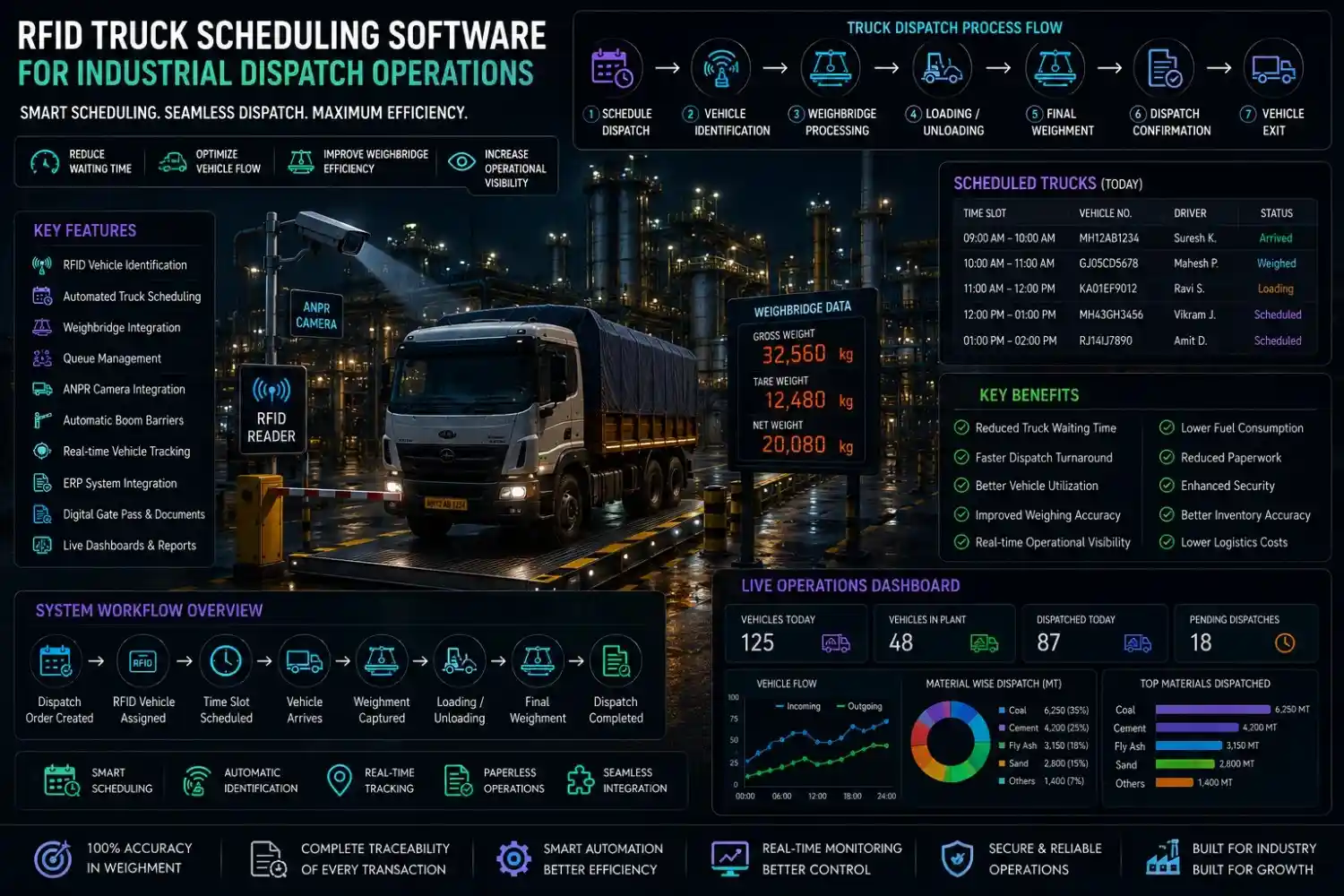
Industrial plants often handle a large number of trucks every day for raw material receipt, finished goods dispatch, and bulk material transportation. When vehicle scheduling is managed manually, trucks may arrive at the same time, creating congestion at plant gates and weighbridges.
This can result in long waiting times, inefficient vehicle utilization, delayed dispatches, and increased transportation costs.
RFID Truck Scheduling Software helps industrial facilities automate vehicle scheduling, identification, queue management, and weighbridge operations. By connecting RFID vehicle identification with dispatch orders and weighbridge systems, businesses can create a more organized and efficient truck movement process.
What is RFID Truck Scheduling Software?
RFID Truck Scheduling Software is a digital vehicle management solution that allows industries to schedule, identify, monitor, and process trucks throughout their dispatch journey.
The system can connect:
Truck Scheduling
Queue Management
Dispatch Management
ANPR Cameras
Automatic Boom Barriers
ERP Systems
Fleet Tracking
Digital Gate Passes
This creates a centralized system for managing industrial vehicle movement from scheduling to final exit.
Why Industrial Plants Need Automated Truck Scheduling
Manual truck scheduling can become difficult when hundreds of vehicles are processed daily. Common challenges include:
Unplanned truck arrivals
Long queues at weighbridges
Congestion at plant gates
Delayed dispatches
Poor vehicle utilization
Manual scheduling errors
Difficulty tracking vehicle status
Communication gaps between logistics and security teams
Higher fuel consumption during waiting
Limited visibility into dispatch operations
RFID-based scheduling helps businesses organize vehicle movement before trucks reach the facility.
How RFID Truck Scheduling Software Works
Step 1: Create a Dispatch Order
The logistics team creates a dispatch schedule containing information such as:
Vehicle Number
Transporter
Driver
Material
Customer
Dispatch Quantity
Delivery Location
Planned Date and Time
Step 2: Assign RFID Vehicle
The selected vehicle is associated with an RFID tag in the system.
This allows the plant to identify the vehicle automatically when it arrives.
Step 3: Schedule Vehicle Arrival
The system assigns an appropriate time slot to the vehicle based on dispatch requirements and plant capacity.
This helps distribute truck arrivals instead of allowing multiple vehicles to arrive simultaneously.
Step 4: Automatic Vehicle Identification
When the truck reaches the plant:
RFID reader identifies the vehicle.
ANPR camera can verify the number plate.
The system checks the scheduled dispatch.
Security receives the vehicle information.
The vehicle is allowed to proceed according to the configured workflow.
Step 5: Weighbridge Processing
The vehicle moves to the weighbridge where its weight is automatically captured.
The weighment transaction is linked with the scheduled dispatch order.
Step 6: Queue and Movement Management
The system tracks the vehicle's status throughout the facility.
For example:
Scheduled → Arrived → Weighed → Loading → Final Weighment → Dispatched
This gives logistics teams real-time visibility into every truck.
Step 7: Dispatch Completion
After the required processes are completed, the system generates the necessary digital documents and marks the vehicle as dispatched.
Key Features of RFID Truck Scheduling Software
RFID Vehicle Identification
Automatically identifies scheduled vehicles when they arrive at the plant.
Automated Truck Scheduling
Assigns vehicles specific time slots based on dispatch requirements and operational capacity.
Weighbridge Integration
Connects scheduled dispatch orders with weighment transactions for better accuracy.
Queue Management
Provides visibility into waiting vehicles and helps reduce congestion around the weighbridge.
ANPR Integration
Uses automatic number plate recognition for additional vehicle verification.
Real-Time Vehicle Status
Track each truck throughout the dispatch process.
Digital Gate Pass
Generate digital entry and exit documents based on completed transactions.
ERP Integration
Synchronize dispatch, inventory, billing, and vehicle information with existing ERP systems.
Benefits of RFID Truck Scheduling Software
Reduced Truck Waiting Time
Scheduled arrivals help prevent unnecessary vehicle congestion at plant gates and weighbridges.
Faster Dispatch
A structured vehicle workflow allows logistics teams to process trucks more efficiently.
Better Vehicle Utilization
Transporters can spend less time waiting inside the facility and more time completing deliveries.
Improved Weighbridge Efficiency
Scheduled vehicles can be processed according to planned dispatch requirements.
Better Operational Visibility
Logistics teams can see which vehicles are scheduled, waiting, loading, weighing, or dispatched.
Reduced Manual Work
Automated identification and digital scheduling reduce repetitive data entry.
Improved Security
RFID and ANPR verification help ensure that only authorized vehicles enter the facility.
Lower Logistics Costs
Reducing idle time can help minimize fuel consumption and improve fleet productivity.
Applications
RFID Truck Scheduling Software can be used across:
Manufacturing Plants
Steel Plants
Power Plants
Chemical Industries
Fertilizer Plants
Construction Material Plants
Warehouses
Ports
Scrap Yards
Bulk Material Handling Facilities
Integration with Weighbridge Automation
Truck scheduling becomes more powerful when integrated with an automated weighbridge.
The scheduled vehicle information can be automatically connected to the weighment transaction.
For example:
Truck Scheduled → RFID Identified → Weighbridge → Loading → Final Weighment → Dispatch
This eliminates duplicate data entry and creates a single digital record for each vehicle movement.
Integration with ERP and Logistics Systems
RFID truck scheduling software can exchange information with enterprise systems for:
Sales Orders
Purchase Orders
Dispatch Orders
Inventory
Billing
Customer Information
Transporter Management
Vehicle Records
Weighment Transactions
This allows logistics and operations teams to work with synchronized information instead of maintaining separate records.
Best Practices for Truck Scheduling
Schedule vehicles according to plant capacity.
Use RFID tags for regular transport vehicles.
Integrate scheduling with the weighbridge.
Monitor truck turnaround time.
Use queue management during peak hours.
Maintain accurate vehicle and transporter records.
Integrate dispatch schedules with ERP systems.
Monitor delayed and missed vehicle slots.
Review logistics performance regularly.
Common Challenges
Unplanned Vehicle Arrivals
Transporters may arrive outside their assigned slots, requiring the system to handle exceptions efficiently.
High Dispatch Volumes
Large plants may require intelligent scheduling and queue management during peak periods.
Multiple Weighbridges
Facilities with several weighbridges need centralized scheduling to distribute vehicle traffic effectively.
Existing Software Integration
The scheduling system may need to connect with existing ERP, weighbridge, and fleet management platforms.
Future of RFID Truck Scheduling
Industrial logistics is moving toward intelligent and connected vehicle management.
Future systems can incorporate:
AI-based scheduling
Predictive truck arrival estimation
GPS integration
Dynamic queue allocation
Automated dispatch prioritization
Cloud-based multi-site monitoring
Mobile notifications
Advanced logistics analytics
These technologies can help organizations optimize vehicle movement based on real-time operational conditions.
Why Choose Robato Systems?
Robato Systems provides RFID Truck Scheduling Software designed to simplify industrial vehicle movement and dispatch operations. The platform can connect RFID vehicle identification, truck scheduling, weighbridge automation, queue management, ANPR, ERP integration, and digital gate control into one centralized system.
By automating the truck scheduling process, businesses can reduce waiting time, improve weighbridge utilization, increase dispatch visibility, and create a more organized logistics workflow.
Conclusion
Managing large numbers of trucks manually can create congestion, delays, and unnecessary logistics costs. A structured truck scheduling system provides industrial facilities with better control over when vehicles arrive, where they need to go, and how they move through the plant.
RFID Truck Scheduling Software combines vehicle identification, scheduling, queue management, weighbridge integration, and dispatch automation to create a connected vehicle management process.
For industries handling high-volume truck traffic, implementing RFID-based scheduling can be an important step toward faster dispatch operations, better fleet utilization, and smarter industrial logistics.
Frequently Asked Questions
What is RFID Truck Scheduling Software?
It is software that uses RFID-based vehicle identification to schedule, monitor, and manage trucks throughout industrial dispatch operations.
Can RFID truck scheduling integrate with a weighbridge?
Yes. Scheduled vehicle information can be linked directly with weighbridge transactions for automated processing and better data accuracy.
Does truck scheduling reduce waiting time?
Yes. Assigning vehicles planned arrival slots can reduce congestion and unnecessary waiting at plant gates and weighbridges.
Can the system integrate with ERP software?
Yes. It can exchange dispatch, inventory, billing, vehicle, and weighment information with ERP systems.
Can ANPR be used with RFID scheduling?
Yes. ANPR can work alongside RFID to provide an additional layer of vehicle identification and verification.
Is RFID truck scheduling suitable for large industrial plants?
Yes. It is particularly useful for facilities that handle high volumes of trucks and require better control over vehicle arrivals, weighment, loading, and dispatch.