
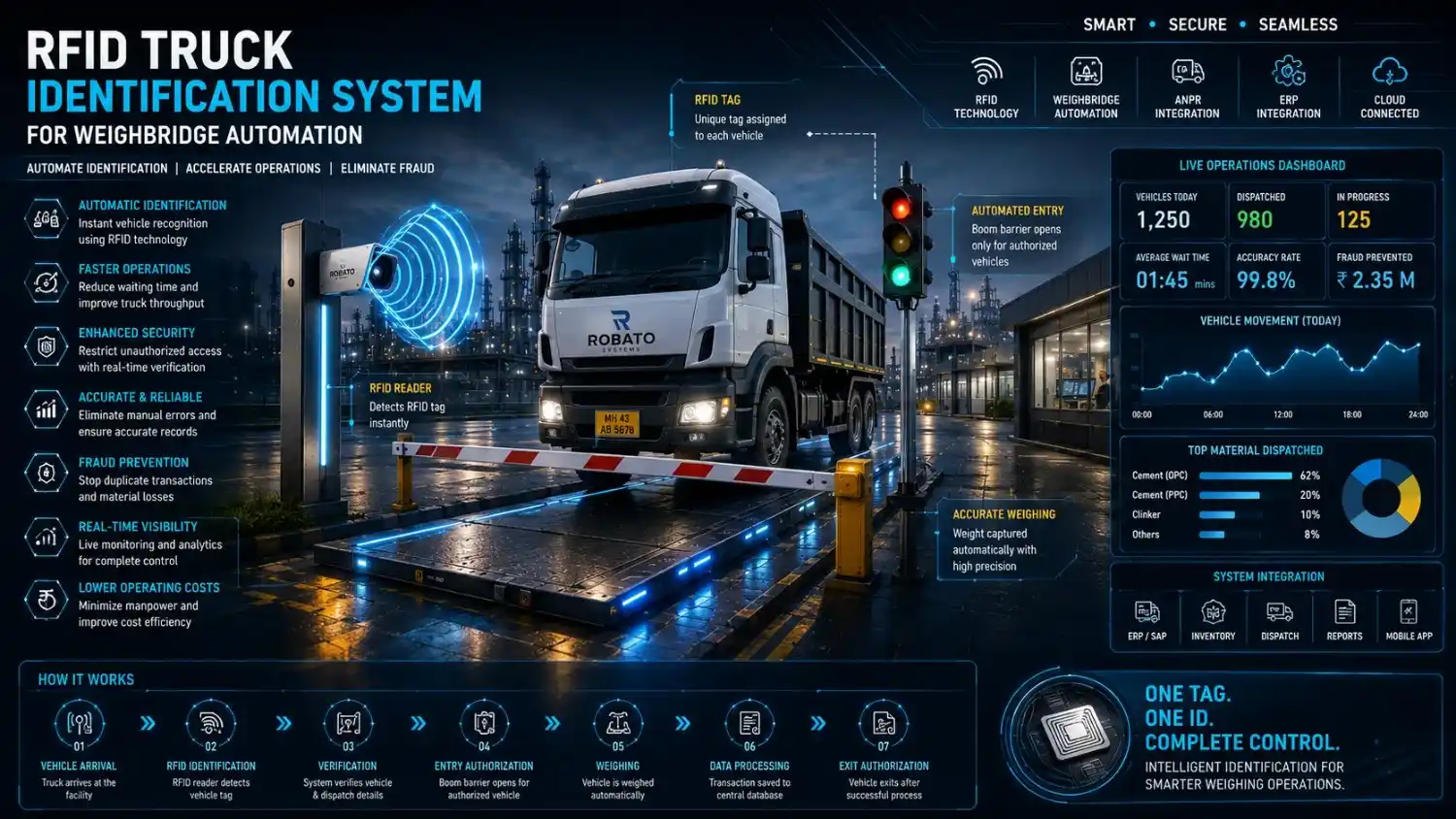
RFID Truck Identification System for Weighbridge Automation
Introduction
Managing vehicle movement efficiently is critical for industries such as cement, mining, steel, logistics, power generation, and manufacturing. Every day, hundreds of trucks enter and exit industrial facilities for loading, unloading, and dispatch operations. Traditional methods of vehicle identification rely on manual entries, paper records, and operator intervention, which often result in delays, inaccuracies, and security concerns.
An RFID Truck Identification System offers a modern solution by automating vehicle identification and integrating seamlessly with weighbridge automation systems. By using RFID tags and readers, industries can identify trucks instantly, eliminate manual errors, and ensure smooth vehicle movement throughout the facility.
As companies embrace Industry 4.0 and digital transformation, RFID-based truck identification systems have become an essential component of intelligent logistics and weighbridge management.
What is an RFID Truck Identification System?
An RFID Truck Identification System is an automated vehicle identification solution that uses Radio Frequency Identification (RFID) technology to recognize trucks without manual intervention.
The system consists of:
RFID Tags attached to vehicles
RFID Readers installed near entry points and weighbridges
Weighbridge Automation SoftwareBoom Barriers and Traffic Signals
Central Database
ERP and Dispatch Integration
When a truck approaches the weighbridge, the RFID reader detects the unique tag and automatically retrieves vehicle information from the database. This eliminates manual verification and speeds up operations.
Challenges with Manual Vehicle Identification
Slow Vehicle Processing
Manual entry and verification increase truck waiting time.
Human Errors
Incorrect vehicle information can lead to billing and inventory discrepancies.
Security Risks
Unauthorized vehicles may gain access to restricted areas.
Increased Operational Costs
Continuous operator involvement increases manpower expenses.
Lack of Real-Time Visibility
Tracking truck movement manually becomes difficult and inefficient.
These challenges can significantly impact dispatch operations and overall productivity.
How RFID Truck Identification Works
Step 1: Vehicle Registration
Each truck is registered and assigned a unique RFID tag.
Step 2: Vehicle Arrival
When the truck approaches the gate or weighbridge, the RFID reader detects the tag.
Step 3: Automatic Verification
The system verifies vehicle details and dispatch information.
Step 4: Entry Authorization
Boom barriers open automatically for authorized vehicles.
Step 5: Weight Recording
The vehicle is weighed, and transaction data is captured automatically.
Step 6: Data Storage
All transaction details are stored in the central database.
Step 7: Vehicle Exit
After processing, the truck exits through automated barriers.
Key Components of an RFID Truck Identification System
RFID Tags
Provide unique identity to every vehicle.
RFID Readers
Detect and read tag information automatically.
Weighbridge Software
Processes transactions and maintains records.
Boom Barriers
Control vehicle entry and exit.
Traffic Signals
Ensure safe movement inside the facility.
Centralized Dashboard
Offers real-time monitoring and reporting.
ERP Integration
Synchronizes weighbridge data with inventory and dispatch systems.
Benefits of RFID Truck Identification System
Faster Vehicle Identification
Vehicles are identified instantly without manual intervention.
Improved Operational Efficiency
Truck movement becomes faster and more organized.
Reduced Human Errors
Automatic data capture ensures accuracy.
Enhanced Security
Unauthorized vehicles can be prevented from entering restricted zones.
Fraud Prevention
RFID technology minimizes duplicate transactions and manipulation.
Lower Operational Costs
Reduced dependency on operators decreases labor expenses.
Real-Time Monitoring
Managers can track truck movements and weighment transactions instantly.
Better Traceability
Complete vehicle history and transaction records improve accountability.
Applications Across Industries
Cement Plants
Automate dispatch operations and improve truck turnaround times.
Mining Industry
Track material transportation and reduce losses.
Steel Plants
Ensure secure vehicle identification and accurate weighing.
Improve fleet movement and dispatch management.
Power Plants
Manage coal transportation and fuel logistics.
Chemical Industries
Maintain accurate inventory and shipment records.
Manufacturing Plants
Automate material inward and outward operations.
Technologies Integrated with RFID Truck Identification
Weighbridge Automation Software
Provides centralized transaction management.
ANPR Cameras
Offer an additional layer of vehicle verification.
ERP and SAP Systems
Ensure seamless data synchronization.
Cloud Platforms
Allow remote access and centralized monitoring.
IoT Sensors
Enable predictive maintenance and equipment monitoring.
Mobile Applications
Provide operational insights anytime and anywhere.
Why Industries are Investing in RFID Truck Identification Systems
Modern industries need:
Faster truck processing
Better security
Accurate vehicle tracking
Reduced manpower dependency
Real-time operational visibility
Improved logistics efficiency
Seamless ERP integration
Enhanced traceability
RFID Truck Identification Systems provide these capabilities while supporting automation and digital transformation initiatives.
Future Trends in RFID Vehicle Identification
AI-Based Analytics
Artificial intelligence helps optimize fleet movement and identify bottlenecks.
IoT Connectivity
Connected devices improve operational visibility.
Cloud-Based Management
Centralized access simplifies multi-location operations.
Mobile Monitoring
Managers can monitor vehicle movement remotely.
Smart Logistics Integration
RFID systems are becoming part of larger Industry 4.0 ecosystems.
How to Choose the Right RFID Truck Identification System
Before implementation, consider:
RFID reader range and accuracy
Integration with weighbridge software
ERP and SAP compatibility
Scalability for future expansion
Cloud and mobile support
Reporting and analytics features
Security mechanisms
Technical support availability
Selecting the right solution ensures higher productivity and long-term return on investment.
Conclusion
An RFID Truck Identification System is transforming industrial vehicle management by enabling automatic identification, faster truck movement, and enhanced security. Integrated with weighbridge automation software, RFID technology eliminates manual errors, prevents fraud, and improves operational efficiency.
As industries continue adopting smart manufacturing and Industry 4.0 technologies, RFID-based truck identification systems are becoming essential for achieving seamless logistics and efficient material handling operations.
Frequently Asked Questions (FAQs)
What is an RFID Truck Identification System?
An RFID Truck Identification System uses RFID tags and readers to automatically identify vehicles and streamline weighbridge operations.
How does RFID improve truck movement?
RFID enables instant vehicle identification, reducing waiting times and improving dispatch efficiency.
Can RFID truck identification integrate with ERP systems?
Yes. Modern RFID systems support ERP and SAP integration for seamless data management.
Which industries use RFID truck identification systems?
Cement, mining, steel, logistics, power plants, manufacturing, and chemical industries widely use RFID vehicle identification systems.
What are the benefits of RFID truck identification?
Benefits include faster vehicle processing, improved security, reduced human errors, fraud prevention, and real-time monitoring.