
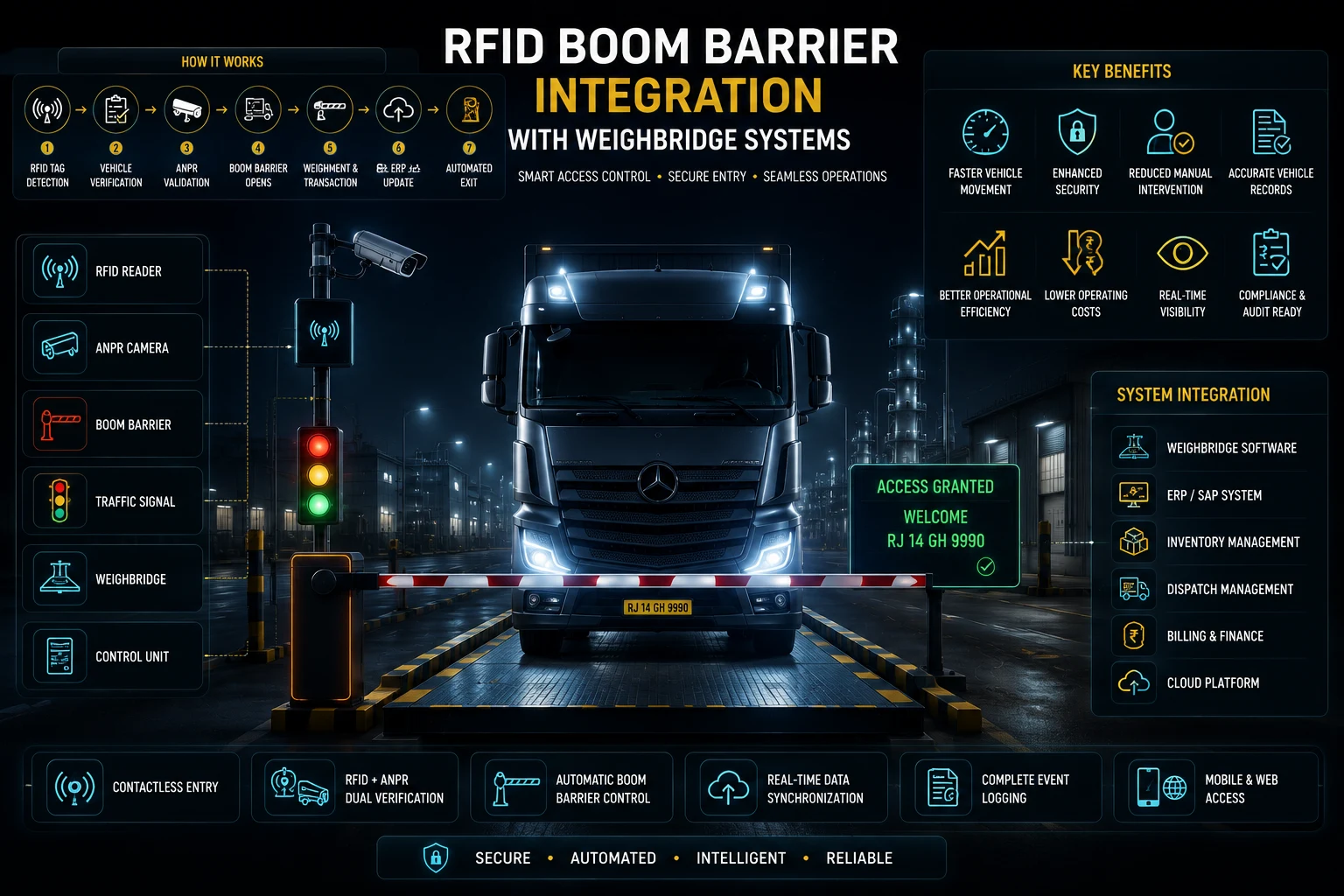
RFID Boom Barrier Integration with Weighbridge Systems
Introduction
Industrial facilities such as manufacturing plants, logistics hubs, mining sites, cement factories, steel plants, warehouses, and power stations handle a continuous flow of trucks every day. Managing vehicle entry and exit manually often results in long queues, security risks, unauthorized access, and unnecessary delays that impact overall productivity.
An RFID Boom Barrier Integration system eliminates these challenges by automating vehicle access at industrial gates. When integrated with weighbridge software, RFID readers, ANPR cameras, and ERP systems, boom barriers automatically open only for authorized vehicles, ensuring secure and efficient movement throughout the facility.
By replacing manual gate operations with intelligent automation, businesses can improve vehicle turnaround time, strengthen security, and gain complete visibility over every vehicle entering or leaving the premises.
What is RFID Boom Barrier Integration?
RFID Boom Barrier Integration is an automated access control solution that combines RFID technology with boom barriers to manage vehicle movement without manual intervention.
Each authorized vehicle is equipped with an RFID tag containing a unique identification number. As the vehicle approaches the entry or exit gate, an RFID reader detects the tag and verifies it against the centralized database. If the vehicle is authorized, the boom barrier opens automatically. If verification fails, access is denied, and the system records the event for further review.
A complete RFID boom barrier solution typically includes:
RFID Vehicle Tags
RFID Readers
Automatic Boom Barriers
ANPR Camera Integration
ERP Integration
Centralized Monitoring Dashboard
Together, these technologies create a secure and fully automated vehicle access control system.
Why Industries Need RFID Boom Barrier Integration
As industrial operations expand, managing vehicle movement manually becomes increasingly difficult.
Common challenges include:
Unauthorized Vehicle Entry
Manual verification increases the possibility of unauthorized vehicles entering restricted areas.
Long Waiting Times
Security personnel manually checking documents can create significant vehicle queues.
Human Errors
Manual record keeping may result in incorrect vehicle entries or missed transactions.
Security Concerns
Without automated verification, facilities are more vulnerable to fraud and unauthorized material movement.
Lack of Operational Visibility
Management cannot monitor live gate activities without centralized reporting.
How RFID Boom Barrier Integration Works
Step 1: Vehicle Registration
Every authorized vehicle is assigned an RFID tag linked to its registration details, transporter information, and business records.
Step 2: RFID Detection
As the vehicle approaches the gate, the RFID reader automatically detects the tag without requiring the driver to stop.
Step 3: Vehicle Verification
The software verifies:
Vehicle Registration
RFID Tag
Driver Authorization
Purchase or Dispatch Order
Entry Permissions
ANPR cameras can simultaneously verify the vehicle number plate for additional security.
Step 4: Boom Barrier Activation
If all verification checks are successful, the boom barrier opens automatically.
Traffic lights indicate when it is safe for the vehicle to proceed.
Step 5: Weighbridge Processing
If integrated with a weighbridge, the vehicle proceeds for automated weighing and transaction processing.
Step 6: ERP Update
Vehicle movement and weighment information are automatically synchronized with ERP and inventory systems.
Step 7: Automated Exit
After completing loading or unloading operations, the exit process follows the same automated verification workflow.
Key Features of RFID Boom Barrier Integration
Automatic Vehicle Identification
Identify authorized vehicles instantly using RFID technology.
Contactless Entry
Drivers can pass through gates without manual document verification.
Boom Barrier Automation
Automatically control vehicle entry and exit based on predefined authorization rules.
ANPR Verification
Enhance security through automatic number plate recognition.
Weighbridge Integration
Connect vehicle access directly with automated weighbridge operations.
ERP Integration
Synchronize access records with logistics, inventory, procurement, and finance systems.
Real-Time Monitoring
Track vehicle movement through live dashboards.
Event Logging
Maintain complete digital records of every vehicle entry and exit.
Benefits of RFID Boom Barrier Integration
Faster Vehicle Movement
Reduce waiting times by automating access control.
Improved Security
Allow only authorized vehicles to enter restricted areas.
Reduced Manual Intervention
Eliminate manual gate operations and document verification.
Better Operational Efficiency
Automate repetitive tasks and improve logistics workflows.
Accurate Vehicle Records
Maintain complete digital logs for every vehicle movement.
Enhanced Compliance
Generate audit-ready reports for internal and regulatory requirements.
Lower Operating Costs
Reduce manpower requirements and administrative expenses.
Increased Customer Satisfaction
Faster vehicle processing improves supplier and customer experience.
Industries That Benefit from RFID Boom Barrier Integration
Manufacturing Plants
Automate supplier and dispatch vehicle access.
Logistics & Warehousing
Improve fleet movement while maintaining secure access control.
Mining Operations
Protect mining sites while monitoring heavy vehicle traffic.
Cement Plants
Manage inbound raw materials and outbound dispatch vehicles.
Steel Manufacturing
Automate truck entry for raw materials and finished products.
Power Plants
Secure coal transportation and fuel handling operations.
Chemical Industries
Control access to hazardous material transportation.
Best Practices for Successful Implementation
For the best results:
Register all authorized vehicles with RFID tags.
Install RFID readers at entry and exit gates.
Integrate the boom barrier with weighbridge software.
Use ANPR cameras for dual-layer verification.
Configure role-based access permissions.
Enable automated alerts for unauthorized access attempts.
Perform regular maintenance of RFID readers and boom barriers.
Future Trends in RFID Boom Barrier Integration
Artificial Intelligence
AI will identify unusual vehicle movement patterns and automatically detect potential security risks.
Internet of Things (IoT)
Smart sensors will continuously monitor barrier performance, gate activity, and equipment health.
Cloud-Based Access Management
Organizations will manage gate operations across multiple facilities from a centralized cloud platform.
Mobile Access Management
Authorized users will monitor gate activities and approve vehicle access through secure mobile applications.
Smart Industrial Campuses
RFID boom barrier systems will become part of fully connected Industry 4.0 environments, integrating with surveillance systems, visitor management, and production planning.
Why Businesses Should Invest in RFID Boom Barrier Integration
An RFID-enabled boom barrier system offers more than automated gate control. It becomes a central component of a modern industrial access management strategy by integrating security, weighbridge operations, logistics, and ERP systems.
Organizations implementing RFID boom barrier integration often experience:
Reduced truck turnaround time
Improved facility security
Better operational transparency
Faster dispatch processes
Reduced paperwork
Improved compliance
Lower operating costs
Higher logistics efficiency
Conclusion
Managing industrial vehicle access manually is no longer sufficient for businesses handling large volumes of daily truck movement. RFID Boom Barrier Integration provides a secure, automated, and scalable solution that improves access control while integrating seamlessly with weighbridge systems, ERP platforms, and logistics operations.
By automating vehicle identification and gate operations, organizations can reduce delays, strengthen security, improve operational efficiency, and gain complete visibility into facility access. It is an essential investment for businesses looking to modernize industrial logistics and embrace digital transformation.
Frequently Asked Questions (FAQs)
What is RFID Boom Barrier Integration?
RFID Boom Barrier Integration is an automated access control solution that uses RFID technology to identify vehicles and automatically control boom barriers at industrial facilities.
How does RFID boom barrier integration improve security?
The system only allows authorized vehicles to enter or exit after verifying RFID tags and, if configured, vehicle number plates through ANPR cameras.
Can RFID boom barriers integrate with weighbridge software?
Yes. RFID boom barrier systems integrate with weighbridge automation software, ERP systems, ANPR cameras, and fleet management platforms.
Which industries use RFID boom barrier integration?
Manufacturing, logistics, mining, cement, steel, power generation, warehouses, and chemical industries commonly use RFID boom barrier systems.
What are the benefits of RFID boom barrier integration?
The key benefits include faster vehicle processing, enhanced security, reduced manual intervention, real-time monitoring, digital record keeping, and improved operational efficiency.