
RFID Based Weighbridge System: The Complete Guide to Smarter Weighing Operations
In industries where material movement is constant and high-value transactions depend on accuracy, manual weighing processes can quickly become a bottleneck. This is where an RFID Based Weighbridge System transforms operations. By combining automated vehicle identification with intelligent weighing software, it eliminates manual errors, speeds up processing, and ensures complete transparency in every transaction.
Why Traditional Weighbridge Systems Fall Short
Conventional weighbridges depend heavily on human intervention. Operators manually enter vehicle details, record weights, and manage entry and exit processes. This not only slows down operations but also increases the risk of errors and fraud. In high-traffic environments like logistics hubs, mining sites, and manufacturing plants, these inefficiencies can lead to long queues, inaccurate records, and operational delays. An RFID Based Weighbridge System addresses these challenges by replacing manual steps with automation and real-time data processing.
What Is an RFID Based Weighbridge System
An RFID Based Weighbridge System is an automated solution where vehicles are identified using RFID tags and long-range RFID readers. Each vehicle is assigned a unique RFID tag that stores its identity. When the vehicle approaches the weighbridge, the system automatically detects and verifies it without any manual input. Once identified, the system captures gross and tare weight automatically and records the transaction in a centralized database. This creates a fully digital and traceable weighing process.
How the System Works in Real Time
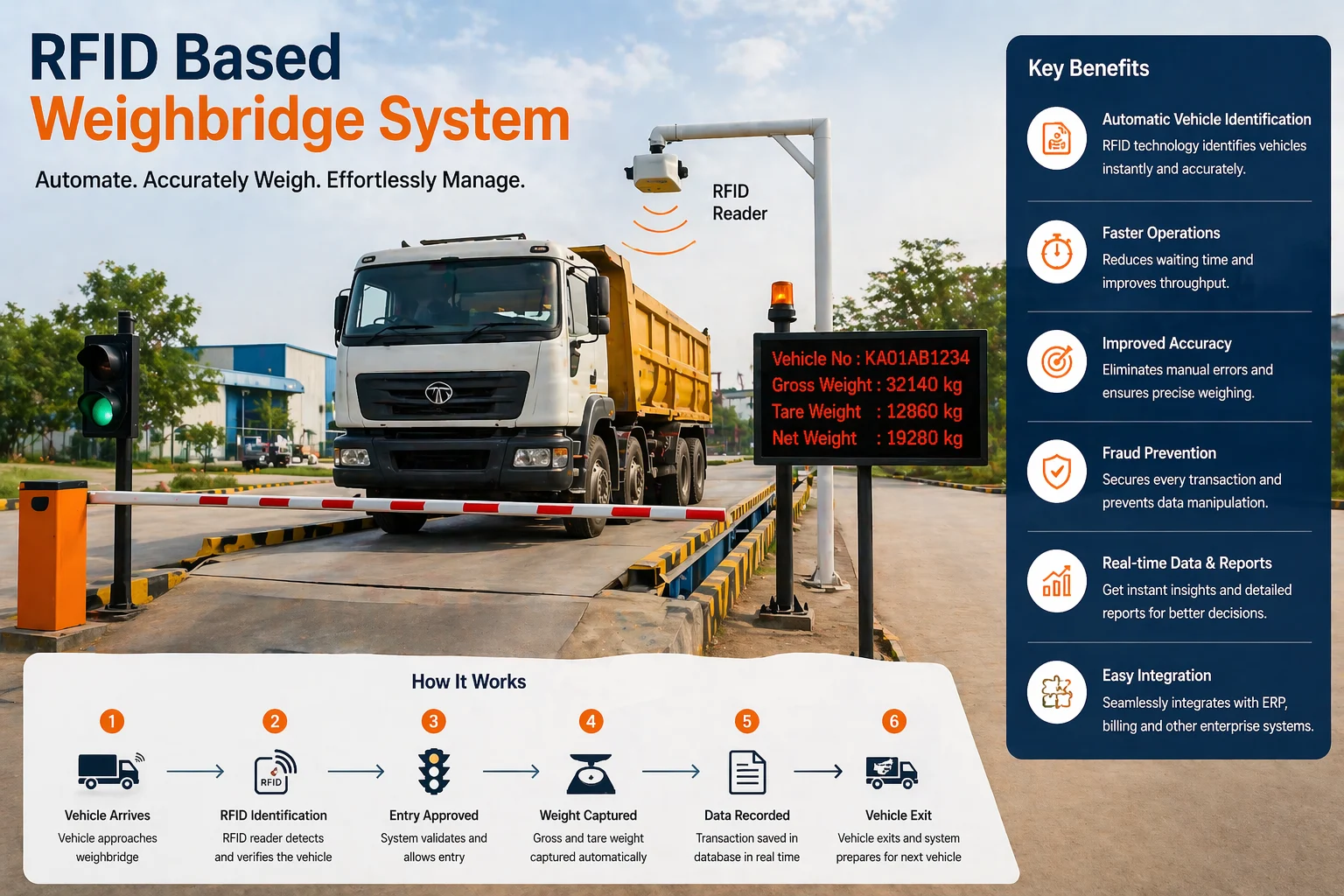
The working of an RFID Based Weighbridge System follows a seamless automated flow. When a vehicle approaches the weighbridge, sensors detect its presence. The RFID reader scans the tag instantly and verifies whether the vehicle is authorized. Once validated, traffic signals guide the driver into position. The system checks alignment using position sensors to ensure accurate weighing. After the vehicle is correctly positioned, the system captures weight automatically and stores the data in real time. Finally, the vehicle exits without needing to stop for manual verification. This entire process happens within seconds, without operator involvement.
Key Components That Power the System
An RFID Based Weighbridge System combines hardware and software to deliver automation. The hardware layer includes RFID readers, RFID tags, loop sensors, position sensors, traffic lights, boom barriers, and industrial load cells. On the software side, a centralized platform manages vehicle data, tracks transactions, enforces business rules, and generates reports. Together, these components create a connected ecosystem that ensures accuracy and efficiency.
Eliminating Fraud and Human Error
One of the biggest advantages of an RFID Based Weighbridge System is fraud prevention. Manual systems are vulnerable to manipulation, such as incorrect data entry or duplicate transactions. With RFID automation, every vehicle is uniquely identified and every transaction is logged automatically. This removes the possibility of tampering and ensures complete traceability. The result is a secure and reliable weighing process.
Faster Turnaround and Better Efficiency
Time is critical in industrial operations. An RFID Based Weighbridge System significantly reduces vehicle waiting time by eliminating manual steps. Vehicles move through the weighbridge quickly, improving turnaround time and reducing congestion. This increased efficiency leads to higher productivity and smoother operations across the facility.
Seamless Integration With Enterprise Systems
Modern industrial operations rely on connected systems. An RFID Based Weighbridge System integrates with ERP, MES, and other enterprise platforms, ensuring that weighment data flows directly into business processes. This integration improves inventory tracking, billing accuracy, and overall operational visibility.
Real-Time Data and Analytics
Data is a powerful asset in any operation. An RFID Based Weighbridge System provides real-time dashboards and detailed reports, including vehicle movement logs, weight records, and transaction history. This data helps managers identify trends, optimize processes, and make informed decisions.
Scalable for Every Industry
RFID Based Weighbridge Systems are used across multiple industries, including cement, mining, steel, logistics, ports, and manufacturing. They can be scaled to handle single weighbridges or multiple locations, making them suitable for both small facilities and large industrial networks.
A Step Toward Fully Automated Operations
Automation is no longer optional in modern industries. An RFID Based Weighbridge System is a key step toward creating a fully automated and digital operation. It reduces dependency on manpower, improves accuracy, and enhances overall efficiency. For businesses handling high volumes of material movement, this system is not just an upgrade. It is a necessity.
Conclusion
An RFID Based Weighbridge System transforms traditional weighing into a fast, accurate, and fully automated process. By combining RFID technology, sensors, and intelligent software, it eliminates manual intervention, prevents fraud, and improves operational efficiency. For any industry that depends on precise weight measurement and smooth vehicle flow, this system delivers measurable and long-term value.