Modern ports handle thousands of trucks carrying containers, bulk cargo, raw materials, and finished goods every day. Managing this massive flow of vehicles efficiently is essential to prevent congestion, reduce turnaround time, and ensure smooth cargo movement. However, manual weighbridge operations often slow down port activities due to lengthy verification processes, manual paperwork, and disconnected logistics systems.
Truck queues at entry gates, inaccurate weighment records, delayed container movement, and limited visibility into vehicle operations can significantly affect port productivity. These delays not only increase operational costs but also impact shipping schedules and customer satisfaction.
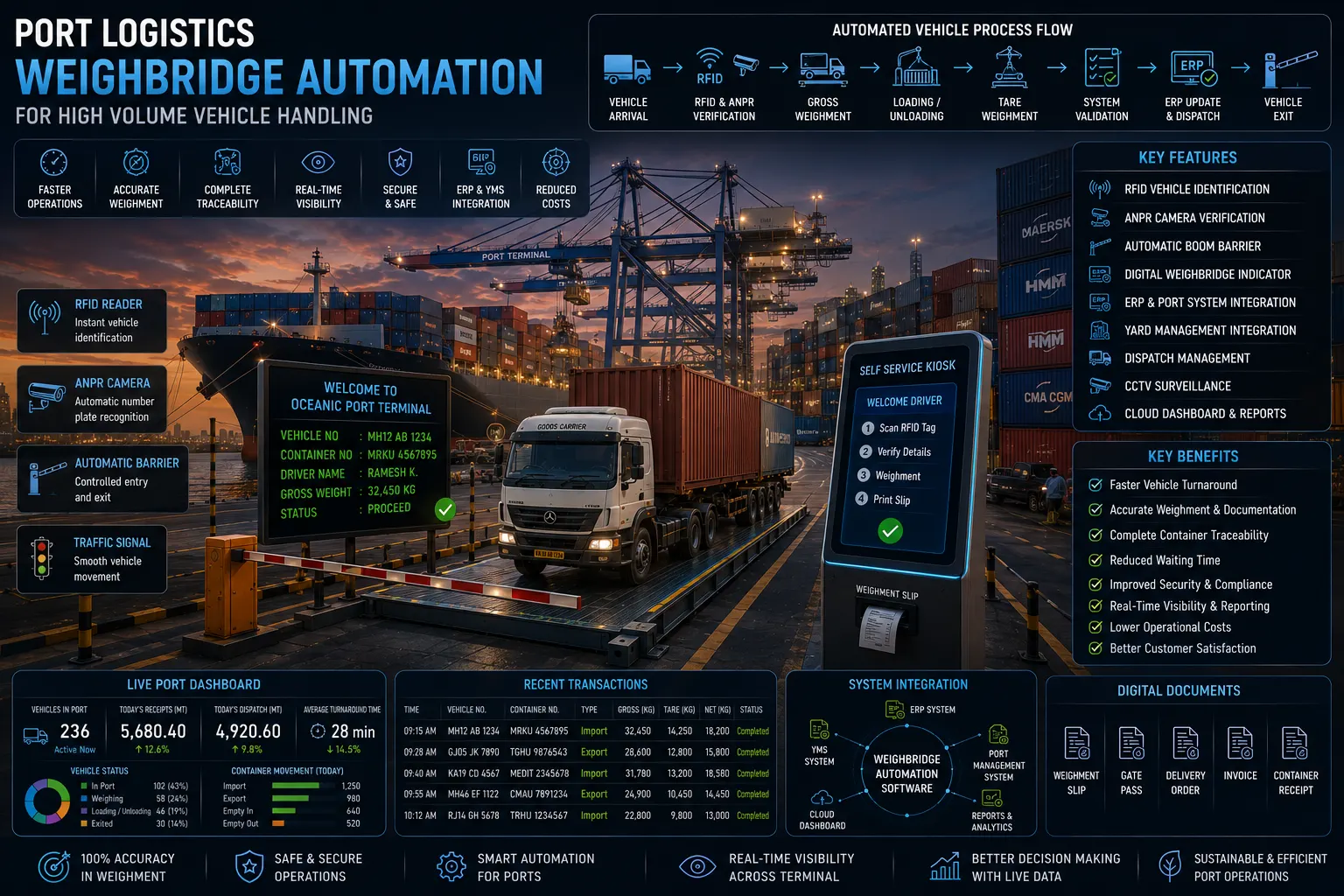
Port Logistics Weighbridge Automation transforms traditional weighbridge operations into a fully automated system by integrating RFID technology, ANPR cameras, automatic boom barriers, weighbridge software, and ERP systems. This enables ports to process more vehicles in less time while maintaining complete accuracy and security.
What is Port Logistics Weighbridge Automation?
Port Logistics Weighbridge Automation is an intelligent solution that automates vehicle identification, weighment, cargo verification, dispatch approval, and reporting for ports, terminals, and logistics hubs.
The solution integrates multiple technologies, including:
Digital Weighbridge Indicators
Automatic Boom Barriers
ERP Integration
Port Management Software
Yard Management System (YMS)
CCTV Surveillance
Cloud Monitoring Dashboard
This integrated platform provides complete control over vehicle movement from entry to exit.
Why Ports Need Weighbridge Automation
Ports operate around the clock with continuous vehicle movement. Manual weighbridge processes often create several operational challenges, including:
Long truck queues at port gates
Slow vehicle verification
Manual data entry errors
Incorrect weighment records
Delayed cargo dispatch
Unauthorized vehicle access
Poor container tracking
Paper-based documentation
Limited real-time visibility
Increased logistics costs
Automating the weighbridge process helps ports increase throughput while maintaining security and compliance.
How Port Logistics Weighbridge Automation Works
Step 1: Vehicle Registration
Each truck is registered in the system with an RFID tag linked to:
Vehicle Number
Driver Details
Container Number
Shipping Line
Cargo Details
Dispatch Order
Step 2: Automatic Vehicle Identification
When the truck reaches the port entrance:
RFID reader identifies the vehicle.
ANPR camera verifies the number plate.
The software validates authorization.
Boom barrier opens automatically.
Only approved vehicles are allowed to enter the port.
Step 3: Vehicle Weighment
The truck enters the weighbridge where the system automatically records:
Gross Weight
Vehicle Details
Cargo Information
Date & Time
Transaction ID
All data is stored instantly in the software.
Step 4: Cargo Loading or Unloading
The vehicle proceeds to the assigned loading or unloading zone while the software tracks every movement in real time.
Step 5: Final Weighment
After loading or unloading, the truck returns for the final weighment.
The software automatically calculates:
Net Weight = Gross Weight − Tare Weight
The transaction is synchronized with ERP and port management software.
Step 6: Exit Clearance
Digital weighment slips, gate passes, and dispatch documents are generated automatically before the truck exits the port.
Key Features of Port Logistics Weighbridge Automation
RFID Vehicle Identification
Automatically recognizes registered vehicles, reducing manual verification and speeding up gate operations.
Automatic Boom Barrier
Controls vehicle entry and exit while improving port security.
ANPR Camera Integration
Automatically verifies vehicle number plates and prevents unauthorized access.
ERP & Port Management Integration
Synchronizes weighbridge transactions with ERP, billing, inventory, and cargo management systems.
Yard Management Integration
Coordinates vehicle movement with container yards for efficient cargo handling.
Digital Weighment Slips
Generates secure electronic weighment records and gate passes for every transaction.
Live Monitoring Dashboard
Monitor:
Incoming Trucks
Outgoing Vehicles
Container Movement
Yard Occupancy
Queue Length
Daily Transactions
Dispatch Automation
Automates dispatch approvals and reduces paperwork for faster cargo movement.
Benefits of Port Logistics Weighbridge Automation
Faster Vehicle Turnaround
RFID-based vehicle identification and automated weighment significantly reduce waiting time.
Higher Port Throughput
Process more trucks every day without increasing manpower.
Accurate Cargo Tracking
Every vehicle and cargo movement is digitally recorded for complete traceability.
Improved Security
RFID, ANPR cameras, CCTV, and boom barriers prevent unauthorized vehicle access.
Reduced Operational Costs
Automation minimizes paperwork, manual verification, and processing delays.
Fraud Prevention
The system prevents duplicate weighments, incorrect cargo records, and unauthorized dispatches.
Real-Time Operational Visibility
Cloud dashboards provide complete visibility into port logistics and vehicle movement.
Applications
Port Logistics Weighbridge Automation is ideal for:
Seaports
Inland Ports
Container Terminals
Cargo Terminals
Dry Ports
Inland Container Depots (ICDs)
Bulk Cargo Handling Facilities
Logistics Parks
Shipping Yards
Industry 4.0 Integration
Modern ports are adopting Industry 4.0 technologies to improve logistics operations.
The system integrates with:
Industrial IoT (IIoT)
ERP Software
Port Management Systems
Yard Management Systems (YMS)
Fleet Management Software
Cloud Dashboards
RFID Tracking
GPS Vehicle Tracking
CCTV Monitoring
Mobile Applications
These integrations provide centralized monitoring, automated reporting, and data-driven operational decisions.
Best Practices
Register all transport vehicles with RFID tags.
Integrate the weighbridge with ERP and port management software.
Perform regular weighbridge calibration.
Install ANPR cameras at entry and exit gates.
Monitor truck turnaround time using dashboards.
Schedule preventive maintenance for all automation equipment.
Regularly verify RFID readers and camera systems.
Common Challenges
High Traffic Volume
Ports experience peak traffic during vessel arrivals, making intelligent queue management essential.
Legacy Infrastructure
Older weighbridges may require hardware upgrades to support automation.
Network Reliability
Stable connectivity is necessary for uninterrupted communication between RFID devices, ERP systems, and cloud dashboards.
RFID Tag Maintenance
Damaged RFID tags should be replaced immediately to avoid processing delays.
Future Trends
Port logistics is rapidly moving toward smart automation with technologies such as:
AI-based truck scheduling
IoT-enabled smart weighbridges
Predictive equipment maintenance
Cloud-based port management
GPS-integrated vehicle tracking
Mobile gate approvals
Digital documentation
Advanced logistics analytics
These innovations will help ports improve throughput, reduce congestion, and optimize cargo movement.
Why Choose Robato Systems for Port Logistics Weighbridge Automation?
Robato Systems offers advanced Port Logistics Weighbridge Automation solutions designed for high-volume ports, container terminals, and logistics facilities. Our platform combines RFID vehicle identification, automated weighbridges, ANPR cameras, ERP integration, yard management systems, cloud dashboards, and digital documentation into a single intelligent solution.
Our software helps port operators reduce truck waiting time, improve cargo traceability, eliminate manual errors, automate dispatch operations, and maximize operational efficiency. Whether you manage a private cargo terminal or a large commercial port, Robato Systems delivers scalable automation solutions tailored to your logistics requirements.
Conclusion
Efficient vehicle handling is essential for ports managing large volumes of daily cargo movement. Manual weighbridge operations often create delays, congestion, inaccurate records, and higher operational costs.
By implementing Port Logistics Weighbridge Automation, ports can automate vehicle identification, weighment, cargo verification, and dispatch management while improving security and operational efficiency. The result is faster truck processing, accurate cargo tracking, reduced paperwork, and complete visibility across port operations.
As ports continue embracing digital transformation, intelligent weighbridge automation has become a critical investment for building smarter, faster, and more connected logistics operations.
Frequently Asked Questions (FAQs)
What is Port Logistics Weighbridge Automation?
It is an automated system that manages vehicle identification, weighing, cargo tracking, and dispatch operations using RFID, ERP integration, and digital technologies.
How does RFID improve port logistics?
RFID automatically identifies vehicles, speeds up gate entry and exit, reduces manual verification, and improves cargo traceability.
Can the software integrate with Port Management Systems?
Yes. It integrates with Port Management Systems, Yard Management Systems, ERP software, and fleet management platforms.
Does the system reduce truck waiting time?
Yes. Automated identification, weighment, and dispatch processing significantly reduce vehicle turnaround time.
Is the solution suitable for high-volume ports?
Yes. It is designed to efficiently manage thousands of trucks and large-scale cargo operations every day.
Can multiple ports be monitored from one dashboard?
Yes. Cloud-enabled software allows centralized monitoring and reporting across multiple ports, terminals, and logistics facilities from a single dashboard.