OEE Monitoring for Packaging and Filling Lines: Improve Production Efficiency and Reduce Downtime
Packaging and filling operations play an important role in industries such as food and beverage, pharmaceuticals, cosmetics, chemicals, and consumer goods. Manufacturers depend on these production lines to fill, seal, label, inspect, and pack products at consistent speeds while meeting quality and delivery requirements.
However, maintaining consistent packaging-line performance is not always straightforward. A filling machine may operate below its expected speed, a labelling unit may interrupt the production flow, or a downstream packaging machine may create bottlenecks that affect the entire line.
Even short stoppages can accumulate into significant production losses when equipment operates across multiple shifts.
For packaging managers, monitoring total production output alone does not provide enough information to understand these problems. They need visibility into machine availability, operating speed, downtime, and quality performance.
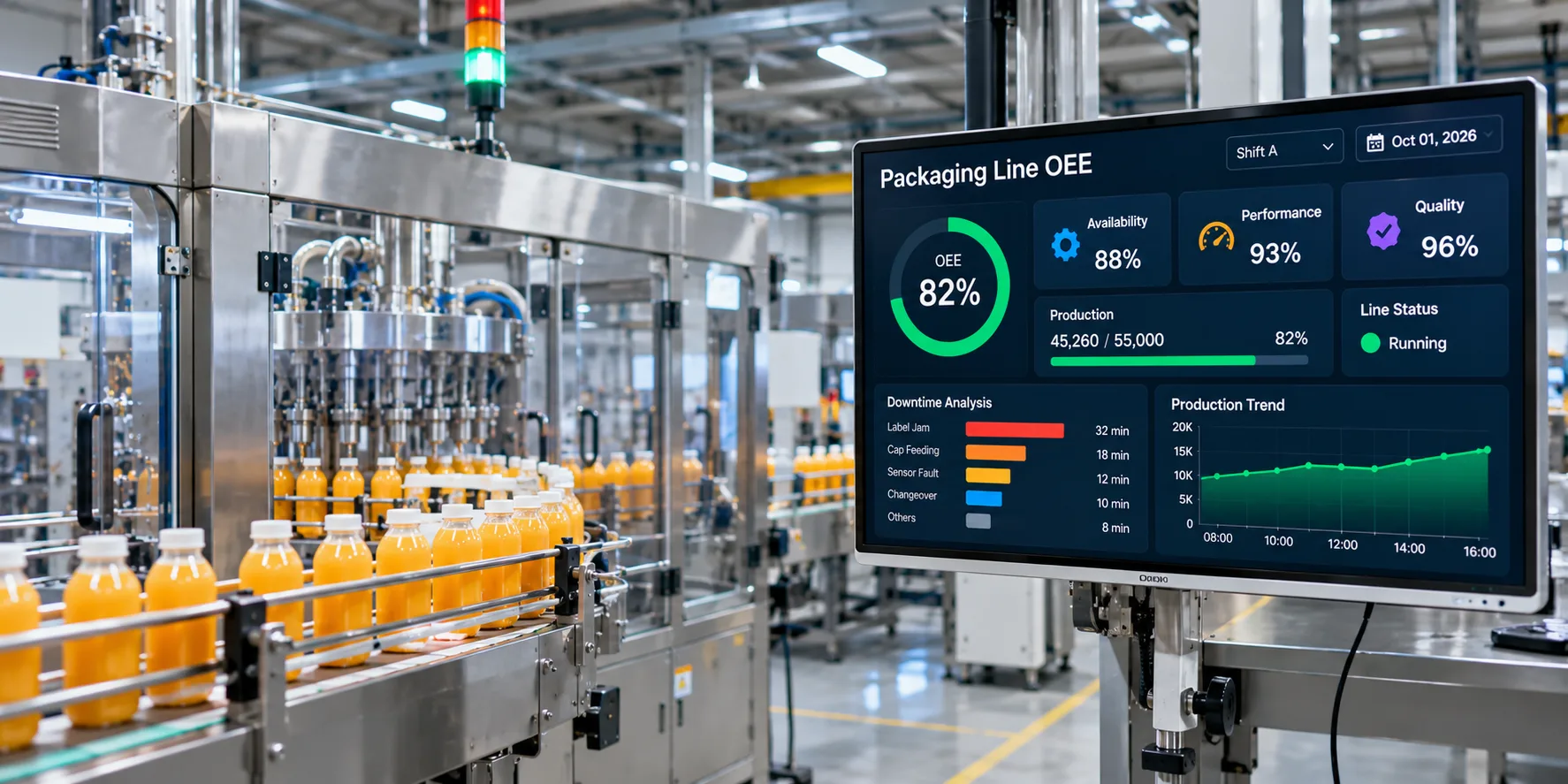
This is where Packaging Line OEE Monitoring becomes valuable. It helps manufacturers measure Overall Equipment Effectiveness (OEE), identify production losses, and understand how efficiently their packaging and filling lines are operating.
In this guide, we will explore how OEE monitoring works for packaging operations, which performance indicators matter, and how manufacturers can use production data to improve line efficiency.
What Is Packaging Line OEE Monitoring?
Packaging Line OEE Monitoring is the process of measuring the effectiveness of packaging and filling equipment using availability, performance, and quality data.
OEE stands for Overall Equipment Effectiveness. It helps manufacturers understand how much of their planned production time is being converted into good-quality output.
A packaging line may include several connected machines, such as:
Bottle or container feeding systems
Filling machines
Capping and sealing machines
Labelling machines
Cartoning and wrapping machines
Inspection and rejection systems
Case packing and palletising equipment
Each machine contributes to the overall production process. A stoppage or performance issue at one stage can affect the output of the entire line.
OEE monitoring helps production teams understand machine-level and line-level performance instead of relying only on the final number of packaged products.
Depending on the monitoring configuration, manufacturers can track:
Machine running and stopped status
Production counts
Actual versus ideal production speed
Downtime duration and reasons
Rejected products
Shift-wise production performance
Availability, performance, and quality percentages
Overall OEE
This information provides a more structured way to evaluate production efficiency and identify areas that require attention.
Why Packaging and Filling Lines Need OEE Monitoring
Packaging operations often involve multiple machines working together at different stages. The performance of the entire line depends on how effectively these machines operate as a coordinated system.
Several common challenges make OEE monitoring important.
1. Frequent Short Stoppages
Packaging lines can experience repeated short interruptions because of misaligned containers, product jams, sensor issues, label-feed problems, cap-feeding interruptions, or other equipment-related events.
These stoppages may last only a few seconds or minutes, but their cumulative impact can be substantial.
If short stops are not recorded consistently, production managers may underestimate how much time is being lost.
OEE monitoring helps capture machine interruptions and makes it easier to identify recurring stoppage patterns.
2. Uneven Production Speeds Across Machines
A packaging line may contain equipment with different operating capacities.
For example, a filling machine may be capable of processing containers faster than the downstream labelling or cartoning machine. This difference can create waiting time, accumulation, or production bottlenecks.
Monitoring actual operating speeds across connected machines helps managers identify where the production flow is being restricted.
3. Changeover and Cleaning Time
Packaging facilities often manufacture multiple products, container sizes, or packaging formats.
Changing from one product to another may require equipment adjustments, format changes, cleaning, material replacement, and quality checks.
These activities can consume a significant portion of planned production time.
Separately recording changeover and cleaning activities helps managers understand their impact and identify opportunities to improve production scheduling and setup procedures.
4. Packaging Defects and Rejection
Packaging quality directly affects the number of saleable products produced.
Common quality problems include:
Incorrect fill levels
Improper sealing
Missing or damaged labels
Incorrect caps or closures
Damaged containers
Incorrect packaging or coding
Product leakage
These issues may result in rejected products, rework, or additional inspection requirements.
Including quality data in OEE calculations helps manufacturers understand how quality losses affect overall production effectiveness.
5. Limited Visibility Across the Production Line
When different packaging machines are monitored independently, it can be difficult to understand the performance of the complete production line.
A centralised dashboard can help production managers view machine status, output, downtime, and efficiency from one location.
This makes it easier to investigate bottlenecks and coordinate corrective actions between production, maintenance, and quality teams.
Understanding OEE for Packaging and Filling Lines
OEE measures how effectively production equipment operates during planned production time.
It is calculated using three factors:
OEE = Availability × Performance × Quality
Each factor provides a different view of production effectiveness.
1. Availability
Availability measures the percentage of planned production time during which the equipment was actually operating.
Availability = Operating Time ÷ Planned Production Time × 100
For example:
Planned production time: 480 minutes
Total downtime: 48 minutes
Actual operating time: 432 minutes
Availability:
432 ÷ 480 × 100 = 90%
This indicates that the packaging line was operating for 90% of its planned production time.
2. Performance
Performance measures whether the equipment operates at its expected production speed.
Performance = Ideal Cycle Time × Total Units Produced ÷ Operating Time × 100
For example:
Ideal production rate: 120 bottles per minute
Operating time: 432 minutes
Actual output: 49,248 bottles
Expected output:
120 × 432 = 51,840 bottles
Performance:
49,248 ÷ 51,840 × 100 = 95%
This means the line produced 95% of its expected output based on the reference production rate.
3. Quality
Quality measures the proportion of total production that meets the required standards.
Quality = Good Units ÷ Total Units Produced × 100
Suppose the packaging line produces 49,248 bottles, of which 48,263 pass quality checks.
Quality:
48,263 ÷ 49,248 × 100 = 98% approximately
The remaining units represent quality losses.
4. Overall OEE Calculation
Using the example:
Availability: 90%
Performance: 95%
Quality: 98%
OEE:
90% × 95% × 98% = 83.79%
This provides an overall measure of how effectively the packaging line converts planned production time into good-quality output.
For accurate results, manufacturers should define planned production time, ideal production rates, and quality-counting rules consistently.
For a multi-machine packaging line, the calculation method should also account for the relationship between individual machines, buffers, and the actual output of the complete line. Simply averaging the OEE percentages of all machines may not represent the effectiveness of the line as a whole.
Key Features of Packaging Line OEE Monitoring Software
An effective monitoring solution should help manufacturers understand what is happening across their packaging operations and where production losses are occurring.
1. Real-Time Machine Status Monitoring
Real-time status monitoring provides visibility into whether packaging and filling machines are running, stopped, or operating in another configured state.
Production managers can use a centralised dashboard to identify interruptions and determine which machines require attention.
For connected production lines, this information can also help teams understand how one machine's status affects other stages of the process.
2. Automated Production Counting
Accurate production counting is essential for comparing actual output against production targets.
Depending on available machine signals, monitoring software can collect production counts automatically through PLC signals, controller interfaces, sensors, or other supported methods.
Automated counting reduces dependence on manual production registers and helps provide more consistent output information.
Manufacturers should define whether the count represents containers, filled units, cases, or completed packages to avoid inconsistencies between production stages.
3. Downtime Tracking and Analysis
Downtime tracking helps identify when equipment stops and how long interruptions last.
Manufacturers can configure downtime categories according to their packaging processes.
Examples include:
Filling machine stoppage
Conveyor jam
Bottle or container shortage
Cap-feeding problem
Labelling machine fault
Sealing or packaging issue
Material shortage
Changeover and cleaning
Maintenance activity
Analysing these reasons helps managers identify the most frequent and time-consuming production losses.
Internal link opportunity: Link the anchor text Downtime Monitoring to the relevant Robato Systems product page in this section.
4. Production Speed Monitoring
Packaging equipment is often designed to operate at a defined production rate.
Monitoring actual speed against the approved production rate helps identify performance losses that may not be visible through machine-running status alone.
For example, a filling machine may remain in the running state throughout a shift but operate below its expected bottles-per-minute rate.
Speed monitoring helps production teams investigate the reasons behind this gap.
5. Centralised OEE Dashboard
A centralised dashboard can provide a consolidated view of machine and line performance.
Depending on the software configuration, managers can monitor:
Availability percentage
Performance percentage
Quality percentage
Overall OEE
Total production output
Rejected units
Downtime duration
Machine status
Production target achievement
This makes it easier to compare machines, identify bottlenecks, and review production performance.
6. Shift-Wise Production Reports
Packaging lines may perform differently across shifts due to product changes, cleaning requirements, staffing, maintenance activities, or material availability.
Shift-wise reporting helps managers compare production output, downtime, and OEE for each shift.
These reports also provide a consistent basis for reviewing production performance during shift handovers.
7. Historical Performance Analysis
Historical production data helps identify recurring problems and long-term performance trends.
Managers can review machine output, downtime categories, production speed, and OEE over selected periods.
This information can support maintenance planning, production scheduling, and continuous improvement initiatives.
How OEE Monitoring Improves Packaging Line Efficiency
OEE monitoring provides value when production teams use the collected data to investigate losses and implement corrective actions.
Identify Production Bottlenecks
A packaging line is only as effective as its overall production flow.
If one machine operates significantly slower than the other connected machines, it may restrict the output of the complete line.
By comparing machine-level performance and production counts, managers can identify where material is accumulating, where machines are waiting, and which equipment needs investigation.
This helps teams focus on the actual constraint instead of making changes across the entire line unnecessarily.
Reduce Unplanned Downtime
Unexpected stoppages reduce available production time and may interrupt the operation of connected equipment.
By analysing downtime frequency, duration, and reason codes, production and maintenance teams can prioritise recurring problems.
For example, repeated conveyor jams may require an investigation into alignment, sensor positioning, container movement, or operating conditions.
Improve Changeover Efficiency
Product and packaging-format changes can create substantial production interruptions.
Tracking changeover time separately helps managers understand how much planned production time is being consumed by these activities.
Teams can then review setup sequences, preparation activities, cleaning procedures, and scheduling to identify practical improvements.
Improve Production Speed
Comparing actual output with the expected production rate can reveal slow-running equipment.
The production team can investigate machine settings, material feeding, equipment condition, and process coordination.
Any changes should be validated against product quality, equipment specifications, and process requirements.
Reduce Quality-Related Losses
Tracking rejected products alongside total production helps identify the impact of packaging defects.
Managers can investigate whether quality problems are associated with particular machines, product formats, packaging materials, or production conditions.
This supports more informed coordination between production and quality teams.
Improve Production Planning
Reliable machine-level information helps planners understand actual line capacity and historical performance.
This can support better production scheduling, more realistic completion estimates, and improved allocation of packaging lines to different products.
Implementing OEE Monitoring in Packaging and Filling Operations
Successful implementation requires more than connecting machines to a dashboard. Manufacturers need to define how production data will be collected, interpreted, and used.
Step 1: Map the Packaging Production Line
Begin by documenting the machines and processes included in the packaging line.
For example:
Container feeding
Filling
Capping or sealing
Labelling
Inspection
Cartoning
Final packaging
Identify the available machine signals, production-counting points, and possible bottlenecks at each stage.
Step 2: Define Production and OEE Parameters
Establish consistent rules for calculating OEE.
Define:
Planned production time
Shift schedules
Ideal production rate
Total output
Good and rejected units
Downtime categories
Changeover and cleaning treatment
Production-counting units
These definitions are important because inconsistent calculations can make comparisons between machines and shifts unreliable.
Step 3: Connect Equipment to the Monitoring System
Packaging machines may provide data through PLCs, machine controllers, sensors, or supported communication interfaces.
The appropriate integration method depends on the age, manufacturer, controller, and available signals of each machine.
For example, a production-counting sensor may be used where direct controller data is unavailable, while a PLC interface may provide multiple machine-status and cycle signals.
All signals should be tested to confirm that the monitoring system correctly interprets machine activity.
Step 4: Configure Machine-Level and Line-Level Dashboards
Configure dashboards according to the information required by different users.
Operators may need current machine status and production counts, while supervisors may require downtime details and shift performance.
Packaging managers may need an overall view of line efficiency, bottlenecks, and production targets.
Both machine-level and line-level visibility are useful because they answer different operational questions.
Step 5: Train Operators and Supervisors
Production teams should understand how machine states are recorded, how downtime reasons are selected, and how production and quality data are interpreted.
Consistent usage across shifts improves the reliability of reports and makes performance comparisons more meaningful.
Step 6: Validate and Expand the System
Start with a representative packaging line or selected machines.
Validate production counts, machine status, downtime records, and OEE calculations against actual operating conditions.
After successful validation, expand the monitoring system to additional production lines or manufacturing areas.
Common Challenges in Packaging Line OEE Monitoring
Manufacturers should address several practical challenges to ensure that OEE data accurately represents production performance.
Inconsistent Production Counting
Different stages of a packaging line may count different production units.
For example, one machine may count individual bottles while another counts completed cartons.
If these values are compared without a clear definition, reports can become misleading.
Establish a consistent counting method and define how output is measured at each production stage.
Incorrect Ideal Production Rates
Different products, container sizes, packaging materials, and production formats may require different operating speeds.
Using one ideal rate for every product can distort performance calculations.
Maintain approved reference rates for relevant production configurations.
Misclassified Downtime
If all machine stops are grouped into a single category, managers cannot identify which problems contribute most to production losses.
Create practical downtime categories and ensure that operators understand when to use each one.
Ignoring Line Dependencies
Packaging machines are connected through conveyors, buffers, and material-handling systems.
A machine may stop because the previous machine is not supplying products or because the downstream machine cannot accept additional output.
Monitoring should account for these dependencies when interpreting machine stops and line-level performance.
Incomplete Quality Data
If rejected products are not recorded accurately, the quality component of OEE may not reflect actual production conditions.
Define how good units, rejected units, and reworked products are counted, and coordinate the process with the quality team.
Collecting Data Without Taking Action
A dashboard alone does not improve packaging efficiency.
Production teams should review major losses regularly, assign corrective actions, and measure whether those actions improve performance.
How to Choose the Right Packaging OEE Monitoring Software
Before selecting a solution, packaging managers should evaluate whether it supports the technical and operational requirements of their production environment.
Consider the following factors:
Machine compatibility: Check whether the solution can connect with existing filling, sealing, labelling, inspection, and packaging equipment.
Real-time monitoring: Confirm that machine status and production information are updated at a frequency suitable for operational decisions.
Automated production counting: Check whether the system can collect production counts accurately through available machine signals or sensors.
Downtime analysis: Evaluate whether stoppages can be categorised and analysed by frequency and duration.
Production speed tracking: Confirm that actual production rates can be compared with product-specific reference rates.
Quality tracking: Check how the system handles rejected products, rework, and good output.
Machine and line-level visibility: Ensure that managers can review individual machine performance as well as overall packaging-line effectiveness.
Reporting capabilities: Review support for shift-wise, machine-wise, and historical production reports.
Integration options: Consider requirements for connecting PLCs, ERP, MES, quality systems, or other manufacturing applications.
Scalability: Evaluate whether the solution can support additional machines, production lines, and manufacturing locations.
Implementation support: Understand the available assistance for integration, configuration, training, and ongoing technical support.
The right solution should provide reliable production visibility and fit the actual operating conditions of the packaging facility.
Measuring the ROI of Packaging Line OEE Monitoring
The return on investment from OEE monitoring depends on how effectively manufacturers use production information to reduce losses and improve output.
Potential benefits include:
Reduced avoidable machine downtime
Improved packaging-line throughput
Better utilisation of existing equipment
Reduced quality-related losses
Improved changeover visibility
More accurate production planning
Better coordination between production and maintenance teams
For example, suppose a filling and packaging line has 480 minutes of planned production time per shift. Monitoring data reveals that recurring short stoppages account for 24 minutes of lost time.
If corrective actions recover a portion of that time and the line has sufficient capacity and demand, the additional good-quality output can be used to estimate the financial benefit.
A realistic ROI calculation should also account for software costs, hardware, integration, training, maintenance, and the operational resources required to sustain improvements.
Manufacturers should avoid treating every recovered production minute as guaranteed additional revenue. Actual financial benefits depend on product demand, material availability, downstream capacity, and other production constraints.
Building a Continuous Improvement Process With OEE Data
OEE monitoring should support a structured improvement process across packaging and filling operations.
A practical approach involves four stages:
Measure: Collect reliable machine-status, production-count, speed, downtime, and quality information.
Analyse: Identify the biggest production losses and understand their underlying causes.
Improve: Implement corrective actions related to equipment, maintenance, setup, material flow, or production processes.
Verify: Compare performance before and after the changes to confirm whether improvements are sustained.
Regular reviews help production managers focus on the most important issues rather than reacting only to individual machine stoppages.
Over time, this approach can improve production visibility, support more effective planning, and help manufacturers make better use of their packaging equipment.
Conclusion
Packaging and filling lines depend on coordinated machine performance, consistent production speeds, and reliable product quality. Even small interruptions or performance losses can affect the output of the entire production process.
Packaging Line OEE Monitoring helps manufacturers measure availability, performance, and quality while providing visibility into machine downtime, production speed, bottlenecks, and rejected products.
With accurate data collection and a consistent improvement process, packaging managers can identify recurring losses, prioritise corrective actions, and make more informed production decisions.
Robato Systems provides manufacturing monitoring solutions designed to improve production visibility and support data-driven operations. Explore how its monitoring capabilities can fit your packaging and filling processes.
Want to improve your packaging-line performance? Request a demo to discuss your production monitoring requirements.