OEE System for Manufacturing Plants: Features and ROI
Manufacturing plants are under constant pressure to increase production output, reduce downtime, improve quality and make better use of existing equipment. Yet many factories still depend on manual production reports, spreadsheets and disconnected machine data to understand daily performance.
This makes it difficult to answer some of the most important questions on the shop floor:
Which machines are performing below expectations?
Where is production time being lost?
How much downtime occurred during the shift?
Are machines running at their expected speed?
How much production was rejected?
Which production lines are meeting their targets?
Are improvement initiatives actually increasing efficiency?
An OEE System for Manufacturing can bring these measurements together in a structured monitoring environment.
By combining machine data, production information, downtime, quality and OEE calculations, manufacturers can gain a clearer picture of equipment effectiveness and identify opportunities to improve plant performance.
The value, however, is not simply having an OEE percentage on a screen. A well-designed OEE system should help production teams understand losses, prioritize improvement opportunities and measure operational results.
What Is an OEE System for Manufacturing?
An OEE system is a manufacturing monitoring solution used to measure and analyze the effectiveness of production equipment.
OEE stands for Overall Equipment Effectiveness and is commonly calculated using three primary components:
OEE = Availability × Performance × Quality
Availability
Availability measures how much of the planned production time equipment was actually available for production.
Performance
Performance measures how closely equipment operates to its expected production rate.
Quality
Quality measures the proportion of production that meets the required quality standard.
Together, these measurements provide a structured view of equipment effectiveness.
A manufacturing OEE system can collect the underlying information required to calculate these metrics and present it through dashboards, reports and production analytics.
Why Manufacturing Plants Need an OEE System
Manufacturing losses are not always obvious.
A machine can appear to be running normally while operating below its standard speed. A production line can meet a shift's quantity target while experiencing significant downtime that affects available capacity. A machine can produce high volumes while generating excessive rejected products.
Without structured measurement, these losses can be difficult to quantify.
An OEE system provides a common framework for evaluating equipment performance.
Instead of looking only at production quantity, teams can analyze:
Availability + Performance + Quality = Overall Equipment Effectiveness
This helps create a broader understanding of how effectively available production capacity is being used.
Key Features of an OEE Manufacturing System
The features required will vary depending on the manufacturing process, machine infrastructure and operational goals. However, several capabilities are particularly useful.
1. Real-Time Machine Monitoring
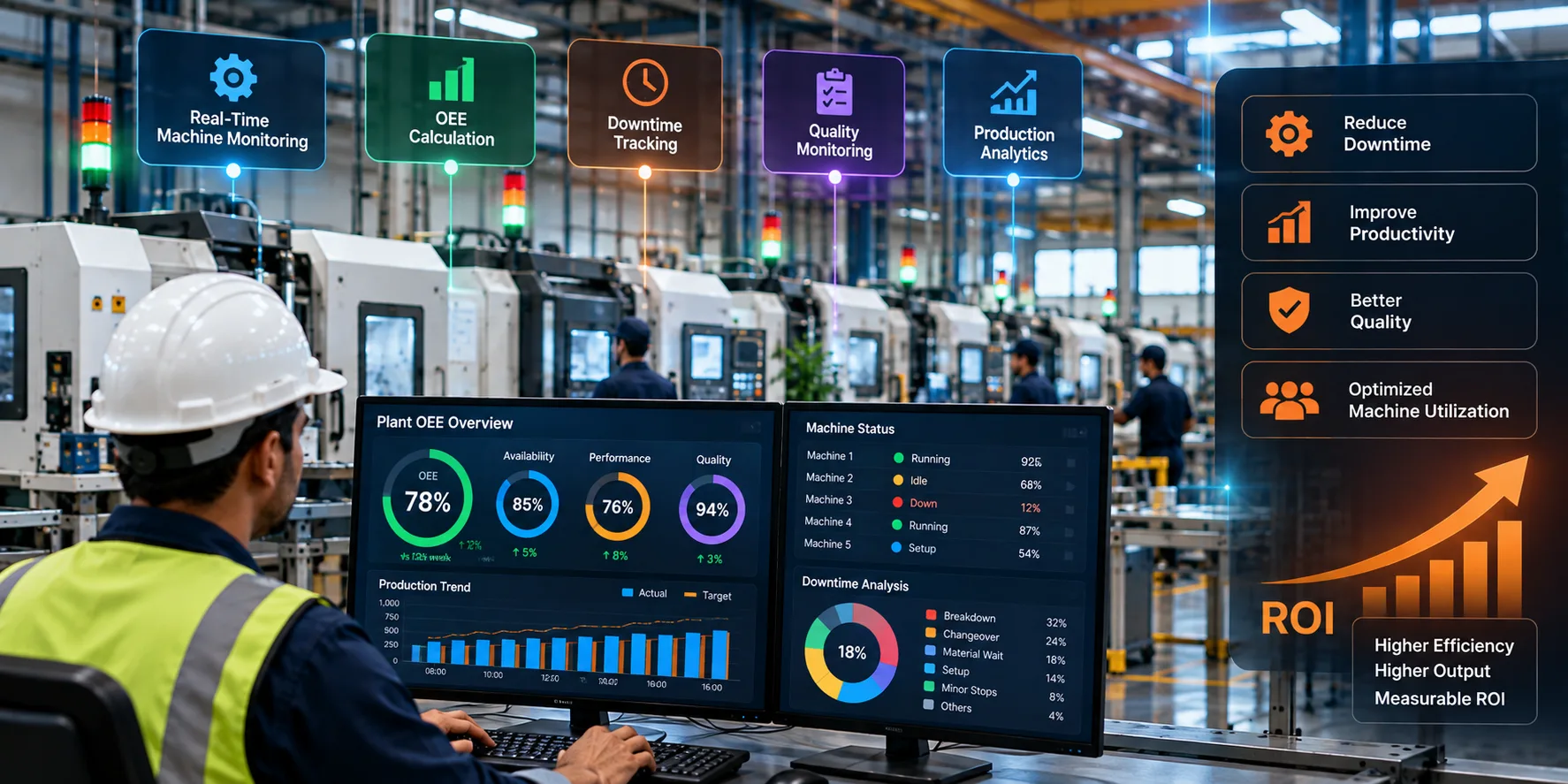
A modern OEE system can provide visibility into machine status during active production.
Depending on the implementation, users may be able to monitor:
Running machines
Idle machines
Machines in downtime
Production counts
Current production rate
Active downtime
Shift performance
Real-time visibility can help production teams identify issues while a shift is still in progress.
2. OEE Calculation
The core function of an OEE system is to calculate equipment effectiveness using availability, performance and quality.
The system can present OEE at different levels, such as:
Machine
Production line
Department
Shift
Product
Plant
This allows different users to review performance according to their responsibilities.
3. Downtime Monitoring
Downtime is one of the most important sources of production loss.
An OEE system can capture and categorize downtime events based on the available machine and production data.
Common categories may include:
Equipment breakdown
Setup
Changeover
Material shortage
Maintenance
Quality-related stoppage
Operator-related stoppage
Other production interruptions
Analyzing these events can help teams understand where available production time is being lost.
4. Production Target Monitoring
Production teams need to know whether actual output is keeping pace with the planned target.
An OEE dashboard can compare:
Target Production vs. Actual Production
This provides a straightforward view of whether the current production rate is sufficient to achieve the shift or order target.
5. Quality Monitoring
Quality should be evaluated alongside machine availability and production performance.
An OEE system can track:
Total production
Good quantity
Rejected quantity
Rejection percentage
Quality-related losses
This prevents production volume from being evaluated without considering the quality of the output.
6. Shift-Wise OEE Monitoring
Manufacturing plants often operate across multiple shifts.
An OEE system can provide shift-level information including:
OEE
Availability
Performance
Quality
Production output
Downtime
Target achievement
This can help managers identify performance patterns and investigate differences between shifts.
7. Historical Production Analytics
Real-time data tells teams what is happening now. Historical data helps them understand what has been happening over time.
An OEE system can maintain historical information for analysis across:
Days
Weeks
Months
Shifts
Machines
Production lines
This can help identify recurring losses and long-term performance trends.
How an OEE System Collects Manufacturing Data
An OEE system needs reliable production information to calculate meaningful metrics.
Depending on the factory's existing infrastructure, data may be collected from:
PLCs
Machine controllers
Sensors
Production counters
Industrial gateways
Operator input
APIs
Existing manufacturing databases
Other connected equipment
The appropriate method depends on the machine architecture and the data available from each production asset.
A typical architecture can be represented as:
Machine → Data Collection → Processing → OEE Calculation → Dashboard → Analysis
The goal is to create a consistent flow of production information from the shop floor to the people responsible for managing performance.
OEE Dashboard for Factory Managers
Factory managers typically need a combination of high-level visibility and detailed information.
A manufacturing OEE dashboard can provide an overview of:
Plant OEE
Line OEE
Machine status
Production output
Downtime
Quality
Target achievement
Performance trends
The dashboard can then allow users to investigate specific machines or production lines when an abnormal result appears.
This creates a hierarchy of information:
Plant → Production Line → Machine → Production Event
Such visibility can make it easier to move from identifying a performance issue to investigating its underlying cause.
Using OEE to Identify Production Losses
The real value of an OEE system comes from understanding the losses behind the KPI.
Suppose a machine has an OEE of 70%.
That number alone does not explain what is happening.
The team needs to determine whether the lower OEE is primarily caused by:
Low availability
Reduced production speed
Quality losses
Long changeovers
Frequent minor stoppages
Equipment breakdowns
An effective OEE monitoring system should therefore provide access to the supporting production data rather than displaying OEE as an isolated number.
OEE and Production Efficiency
OEE can serve as an important indicator of production efficiency because it combines multiple dimensions of equipment performance.
However, OEE should be interpreted within the context of the actual production process.
A machine producing different products may have different standard cycle times. Planned maintenance or changeovers may also affect availability.
For this reason, an OEE system should be configured according to the plant's production rules, equipment characteristics and operating requirements.
The objective is to create meaningful measurements rather than simply maximize a percentage.
How an OEE System Can Support ROI
Implementing manufacturing software requires investment in technology, integration, implementation and user adoption.
The business case should therefore consider measurable operational benefits.
Potential sources of value include:
Reduced unplanned downtime
Improved machine utilization
Better production visibility
Reduced production losses
Improved quality monitoring
Reduced manual reporting effort
Better production planning
Faster identification of performance issues
More measurable continuous improvement
The actual financial return will vary significantly between plants.
An OEE system should therefore be evaluated using the plant's own production data rather than relying on a generic ROI percentage.
Calculating the Potential ROI of an OEE System
A simple ROI framework can help organizations evaluate the business case.
One approach is:
ROI = (Financial Benefit − Implementation Cost) ÷ Implementation Cost × 100
Potential financial benefits may come from measurable improvements such as:
Additional productive machine hours
Increased production output
Reduced scrap
Reduced downtime
Lower manual reporting costs
Improved machine utilization
For example, if a plant identifies a recurring downtime problem and reduces it after implementing a structured monitoring and improvement process, the additional productive capacity can be assigned a financial value.
The calculation should use realistic plant-specific assumptions.
Example: Understanding the Financial Impact of Downtime
Consider a machine that is scheduled for production for 20 hours per day.
If recurring unplanned downtime results in two hours of lost production time, the plant is losing 10% of the scheduled production window for that machine.
If production efficiency improves and part of that lost time is recovered, the plant may gain additional productive capacity without purchasing another machine.
The financial impact will depend on factors such as:
Production rate
Contribution margin
Product value
Number of affected machines
Frequency of downtime
Recovery percentage
This is why production data is important when building an OEE business case.
This does not mean manual reporting becomes irrelevant. Operators and supervisors can still provide important context that machine data alone may not capture.
The goal is to combine reliable production data with operational knowledge.
OEE System Integration with Existing Equipment
A major consideration for manufacturers is whether existing equipment can be connected.
Many plants contain machines from different manufacturers and different generations.
An OEE system may need to work with:
Modern PLC-controlled equipment
Older machines
Production counters
Sensors
Industrial controllers
Existing databases
The integration approach depends on what data is available from each machine.
A phased implementation can allow organizations to begin with selected machines or production lines before expanding across the plant.
OEE for Multiple Production Lines
Large manufacturing plants may need to monitor multiple production lines simultaneously.
A centralized OEE system can allow managers to compare:
Line performance
Machine OEE
Production output
Downtime
Quality
Target achievement
This can help identify which production areas require additional attention.
It can also provide leadership with a consistent framework for comparing manufacturing performance across departments.
OEE for Continuous Improvement
OEE can support continuous improvement by providing measurable performance indicators.
A typical improvement cycle can be:
Measure → Identify Loss → Analyze Cause → Implement Improvement → Measure Again
For example, if downtime is identified as a major contributor to poor OEE, a team can investigate the highest-frequency downtime causes.
After corrective action, the same metrics can be monitored to determine whether the situation has improved.
This creates a measurable feedback loop for manufacturing improvement initiatives.
What Should You Consider Before Implementing an OEE System?
Before selecting an OEE platform, manufacturers should understand their operational requirements.
Important questions include:
Which machines need to be monitored?
What production data is currently available?
How is downtime recorded?
How are production targets defined?
What quality information is available?
Which KPIs should management monitor?
Which systems need integration?
How many users will access the platform?
Does the system need multi-line or multi-plant support?
What improvement objectives will be measured?
Answering these questions can help prevent the implementation from becoming focused only on technology.
Common Mistakes When Implementing OEE
Focusing Only on the OEE Percentage
A single OEE number does not explain the cause of a production loss.
Ignoring Data Quality
Incorrect machine counts, cycle times or production inputs can lead to misleading results.
Measuring Everything Without a Purpose
Collecting large amounts of data does not automatically create better decisions.
Not Defining Standard Production Conditions
OEE calculations require clear definitions around planned production time, ideal cycle time and quality output.
Treating OEE as an Operator Ranking Tool
OEE is primarily a process and equipment performance measurement. Using it only to rank operators can create the wrong incentives.
Failing to Act on the Data
The value of monitoring comes from using the information to investigate and improve production performance.
Building a Scalable OEE Monitoring Strategy
Manufacturing digitalization does not always need to happen across the entire plant at once.
A practical approach can begin with a pilot area.
For example:
Phase 1: Select critical machines
Phase 2: Connect production data
Phase 3: Establish OEE baselines
Phase 4: Identify major losses
Phase 5: Implement improvements
Phase 6: Measure results
Phase 7: Expand to additional production areas
This approach allows the organization to validate the system, refine measurement rules and demonstrate operational value before scaling.
Long-Term Benefits of an OEE System
When consistently used, an OEE system can become part of the plant's broader production management strategy.
Over time, historical data can help organizations understand:
Equipment performance trends
Recurring downtime
Production capacity
Quality losses
Machine utilization
Shift performance
Improvement results
This information can support future production planning and continuous improvement initiatives.
The long-term objective is to create a manufacturing environment where production decisions are supported by reliable operational data.
Final Thoughts
An OEE System for Manufacturing can provide more than a dashboard showing availability, performance, quality and OEE.
When properly implemented, it can provide a structured way to understand machine performance, identify production losses, monitor operational trends and measure improvement initiatives.
For factory managers, the business case should focus on measurable operational outcomes such as reduced downtime, improved machine utilization, better production visibility and reduced losses.
The best OEE implementation is not necessarily the one with the most features. It is the one that provides reliable information, fits the plant's existing infrastructure and helps teams take meaningful action on production performance.
Evaluate Your Manufacturing OEE Requirements
If you are looking to improve machine visibility, understand production losses and build a more measurable approach to manufacturing performance, an OEE system can provide the foundation.
Request a Consultation to discuss your production environment, machine data and OEE monitoring requirements.