
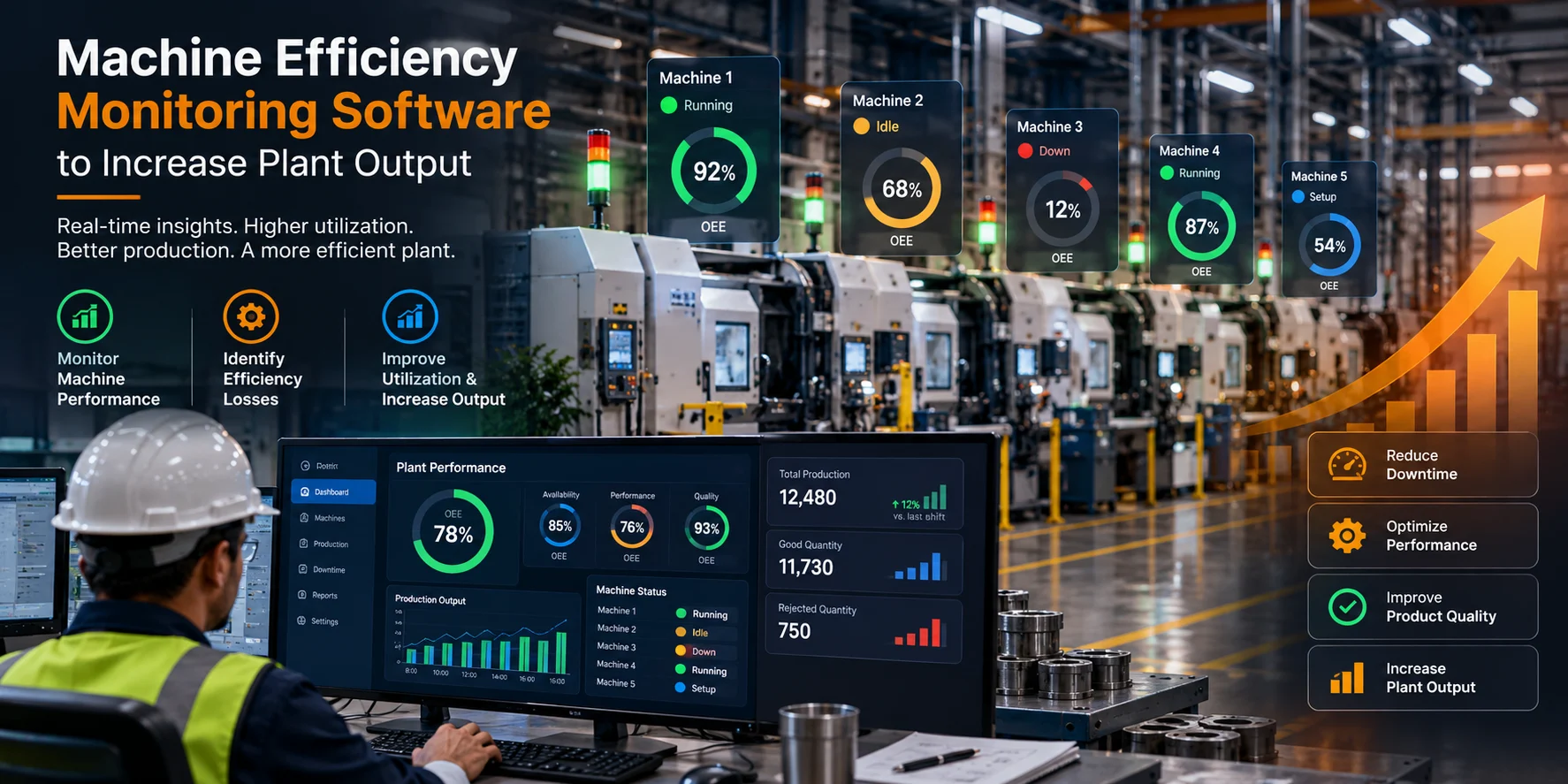
Machine Efficiency Monitoring Software to Increase Plant Output
Manufacturing plants can have the right machines, skilled operators, and established production processes, yet still struggle to achieve their expected output. The reason is often not a lack of production capacity but limited visibility into how effectively machines are actually being used.
Machines may spend time waiting for materials, operating below their standard speed, experiencing minor stoppages, undergoing unplanned downtime, or producing rejected parts. When these losses are not measured consistently, they can remain hidden within daily production numbers.
Machine efficiency monitoring software helps manufacturing teams understand how equipment is performing during actual production. By collecting and analyzing machine and production data, organizations can identify efficiency losses, monitor utilization, compare equipment performance, and take informed action to improve plant output.
What Is Machine Efficiency Monitoring Software?
Machine efficiency monitoring software is a digital manufacturing solution designed to track how effectively production equipment is being utilized.
Instead of relying entirely on manually recorded production sheets, the software can collect machine and production information from connected equipment and present it through dashboards and reports.
Depending on the manufacturing environment, the system can monitor information such as:
Machine running and idle status
Production quantity
Production targets
Machine downtime
Cycle time
Planned and unplanned stoppages
Good and rejected production
Availability
Performance
OEE
Shift-wise production
Machine utilization
This information gives production teams a clearer understanding of where available machine capacity is being lost.
Why Machine Efficiency Matters in Manufacturing
Increasing production output does not always require purchasing additional machines.
In many plants, existing equipment has unused or underutilized capacity. The challenge is identifying where that capacity is being lost.
For example, a machine may be scheduled to operate for eight hours but experience:
45 minutes of breakdowns
30 minutes of changeover
20 minutes waiting for material
15 minutes of minor stoppages
Reduced operating speed during production
Although the machine was technically scheduled for the entire shift, its productive operating time can be significantly lower.
Machine efficiency monitoring makes these losses more visible.
Once losses are measured, production teams can investigate their causes and determine which issues require attention.
How Machine Efficiency Monitoring Works
A typical machine efficiency monitoring system follows a structured data flow:
Machine → Data Collection → Processing → Efficiency Calculation → Dashboard → Analysis → Corrective Action
Machine data can be collected through different sources depending on the equipment and existing factory infrastructure.
These may include:
PLCs
Machine controllers
Sensors
Production counters
Industrial gateways
APIs
Existing manufacturing systems
The collected information can then be processed and displayed through a centralized monitoring platform.
This allows production teams to view current and historical machine performance without depending entirely on manual data consolidation.
Key Machine Efficiency Metrics to Monitor
Effective machine monitoring requires more than simply knowing whether equipment is running.
Several metrics can provide a more complete picture of machine productivity.
Machine Availability
Availability measures how much of the planned production time a machine was actually available for operation.
Low availability may be associated with:
Equipment breakdowns
Setup activities
Changeovers
Material shortages
Maintenance
Operator-related waiting
Other production interruptions
Monitoring availability helps identify where production time is being lost.
Machine Performance
A machine can be running while still producing below its expected rate.
Performance monitoring compares actual production behavior against defined production standards.
This can reveal:
Slow cycle times
Reduced machine speed
Frequent minor stops
Production below standard rate
Variation in machine output
Understanding these losses is particularly useful when a machine appears operational but is not delivering its expected production capacity.
Quality Performance
Machine efficiency should also consider whether the output meets quality requirements.
Monitoring good and rejected quantities helps production teams understand whether efficiency losses are related to quality problems.
A machine producing large quantities with a high rejection rate may not be delivering effective production output.
OEE
Overall Equipment Effectiveness combines:
Availability × Performance × Quality
OEE can therefore provide a broader view of equipment effectiveness rather than focusing on only one operational metric.
However, the OEE percentage itself should be supported by detailed loss information so teams can understand what is affecting performance.
Identify Hidden Production Losses
One of the most useful capabilities of machine efficiency monitoring software is its ability to make hidden losses more visible.
Production losses can occur in small increments throughout a shift.
A machine might stop for two minutes several times during production. Each individual event may appear insignificant, but the accumulated downtime can become substantial over a week or month.
Similarly, operating slightly below the expected cycle time may have a significant effect on total production output when repeated across thousands of cycles.
By capturing these events systematically, production teams can identify patterns that may otherwise be difficult to see through manual reporting.
Monitor Machine Performance in Real Time
Historical reports are useful for analyzing completed production, but production managers also need visibility into what is happening during an active shift.
A machine efficiency monitoring dashboard can provide real-time information such as:
Current machine status
Current production count
Target versus actual production
Current OEE
Downtime duration
Active downtime reason
Production rate
Shift performance
This allows supervisors to identify deviations from expected performance while production is still underway.
The objective is not simply to display more information. It is to make important production information available at the time when it can support operational decisions.
Compare Machine Efficiency Across the Plant
When a plant contains multiple machines performing similar operations, comparing their performance can reveal valuable differences.
For example, two machines may have similar specifications but different production results.
A machine efficiency dashboard can help compare:
OEE by machine
Production output
Availability
Performance
Quality
Downtime
Cycle time
Utilization
Shift performance
This comparison can help teams determine which equipment requires deeper investigation.
The results should be interpreted alongside machine type, product mix, operating conditions, and production requirements rather than relying on a single metric.
Machine Efficiency Monitoring for Production Planning
Production planning depends heavily on knowing the actual capacity of available equipment.
If planners rely only on theoretical machine capacity, production schedules may not accurately reflect real operating conditions.
Machine efficiency data can provide historical information about:
Actual production rates
Typical downtime
Machine utilization
Average cycle times
Changeover duration
Historical output
This information can support more informed production planning.
Instead of planning around theoretical capacity alone, teams can consider observed production performance when evaluating production schedules and available capacity.
Reduce Unplanned Downtime
Unplanned downtime directly reduces available production time.
Machine efficiency monitoring software can help make downtime events visible by recording when equipment stops and, where configured, capturing the corresponding downtime reason.
Over time, historical downtime information can reveal recurring patterns.
For example, a plant may discover that a particular machine frequently stops because of:
Material feeding problems
Tool changes
Sensor issues
Mechanical failures
Quality-related stoppages
Operator interventions
This information can support maintenance and production teams when prioritizing investigations.
Improve Shift Performance Visibility
Machine performance can vary from one shift to another.
A machine that consistently achieves its target during one shift but falls below target during another requires further investigation.
Shift-wise machine efficiency monitoring can provide information such as:
Production by shift
OEE by shift
Downtime by shift
Machine utilization
Production target achievement
Rejection quantity
Performance losses
This provides production managers with a structured way to review differences in operational performance.
The objective should be to identify process conditions and operational causes rather than simply comparing operators or shifts without context.
Use Historical Data to Identify Performance Trends
Real-time monitoring shows what is happening now, while historical data helps explain how performance changes over time.
A machine efficiency monitoring system can store production information for analysis across:
Days
Weeks
Months
Shifts
Machines
Production lines
Products
Trend analysis can reveal whether machine performance is improving, declining, or remaining stable.
For example, a gradual reduction in availability over several weeks may indicate a developing maintenance issue that deserves investigation.
Similarly, a recurring reduction in performance after a particular changeover may point toward a process optimization opportunity.
Machine Efficiency Monitoring and OEE
Machine efficiency monitoring and OEE monitoring are closely connected, but they are not necessarily identical.
Machine efficiency monitoring focuses on understanding equipment utilization and production performance.
OEE provides a structured measurement based on:
Availability
Performance
Quality
A modern manufacturing monitoring platform can combine both approaches.
This gives production teams a broader view:
Machine Status → Production Output → Losses → OEE → Performance Analysis
The combination allows teams to move beyond a single efficiency percentage and investigate the factors affecting production performance.
Benefits of Machine Efficiency Monitoring Software
Implementing machine efficiency monitoring can support several areas of manufacturing operations.
Better Production Visibility
Production teams gain a centralized view of machine and production performance.
Faster Identification of Performance Issues
Real-time information can make abnormal machine behavior easier to identify during production.
Improved Downtime Visibility
Downtime events can be captured and analyzed instead of relying solely on manually recorded stoppage information.
Better Capacity Understanding
Historical machine performance can provide a more realistic picture of actual production capacity.
Data-Driven Continuous Improvement
Production teams can use measured performance and loss data to identify areas for investigation.
Reduced Dependence on Manual Reports
Automated data collection and dashboards can reduce the amount of manual effort required to consolidate production information.
Improved Production Decision-Making
Managers can use current and historical performance data when reviewing production conditions and improvement opportunities.
What Should You Look for in Machine Efficiency Monitoring Software?
Every manufacturing plant has different machines, processes and data requirements. Therefore, software should be evaluated according to the actual operating environment.
Important capabilities may include:
Real-time machine monitoring
Machine status tracking
Production counter integration
Downtime monitoring
OEE calculation
Availability and performance tracking
Quality monitoring
Shift-wise analysis
Historical trend analysis
Production target monitoring
Multi-machine dashboards
Production reports
Role-based access
Integration with PLCs and existing systems
Scalability is also important for plants that expect to add additional machines or production lines over time.
Integrating Existing Machines
A common concern during manufacturing digitalization is whether existing machines need to be replaced.
In many cases, machine efficiency monitoring can be implemented around the equipment already installed in the plant.
Depending on the machine architecture, data may be obtained through existing PLCs, controllers, sensors, production counters or suitable industrial communication methods.
This allows organizations to approach monitoring as a gradual improvement rather than treating digitalization as an all-or-nothing replacement project.
The appropriate integration method depends on the machine's age, controller, available interfaces and the type of information required.
From Machine Data to Production Improvement
Collecting machine data is only the first step.
The real value comes from converting that information into actionable production insight.
A practical improvement cycle can look like this:
Monitor → Measure → Identify Loss → Investigate → Improve → Verify
For example, if a machine repeatedly experiences extended downtime during a particular shift, the team can investigate the underlying reason.
After implementing a corrective action, the same metrics can be monitored to determine whether the condition has improved.
This creates a measurable approach to continuous improvement.
Who Can Use Machine Efficiency Monitoring Software?
Machine efficiency monitoring can support different manufacturing roles.
Production Managers can monitor machine output, targets and performance.
Production Heads can review performance across multiple production areas.
Plant Managers can monitor overall equipment utilization and production efficiency.
Maintenance Teams can use downtime information to identify recurring equipment-related issues.
Continuous Improvement Teams can analyze machine losses and performance trends.
Operations Leadership can review summarized manufacturing KPIs and plant-level performance.
Each role can use the same underlying production data for different operational decisions.
Machine Efficiency Monitoring for Modern Manufacturing
Manufacturing operations are becoming increasingly data-driven.
As plants adopt connected machines, industrial automation, digital production systems and Industry 4.0 technologies, the ability to capture and use machine data becomes increasingly important.
Machine efficiency monitoring provides a foundation for this transformation by connecting equipment performance with production visibility.
When machine data is consistently captured, organizations can build additional capabilities around:
Production analytics
OEE monitoring
Predictive maintenance initiatives
Digital production reporting
Production planning
Performance benchmarking
Continuous improvement
The implementation should be aligned with the plant's actual operational goals rather than collecting data simply because it is available.
Final Thoughts
Improving plant output does not always mean adding more machines or increasing production hours.
Before investing in additional capacity, manufacturers can benefit from understanding how effectively their existing equipment is being utilized.
Machine efficiency monitoring software provides a structured way to monitor machine status, production output, downtime, performance, quality and OEE.
With real-time visibility and historical production data, manufacturing teams can identify hidden losses, investigate recurring problems and make better-informed decisions about equipment utilization and production improvement.
For plants looking to improve production visibility and make better use of existing manufacturing capacity, machine efficiency monitoring can provide an important foundation for continuous improvement.
Improve Your Machine Performance Visibility
Want to understand where your machines are losing productive time and how your plant is performing against production targets?
Request a Demo to explore how machine efficiency monitoring can help your production team monitor equipment performance and identify opportunities for improvement.