Logistics Weighbridge Software for Fleet Operations
Introduction
The logistics industry relies on speed, accuracy, and efficient fleet management to ensure goods are delivered on time. Every day, logistics companies, warehouses, distribution centers, and transportation businesses manage hundreds or even thousands of trucks carrying raw materials, finished products, and commercial goods. As fleet sizes grow, manual weighbridge operations often become a bottleneck, causing delays, paperwork errors, vehicle congestion, and poor operational visibility.
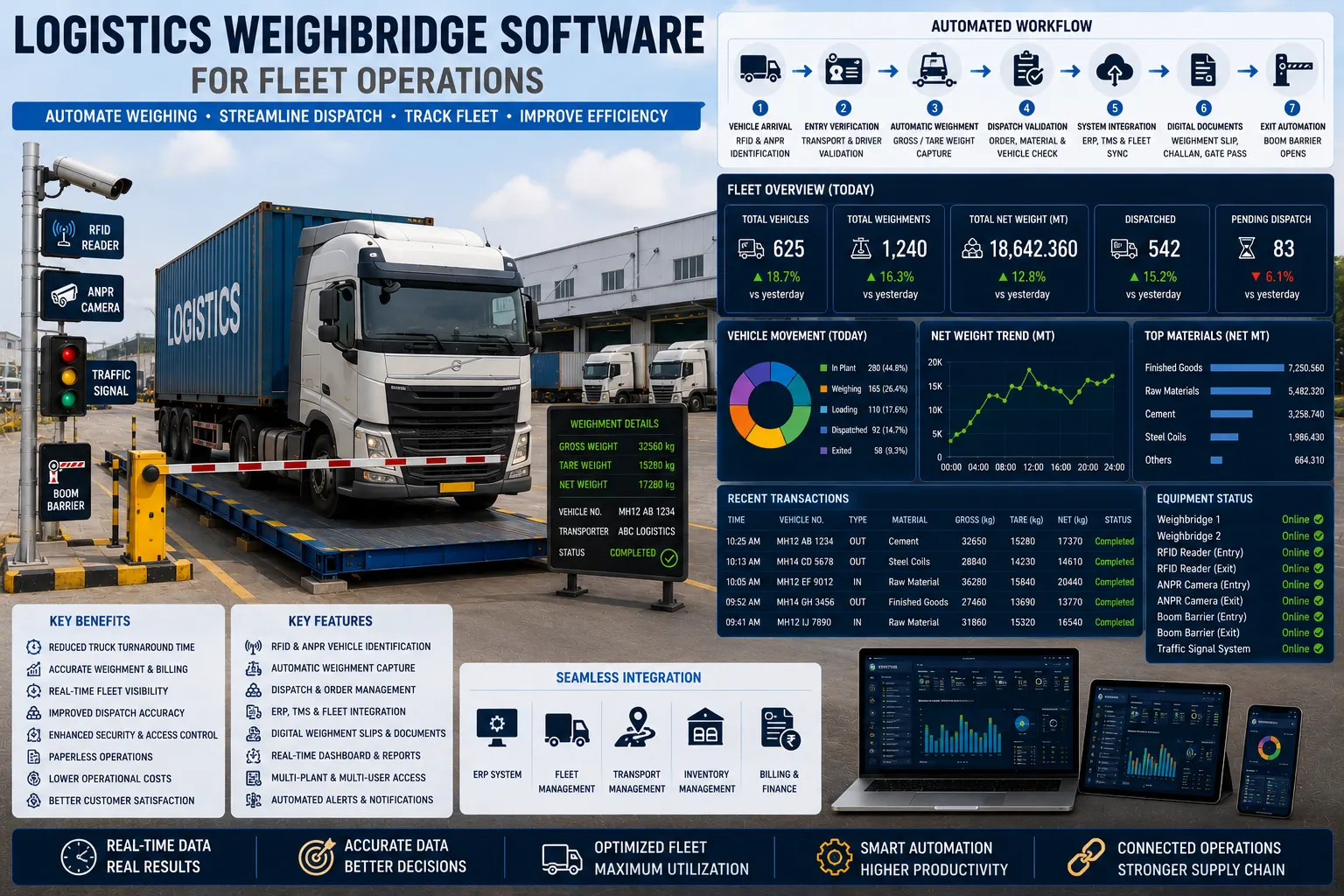
Logistics Weighbridge Software simplifies fleet operations by automating truck weighing, vehicle identification, dispatch management, and real-time reporting. By integrating RFID technology, ANPR cameras, boom barriers, ERP systems, and fleet management platforms, businesses can eliminate manual processes and gain complete control over vehicle movement.
With real-time insights into fleet activities, organizations can reduce turnaround times, improve dispatch accuracy, enhance security, and optimize transportation efficiency across the supply chain.
What is Logistics Weighbridge Software?
Logistics Weighbridge Software is an intelligent automation solution that manages vehicle weighing and fleet movement throughout logistics operations.
The software automatically captures vehicle weights, validates transport details, updates dispatch records, and synchronizes information with ERP and fleet management systems.
A complete logistics weighbridge solution typically includes:
RFID Vehicle Identification
ANPR Camera Integration
Boom Barrier Automation
Fleet Management Integration
Dispatch Management
ERP & Transport Management System (TMS) Integration
Live Dashboard & Reporting
These technologies work together to streamline fleet operations while improving data accuracy and operational efficiency.
Challenges in Manual Fleet Weighment
Many logistics organizations still rely on manual weighbridge processes, resulting in operational inefficiencies.
Long Vehicle Waiting Times
Manual verification creates congestion at weighbridges and dispatch points.
Delayed Dispatch
Slow vehicle processing impacts delivery schedules and customer commitments.
Inaccurate Documentation
Manual paperwork often leads to incorrect transport records and billing issues.
Limited Fleet Visibility
Managers cannot track vehicle movement in real time.
Higher Operating Costs
Manual processes require additional manpower and increase administrative expenses.
How Logistics Weighbridge Software Works
Step 1: Vehicle Registration
Fleet vehicles are registered with RFID tags and linked to transport and dispatch records.
Step 2: Automated Vehicle Entry
As trucks arrive, RFID readers automatically identify the vehicle while ANPR cameras verify the registration number.
The system checks transport schedules and dispatch authorization before allowing entry.
Step 3: Automatic Weighment
The vehicle passes over the weighbridge, where weight data is captured automatically without manual intervention.
Step 4: Dispatch Validation
The software verifies:
Vehicle Information
Driver Details
Transport Order
Shipment Details
Customer Information
Material Weight
Step 5: System Integration
Weighment data is synchronized with:
ERP Software
Fleet Management System
Transport Management System (TMS)
Inventory Software
Billing System
Step 6: Dispatch & Exit
After verification, dispatch documents are generated automatically, and the boom barrier opens for vehicle departure.
Key Features of Logistics Weighbridge Software
Automated Vehicle Identification
Identify fleet vehicles instantly using RFID technology.
Automatic Weight Capture
Record accurate weight data without manual input.
Fleet Tracking
Monitor truck movement from entry to dispatch.
Dispatch Automation
Streamline dispatch approvals and shipment processing.
ERP & TMS Integration
Automatically synchronize logistics data across business systems.
Digital Documentation
Generate:
Weighment Slips
Delivery Challans
E-Way Bill References
Dispatch Reports
Gate Passes
Shipment Records
Real-Time Dashboard
Monitor fleet performance, weighbridge utilization, dispatch status, and vehicle movement from a centralized dashboard.
Advanced Reporting
Generate reports for fleet utilization, weighment history, vehicle turnaround time, and dispatch performance.
Benefits of Logistics Weighbridge Software
Faster Fleet Turnaround
Reduce truck waiting time and increase daily vehicle throughput.
Improved Dispatch Accuracy
Ensure shipments are dispatched using verified weighment data.
Better Fleet Visibility
Track every vehicle from arrival to departure in real time.
Reduced Human Errors
Automate weight capture and eliminate manual documentation mistakes.
Enhanced Security
Prevent unauthorized vehicle movement using RFID and ANPR verification.
Lower Operational Costs
Reduce paperwork, manual labor, and administrative tasks.
Accurate Billing
Generate invoices based on verified vehicle and material weights.
Data-Driven Decision Making
Access live dashboards and analytics for better logistics planning.
Industries That Benefit from Logistics Weighbridge Software
Third-Party Logistics (3PL)
Manage high-volume fleet operations with greater efficiency.
Warehousing & Distribution
Automate inbound and outbound truck processing.
Manufacturing
Coordinate raw material deliveries and finished goods dispatch.
Retail Supply Chains
Track distribution vehicles and improve delivery performance.
Cement & Construction
Manage transportation of bulk construction materials.
Mining & Quarry Operations
Monitor heavy vehicle movement and dispatch activities.
Steel & Metal Industries
Track transport vehicles carrying raw materials and finished products.
Best Practices for Successful Implementation
To maximize operational efficiency:
Register all fleet vehicles with RFID tags.
Integrate weighbridge software with ERP and TMS platforms.
Install ANPR cameras at facility entry and exit points.
Enable automatic boom barrier control.
Configure live dashboards for logistics teams.
Monitor fleet KPIs regularly.
Schedule periodic weighbridge calibration and preventive maintenance.
Future Trends in Logistics Weighbridge Software
Artificial Intelligence
AI will optimize fleet scheduling, identify delays, and recommend efficient dispatch routes.
Internet of Things (IoT)
Connected devices will continuously monitor weighbridge equipment, vehicle flow, and system performance.
Cloud-Based Fleet Management
Organizations will monitor logistics operations across multiple locations through centralized cloud dashboards.
Predictive Analytics
Historical fleet data will help forecast dispatch demand and optimize vehicle utilization.
Digital Supply Chain Integration
Weighbridge software will become part of fully connected supply chain ecosystems, enabling end-to-end logistics visibility.
Why Logistics Companies Should Invest in Weighbridge Software
Efficient fleet operations are essential for reducing transportation costs and improving customer satisfaction. By automating weighbridge operations, logistics companies can eliminate bottlenecks, increase fleet productivity, and gain complete visibility into vehicle movement.
Organizations implementing logistics weighbridge software often achieve:
Reduced truck turnaround time
Improved fleet utilization
Faster dispatch processing
Better shipment accuracy
Enhanced operational transparency
Lower administrative costs
Increased customer satisfaction
Stronger compliance and audit readiness
Conclusion
As logistics operations continue to expand, manual weighbridge management is no longer capable of supporting high-volume fleet movement efficiently. Logistics Weighbridge Software provides an integrated platform for automating truck weighing, vehicle identification, dispatch management, and reporting while connecting seamlessly with ERP and transport management systems.
By implementing intelligent weighbridge automation, logistics companies can improve fleet efficiency, reduce operational costs, enhance shipment accuracy, and deliver superior customer service. It is a key investment for organizations aiming to build a smarter and more efficient logistics network.
Frequently Asked Questions (FAQs)
What is Logistics Weighbridge Software?
Logistics Weighbridge Software is an automation solution that manages truck weighing, fleet tracking, dispatch operations, and logistics reporting through a centralized platform.
How does logistics weighbridge software improve fleet operations?
It automates vehicle identification, weighment, dispatch processing, and reporting, helping businesses reduce delays and improve fleet efficiency.
Can logistics weighbridge software integrate with ERP and TMS systems?
Yes. Modern solutions integrate with ERP platforms, Transport Management Systems (TMS), fleet management software, and billing applications.
Which industries benefit from logistics weighbridge software?
Third-party logistics providers, warehouses, manufacturing companies, retail supply chains, mining operations, cement plants, and steel industries all benefit from automated weighbridge management.
What are the advantages of logistics weighbridge software?
Benefits include faster truck processing, real-time fleet visibility, accurate billing, automated reporting, improved security, reduced paperwork, and better operational efficiency.