Industrial OEE System for Industry 4.0 Manufacturing Plants
Manufacturing is becoming increasingly connected. Production equipment generates operational data, automation systems control machine processes, and digital platforms help teams monitor performance across the factory floor.
Yet having connected machines does not automatically mean a plant has complete visibility into its production performance.
Manufacturing directors still need reliable answers to important operational questions. Are machines operating at their expected rates? Where is productive time being lost? Which production lines are falling behind their targets? How effectively is existing equipment being utilized?
An Industrial OEE System helps address these questions by connecting equipment performance data with production monitoring and analytics.
For manufacturers pursuing Industry 4.0 , an industrial OEE system can provide an important link between shop-floor operations and data-driven decision-making. It turns machine activity into structured performance information that production, maintenance and management teams can use to understand operational losses.
The objective is not simply to digitize existing reports. It is to establish a more consistent way to measure equipment effectiveness, identify production problems and evaluate improvement initiatives.
What Is an Industrial OEE System?
An industrial OEE system is a manufacturing monitoring solution designed to measure Overall Equipment Effectiveness across machines, production lines and, where supported, multiple facilities.
OEE stands for Overall Equipment Effectiveness. It evaluates equipment performance through three components:
OEE = Availability × Performance × Quality
Availability
Availability measures the proportion of planned production time during which equipment is available for production.
It helps reveal losses associated with breakdowns, setup activities and other production interruptions.
Performance
Performance measures how closely equipment operates against its expected production rate.
It helps identify reduced operating speed, longer cycle times and minor stoppages.
Quality
Quality measures the proportion of output that meets the required specification.
It helps quantify the impact of rejected products, scrap and other quality losses.
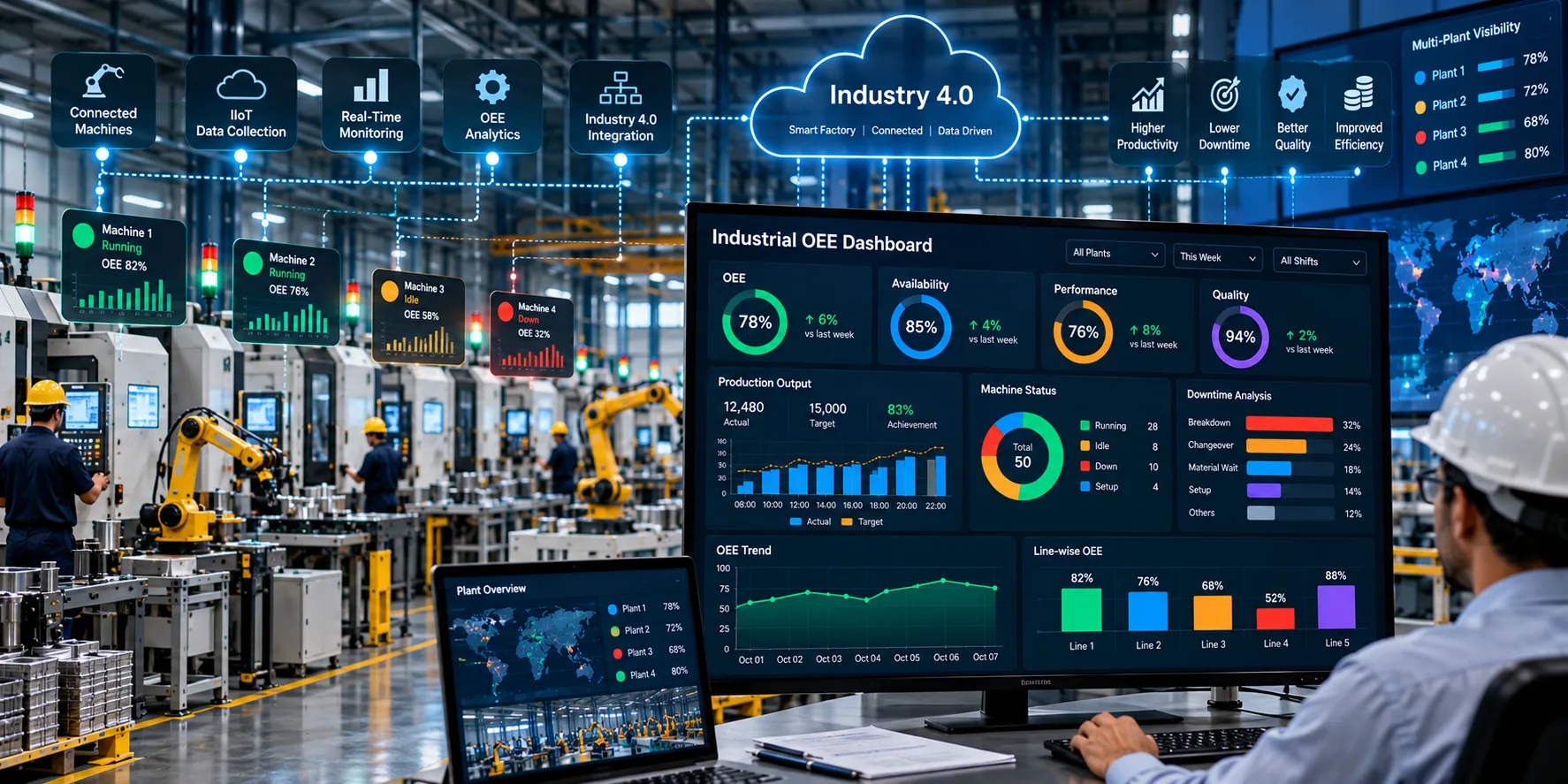
An industrial OEE system collects or receives the data required to calculate these measurements and presents the results through dashboards, reports and historical analytics.
Depending on the implementation, it may also support machine status monitoring, downtime tracking, shift-wise analysis and production target monitoring.
Why OEE Matters in Industry 4.0
Industry 4.0 focuses on the use of connected technologies, automation, data and digital systems to improve manufacturing operations.
However, collecting machine data is only one part of the transformation. Organizations also need to interpret that data in a way that supports operational decisions.
For example, a connected machine may provide information about its running state and production count. Without a structured monitoring system, that information may remain isolated from the production reports used by supervisors and plant managers.
An industrial OEE system helps connect machine-level data with manufacturing performance indicators.
This allows organizations to move toward:
More consistent production measurement
Better visibility into machine performance
Structured downtime analysis
Historical performance tracking
Production-line comparisons
Data-supported continuous improvement
More informed capacity planning
OEE is therefore a practical measurement framework for manufacturers who want to turn connected equipment data into operational insight.
How an Industrial OEE System Works
A typical industrial OEE monitoring workflow connects equipment, data collection, calculations and dashboards.
Industrial Machines → Data Collection → Production Data Processing → OEE Calculation → Dashboard and Reports → Operational Decisions
Step 1: Collect Machine Data
Production information may come from PLCs, machine controllers, sensors, production counters or other available interfaces.
The appropriate method depends on the equipment and the signals required.
Step 2: Process Production Information
The system organizes the collected data according to configured machine settings, production schedules, cycle times and quality information.
Step 3: Calculate OEE
Availability, performance and quality are calculated using the defined production rules.
Consistent rules are essential when comparing equipment or production lines.
Step 4: Display Performance Information
Dashboards and reports present machine status, OEE, production output, downtime and related KPIs.
Step 5: Investigate and Improve
Production and maintenance teams use the information to identify abnormal conditions, investigate losses and measure the results of corrective actions.
This process establishes a connection between the physical production environment and the digital systems used to manage manufacturing performance.
Essential Features of an Industrial OEE System
The features required will depend on the size of the plant, its automation infrastructure and its production objectives. Several capabilities are particularly valuable.
1. Real-Time Machine Monitoring
Real-time or near-real-time monitoring provides visibility into current machine activity.
Depending on the available data, the system may display:
Machine running status
Idle equipment
Downtime events
Production counts
Current production rate
Shift progress
Machine-level OEE
This helps supervisors identify operational issues without relying exclusively on end-of-shift reports.
The actual update frequency depends on data collection, connectivity and system configuration.
2. Automated OEE Calculation
An industrial OEE system can calculate equipment effectiveness using consistent production rules.
This reduces the need for separate manual calculations and provides a common measurement framework across monitored equipment.
For meaningful comparisons, manufacturers should ensure that planned production time, ideal cycle time and quality definitions are configured correctly.
3. Downtime Monitoring
Downtime monitoring helps quantify when equipment is unavailable and, where the necessary information is collected, why interruptions occur.
Common categories include:
Equipment breakdown
Setup and changeover
Material shortages
Maintenance
Quality-related stoppages
Other production interruptions
Analyzing downtime duration and frequency helps teams identify recurring losses and determine which events deserve investigation.
4. Production Target Tracking
A production monitoring system can compare planned output with actual production.
This provides visibility into whether machines and production lines are progressing toward their shift or order targets.
When output falls behind plan, teams can review downtime, machine speed and quality data to investigate the shortfall.
5. Historical Performance Analytics
Historical information helps manufacturers understand performance beyond the current shift.
An industrial OEE system may support analysis by machine, line, shift, product or reporting period.
This makes it possible to review recurring production losses and assess whether improvement initiatives have produced measurable changes.
6. Centralized Production Dashboard
A centralized dashboard can bring machine and production information together in a common interface.
Manufacturing directors may use summarized KPIs to understand plant performance, while production supervisors need more detailed machine-level information.
Role-appropriate dashboards help make operational information accessible without presenting every user with unnecessary detail.
Connecting Existing Machines to an Industrial OEE System
One of the practical challenges of Industry 4.0 adoption is the variety of equipment found in manufacturing plants.
A facility may contain modern PLC-controlled machines alongside older equipment with limited connectivity.
An industrial OEE system does not necessarily require every machine to be replaced. Depending on the equipment, production data may be collected through:
Existing PLCs
Machine controllers
Sensors
Production counters
Industrial gateways
Supported communication interfaces
Existing manufacturing databases
For older equipment, additional sensors or external data collection devices may be necessary.
Before implementation, manufacturers should assess which signals are available, how machine states will be interpreted and whether the data is sufficient for the intended OEE calculations.
A phased approach can help validate the integration before expanding to additional production areas.
Industrial OEE System and Smart Factory Operations
A smart factory uses connected systems and operational data to improve visibility, coordination and decision-making.
An industrial OEE system can contribute to this approach by providing a structured view of machine performance.
For example, a manufacturing facility may use connected equipment to collect production counts and machine states. An OEE platform can convert this information into availability, performance, quality and downtime metrics.
The resulting information can help teams investigate production losses and compare equipment performance.
When integrated appropriately with other manufacturing systems, OEE data may also support wider production planning and operational reporting.
However, a smart factory requires more than an OEE dashboard. Connectivity, data governance, cybersecurity, process integration and effective use of the information are also important.
How OEE Supports Data-Driven Manufacturing Decisions
Manufacturing decisions often involve competing priorities.
A plant may need to determine whether to focus on maintenance, improve cycle times, reduce rejection rates or change a production process.
OEE provides a measurement framework that helps teams distinguish between different types of equipment losses.
Consider a machine with low OEE.
The team can examine its three components to determine whether availability, performance or quality is contributing most to the result.
If availability is low, downtime records may reveal repeated interruptions.
If performance is low, the team can investigate operating speed and cycle times.
If quality is low, rejection data can help identify patterns requiring further analysis.
This approach gives production teams a more structured starting point than relying on overall output alone.
Multi-Line Monitoring Across Manufacturing Operations
Manufacturing directors often need to compare performance across multiple production lines.
An industrial OEE system can provide a centralized view of equipment effectiveness across monitored areas.
Typical comparisons include:
OEE by production line
Availability by machine
Downtime by department
Production target achievement
Quality performance
Shift-wise OEE
Historical production trends
These figures are illustrative and are not industry benchmarks or actual customer results.
Line B may warrant an investigation into availability losses. However, managers should review the underlying operating conditions and downtime information before deciding which corrective action is appropriate.
Comparisons are most useful when equipment, products and OEE calculation rules are sufficiently comparable.
Industry 4.0, OEE and Downtime Reduction
Downtime can affect production schedules, equipment utilization and delivery commitments.
In a connected manufacturing environment, collecting machine-state information can help make equipment interruptions more visible.
An industrial OEE system can combine downtime information with production performance to help teams understand the operational impact of stoppages.
For example, a machine may experience frequent short interruptions that do not appear significant when considered individually.
Historical records can reveal whether those events are recurring and how much total time they consume.
Maintenance and production teams can then investigate the underlying causes.
The system supports visibility and measurement; actual downtime reduction depends on the effectiveness of the investigation and corrective action.
OEE Monitoring for Continuous Improvement
Industry 4.0 initiatives should deliver measurable operational value rather than simply introduce additional technology.
OEE monitoring can support continuous improvement by providing a consistent way to measure equipment performance before and after an intervention.
A practical improvement cycle is:
Measure → Identify Loss → Investigate Cause → Implement Change → Verify Results
For example, a team may introduce a revised setup procedure to reduce changeover time.
The team can compare recorded changeover duration and availability before and after implementation to evaluate whether the intended improvement occurred.
Similar methods can be used for maintenance initiatives, cycle-time improvements and quality-related projects.
The value lies in connecting operational changes with measurable production results.
Integrating OEE with Other Manufacturing Systems
Manufacturing environments often contain several applications responsible for different operational functions.
Depending on the organization's requirements, an industrial OEE system may need to exchange information with:
Manufacturing execution systems
ERP platforms
Maintenance management systems
Production databases
Industrial IoT platforms
Business intelligence tools
Integration can help align machine-level performance with production orders, maintenance records or management reporting.
However, the availability and scope of integration depend on the software, interfaces, data structures and security requirements involved.
Manufacturers should define which information needs to be exchanged and why before selecting an integration approach.
Measuring the Business Value of an Industrial OEE System
The business case for an industrial OEE system should be based on measurable objectives.
Potential areas of value include:
Reduced time spent preparing production reports
Improved visibility into downtime
Better identification of recurring losses
More informed production planning
Improved quality-loss analysis
Better use of existing equipment
More consistent performance reviews
The financial impact varies according to the plant's starting conditions and how effectively the organization acts on the information.
For example, if a monitoring initiative helps a team reduce recurring downtime, the plant can evaluate the change using verified downtime records and the financial contribution of recovered production capacity.
Similarly, reductions in manual reporting time can be measured against the previous reporting process.
Avoid assuming that improved OEE automatically translates into an equivalent increase in revenue. Demand, available capacity, product mix and other operational constraints affect the financial result.
What to Consider Before Implementing an Industrial OEE System
A successful implementation begins with clear operational requirements.
Manufacturers should evaluate:
Machine Compatibility
Determine which machines can provide the signals needed for monitoring.
Data Quality
Confirm that production counts, cycle times and machine states can be captured reliably.
KPI Definitions
Establish consistent rules for availability, performance, quality and OEE.
Reporting Requirements
Identify which information is required by operators, supervisors, production managers and leadership.
Integration Needs
Determine whether the system must exchange information with existing manufacturing applications.
Scalability
Consider whether the solution can accommodate additional machines and production lines as requirements grow.
Cybersecurity
Assess access controls, network architecture, data handling and other security requirements relevant to the plant.
Implementation and Support
Evaluate commissioning, training, troubleshooting and ongoing maintenance requirements.
These considerations help ensure that the selected system fits the manufacturing environment instead of forcing the plant into an unsuitable configuration.
Common Mistakes in Industrial OEE Implementation
Treating Connectivity as the Final Goal
Collecting machine data is only the beginning. The information must support operational decisions.
Using Inconsistent OEE Rules
Different definitions of production time or ideal cycle time can make comparisons unreliable.
Ignoring Data Validation
Incorrect production counts or incomplete downtime records can distort the results.
Overloading Dashboards
Users need clear, relevant information rather than an excessive number of indicators.
Ignoring Shop-Floor Adoption
Production teams need to understand the purpose of monitoring and how the information will be used.
Failing to Act on Identified Losses
Monitoring produces value when the organization investigates problems, implements changes and evaluates the results.
How to Start an Industry 4.0 OEE Monitoring Initiative
Manufacturers do not necessarily need to digitize every machine simultaneously.
A structured pilot can establish the foundation for wider implementation.
Step 1: Define the Objective
Identify the production problem to address, such as recurring downtime, missed targets or inconsistent reporting.
Step 2: Select Critical Equipment
Choose machines or lines where monitoring could provide meaningful operational insight.
Step 3: Assess Available Data
Identify which signals and production metrics can be captured.
Step 4: Configure the OEE Rules
Establish production schedules, cycle times, downtime categories and quality calculations.
Step 5: Validate the Results
Compare system measurements with verified production records.
Step 6: Review the Findings
Use the collected information to identify losses and prioritize investigations.
Step 7: Measure the Results
Evaluate whether corrective actions produce measurable changes.
Step 8: Expand Gradually
Extend monitoring to additional equipment once the pilot demonstrates reliable data collection and operational usefulness.
This approach helps align Industry 4.0 investment with practical manufacturing objectives.
Frequently Asked Questions
What is an industrial OEE system?
An industrial OEE system measures equipment effectiveness using availability, performance and quality. It can provide machine monitoring, downtime tracking, production dashboards and historical analytics.
How does an industrial OEE system support Industry 4.0?
It connects machine-level information with structured production metrics, helping manufacturers use operational data to understand performance and investigate losses.
Can an industrial OEE system work with older machines?
Potentially. Existing controllers, counters or additional sensors may provide the required information. Compatibility depends on the equipment, available interfaces and monitoring requirements.
Does an industrial OEE system require IoT connectivity?
Not necessarily. Data can be collected through several methods, including PLCs, controllers, sensors and other available interfaces. The appropriate architecture depends on the plant's requirements.
Can OEE monitoring improve manufacturing productivity?
It can help identify performance losses and provide data for improvement initiatives. Actual productivity gains depend on the causes of the losses and the corrective actions taken.
What is the difference between an industrial OEE system and an MES?
An OEE system focuses on equipment effectiveness and related performance metrics. A manufacturing execution system generally covers a broader set of production-management functions. The scope of each solution depends on its implementation, and some capabilities may overlap.
Final Thoughts
Industry 4.0 is not only about connecting machines. It is also about using the information generated by those machines to make better manufacturing decisions.
An Industrial OEE System can provide a structured foundation for this process by connecting equipment data with availability, performance, quality, downtime and production analytics.
For manufacturing directors, the value lies in establishing reliable production visibility, identifying recurring losses and creating a measurable approach to continuous improvement.
The most effective implementation begins with clear operational objectives, accurate data and consistent KPI definitions. From there, manufacturers can expand monitoring across production lines and connect OEE information with broader digital manufacturing initiatives.
Bring Greater Visibility to Your Manufacturing Operations
If your plant is pursuing Industry 4.0 and needs better visibility into equipment performance, production losses and OEE, a structured monitoring solution can help establish the data foundation.
Book a Demo to explore how industrial OEE monitoring can fit your manufacturing environment and support your production performance objectives.