
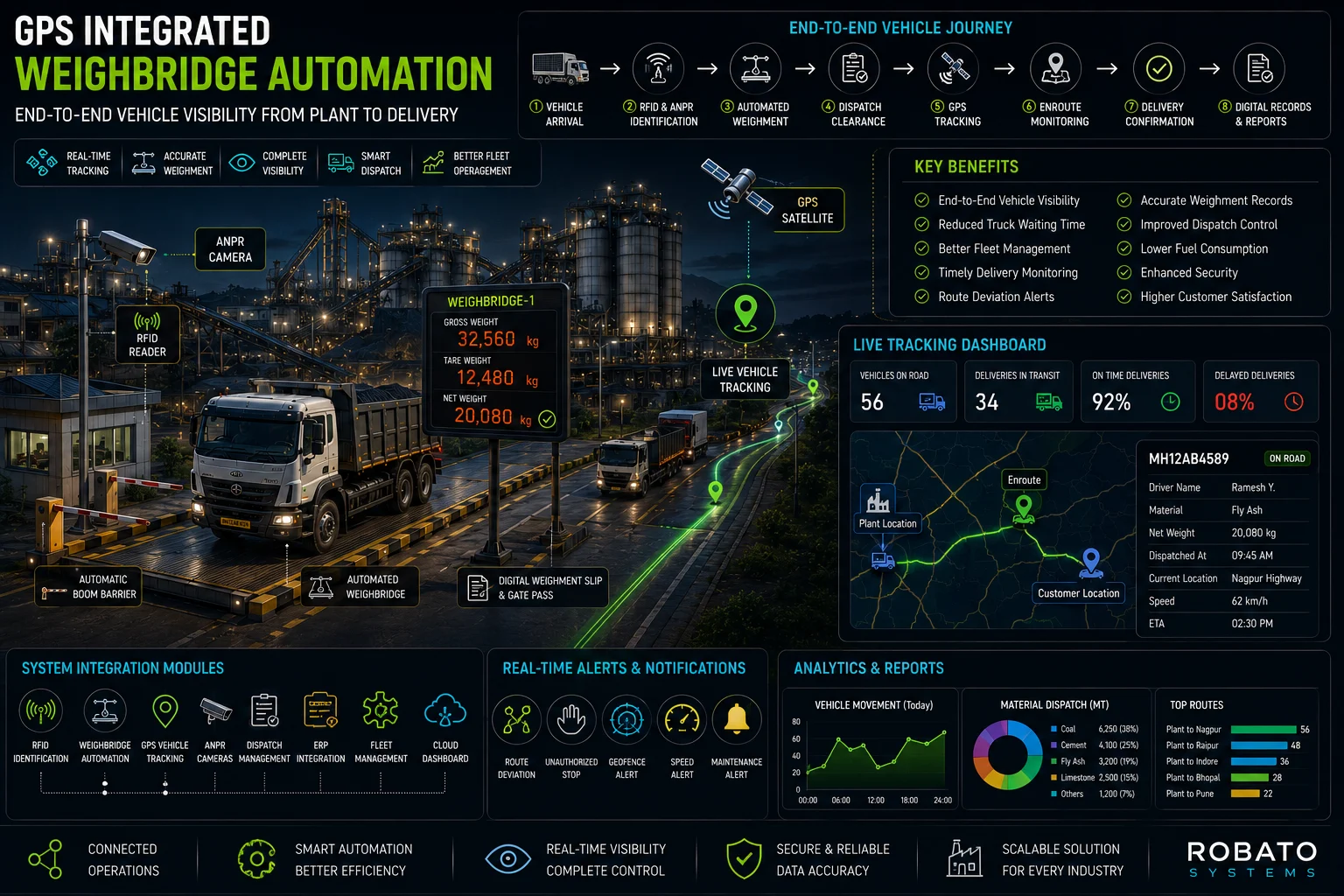
Industrial facilities often manage hundreds of trucks transporting raw materials and finished goods between plants, warehouses, mines, ports, and customer locations. While weighbridge automation can digitize vehicle weighing, businesses also need visibility into where vehicles are located and how they move throughout the logistics process.
Without vehicle tracking, logistics teams may know when a truck was weighed but have limited visibility into its actual location, route, or delivery progress. This can make it difficult to identify delays, coordinate dispatches, and manage fleet performance.
GPS Integrated Weighbridge Automation combines weighbridge transactions with GPS vehicle tracking to provide end-to-end visibility of industrial vehicles. By connecting GPS data with RFID, weighbridge software, dispatch systems, and ERP platforms, businesses can monitor vehicles from plant entry through dispatch and delivery.
What is GPS Integrated Weighbridge Automation?
GPS Integrated Weighbridge Automation is a connected logistics solution that combines vehicle location data with weighbridge and dispatch information.
The system can integrate:
GPS Vehicle Tracking
RFID Vehicle Identification
Automated Weighbridges
ANPR Cameras
Dispatch Management
ERP Integration
Fleet Management Software
Geofencing
Real-Time Dashboards
Digital Weighment Records
This allows organizations to connect a vehicle's physical location with its weighment and dispatch transactions.
Why Integrate GPS with Weighbridge Automation?
A traditional weighbridge system primarily records vehicle and weight information. GPS adds another layer of visibility by showing where the vehicle is during its transportation journey.
Without GPS integration, businesses may face challenges such as:
Limited vehicle visibility after dispatch
Difficulty identifying delivery delays
Poor fleet utilization
Manual vehicle status updates
Delayed response to route deviations
Difficulty monitoring long-distance shipments
Limited coordination between plant and logistics teams
GPS integration helps create a more complete view of vehicle movement.
How GPS Integrated Weighbridge Automation Works
Step 1: Vehicle Registration
Each vehicle is registered in the system with details such as:
Vehicle Number
RFID Tag
GPS Device
Transporter
Driver
Vehicle Type
Customer
Material
Step 2: Vehicle Arrival
When the vehicle reaches the facility, RFID or ANPR identifies it.
The weighbridge system retrieves the vehicle's information and connects it with the relevant dispatch order.
Step 3: Automated Weighment
The vehicle enters the weighbridge and its weight is automatically recorded.
The transaction can include:
Vehicle Number
Gross Weight
Tare Weight
Net Weight
Date and Time
Dispatch Order
RFID Information
Step 4: Dispatch Confirmation
Once the required loading, unloading, and weighing processes are completed, the vehicle is cleared for dispatch.
The dispatch status is synchronized with the logistics system.
Step 5: GPS Tracking
After dispatch, the GPS system continuously provides vehicle location information.
The logistics team can monitor:
Current Location
Vehicle Movement
Route
Stops
Delivery Progress
Geofence Events
Step 6: Delivery Monitoring
The vehicle's GPS information can be connected with its original weighbridge transaction and dispatch order.
This creates a connected record from weighment to delivery.
Key Features of GPS Integrated Weighbridge Automation
Real-Time GPS Tracking
Monitor vehicle locations through a centralized dashboard.
RFID Vehicle Identification
Automatically identify registered vehicles when they enter the facility.
Automated Weighment
Capture vehicle weight directly from the weighbridge.
Dispatch Tracking
Connect vehicle location with dispatch information for better logistics visibility.
Geofencing
Create virtual geographical boundaries around plants, warehouses, customer locations, and other important areas.
Route Monitoring
Track vehicle movement and identify unexpected route deviations.
ERP Integration
Synchronize weighment, dispatch, inventory, and vehicle information with ERP systems.
Centralized Dashboard
Monitor:
Vehicle Location
Weighbridge Transactions
Dispatch Status
Vehicle Movement
Delivery Progress
Fleet Activity
Benefits of GPS Integrated Weighbridge Automation
End-to-End Vehicle Visibility
Track vehicles from plant entry and weighing through dispatch and delivery.
Better Fleet Management
Logistics teams can monitor vehicle utilization and movement from a centralized system.
Faster Response to Delays
GPS visibility helps teams identify stopped or delayed vehicles more quickly.
Improved Dispatch Control
Connecting weighbridge and GPS data provides better visibility into the complete dispatch lifecycle.
Better Customer Communication
Accurate vehicle location information can help logistics teams provide more reliable delivery updates.
Reduced Manual Tracking
Automated GPS and weighbridge data reduce dependence on phone calls and manual status updates.
Improved Logistics Planning
Historical vehicle movement data can help organizations analyze routes, delays, and transportation performance.
Applications
GPS Integrated Weighbridge Automation is suitable for:
Steel Plants
Power Plants
Manufacturing Facilities
Construction Material Plants
Chemical Industries
Fertilizer Plants
Warehouses
Ports
Bulk Material Handling Facilities
Large Distribution Centers
Integration with RFID and Weighbridge Systems
GPS becomes even more useful when combined with RFID-based weighbridge automation.
A typical workflow can be:
GPS-Enabled Vehicle → RFID Identification → Weighbridge → Loading/Unloading → Dispatch → GPS Tracking → Delivery
This creates a connected digital trail for the vehicle throughout the logistics cycle.
ERP and Logistics Software Integration
GPS integrated weighbridge software can exchange information with ERP and logistics platforms, including:
Vehicle Details
Dispatch Orders
Material Information
Customer Information
Weighment Data
Inventory Transactions
Delivery Status
Transporter Information
This allows different departments to access synchronized vehicle and dispatch information.
Best Practices
Install GPS devices on regularly used transport vehicles.
Link GPS devices with vehicle master records.
Connect RFID identification with weighbridge transactions.
Define geofences for important locations.
Monitor vehicle idle time and route deviations.
Integrate GPS data with dispatch software.
Maintain accurate vehicle and transporter information.
Use dashboards to monitor logistics performance.
Common Challenges
GPS Connectivity
Vehicles operating in remote areas may experience connectivity limitations.
Large Fleet Data
Large fleets generate significant amounts of location data that need to be organized effectively.
Existing System Integration
GPS, weighbridge, ERP, and fleet management systems may need customized integration.
Device Maintenance
GPS tracking devices require proper installation, configuration, and periodic maintenance.
Future of GPS Integrated Weighbridge Automation
The combination of GPS, weighbridge automation, and intelligent logistics software is creating new opportunities for industrial transportation management.
Future systems can incorporate:
AI-Based Route Optimization
Predictive Arrival Times
Automated Truck Scheduling
Dynamic Dispatch Planning
Fuel Monitoring
Driver Behavior Analytics
Cloud-Based Fleet Dashboards
Predictive Logistics Analytics
These capabilities can help businesses move from basic vehicle tracking toward intelligent fleet and logistics management.
Why Choose Robato Systems?
Robato Systems provides GPS Integrated Weighbridge Automation that connects vehicle tracking with weighing, dispatch, and logistics operations.
The solution can combine GPS tracking, RFID vehicle identification, automated weighbridges, ANPR, ERP integration, dispatch management, and centralized dashboards into one connected platform.
This helps businesses improve vehicle visibility, monitor dispatch progress, reduce manual tracking, and gain better control over industrial transportation operations.
Conclusion
Knowing the weight of a vehicle is only one part of effective logistics management. Businesses also need to know where the vehicle is, whether it has departed, whether it is following the expected route, and when it is likely to reach its destination.
GPS Integrated Weighbridge Automation connects weighbridge transactions with real-time vehicle tracking to provide end-to-end visibility across the transportation process.
By integrating GPS with RFID, weighbridge automation, ERP, and dispatch systems, industrial facilities can build a more connected logistics operation with better fleet visibility, improved dispatch control, and more reliable transportation monitoring.
Frequently Asked Questions
What is GPS Integrated Weighbridge Automation?
It is a system that combines GPS vehicle tracking with automated weighbridge and dispatch management to provide complete vehicle visibility.
Can GPS be integrated with RFID weighbridge systems?
Yes. RFID can identify the vehicle at the weighbridge while GPS provides its location during transportation.
What information can be monitored?
Businesses can monitor vehicle location, weighment records, dispatch status, route movement, stops, and delivery progress.
Can GPS weighbridge automation integrate with ERP?
Yes. Vehicle, dispatch, weighment, inventory, and delivery information can be synchronized with ERP and logistics systems.
Does GPS tracking help reduce logistics delays?
It can help identify vehicle stops, route deviations, and delays earlier, allowing logistics teams to respond more quickly.
Is GPS integrated weighbridge automation suitable for large fleets?
Yes. It is particularly useful for organizations managing large numbers of industrial vehicles across multiple locations.