
ESD Gate: Why Every Electronics Facility Needs One
Walk into any facility that manufactures or handles sensitive electronic components, and the risk that nobody talks about loudly enough is electrostatic discharge. A human body can carry an electrostatic charge of up to 20,000 volts without feeling anything at all. At those levels, an invisible discharge from a worker entering the production floor can permanently damage integrated circuits, microchips, and semiconductor components worth thousands of dollars in finished products and cause field failures that reach customers. An ESD gate is the technology that stops this from happening. It ensures that no person enters an ESD Protected Area without being tested, verified, and confirmed as electrostatically safe before they set foot on the production floor.
What Exactly Is an ESD Gate?
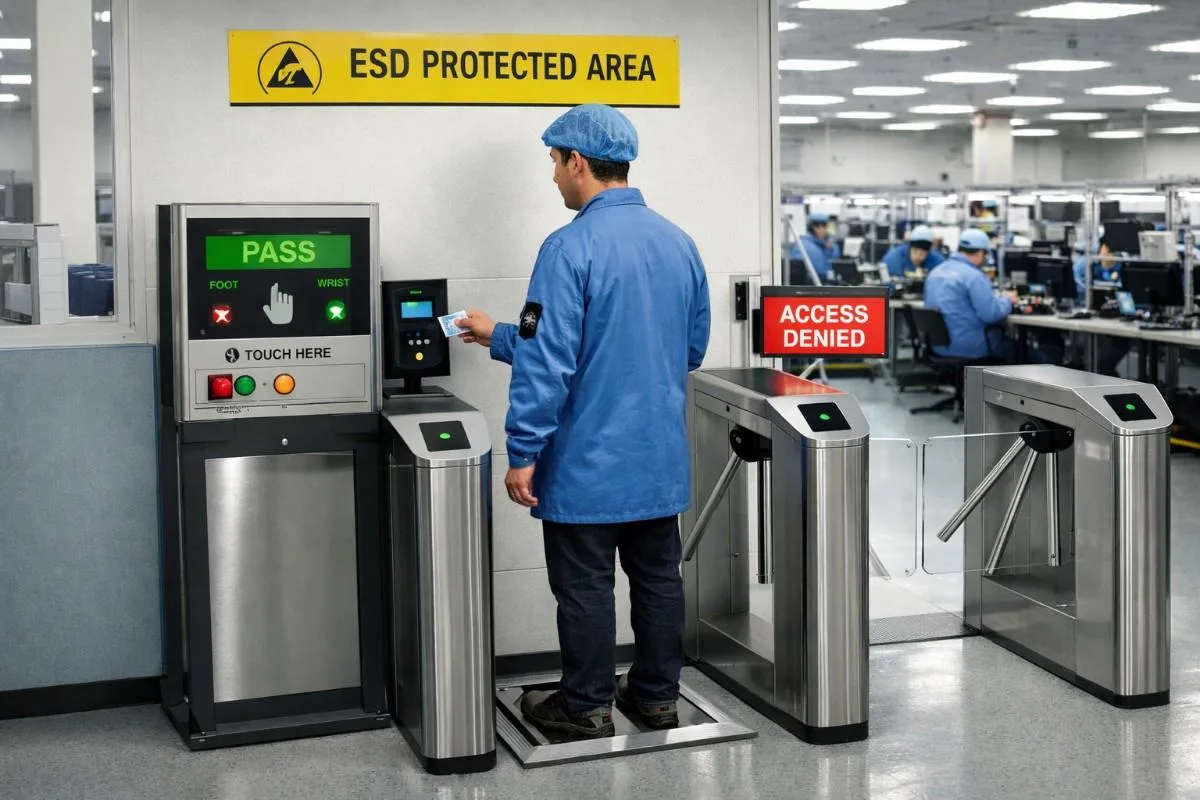
An ESD gate is an automated access control system that integrates electrostatic discharge testing with physical access control at the entrance to an ESD Protected Area, also known as an EPA. It combines an ESD combo tester, a physical turnstile or flap barrier gate, proximity card or identity verification technology, and management software into a single automated system.
When a worker or visitor approaches the ESD gate, they swipe their identity card or present a credential to the system. The gate then prompts them to stand on the ESD tester footplates and complete the electrostatic discharge test. If the test passes, confirming that their footwear and wristband are grounding them effectively, the gate opens automatically. If the test fails, the gate remains locked and the system alerts the individual to check their ESD protective equipment before attempting access again.
The entire process is fully automatic, fully documented, and completely removes the possibility of anyone bypassing the ESD test through human error, oversight, or deliberate non-compliance.
The Real Problem With Manual ESD Testing
Many facilities still rely on manual ESD testing processes at the entrance to their production areas. An ESD tester is placed near the door, workers are instructed to test themselves before entering, and supervisors are expected to enforce compliance. In practice, this approach fails regularly.
During busy shift changes, workers under time pressure skip the test entirely. New employees or visitors who are unfamiliar with the process complete it incorrectly. There are no records of who tested, when they tested, or whether they passed or failed. When product quality issues arise and an ESD audit is required, there is no data to review. Robato Systems' fully automatic ESD gate access control system eliminates every one of these failure points by making the test mandatory, automated, and recorded before the gate will open.
Every Entry Is Recorded and Every Audit Is Ready
One of the most important operational benefits of an ESD gate goes beyond the protection it provides in real time. The system generates a complete, timestamped digital log of every access event across every gate in the facility. Each record includes the employee or visitor identity, the test result, whether the result was a pass or fail, and the exact time of each entry and exit.
These logs are stored in a centralized SQL server database that can be accessed through the management software to generate detailed reports in Excel and PDF format. When an ESD floor audit is required, the data needed to demonstrate compliance is available instantly without any additional effort from the operations team. This transforms what is typically a time-consuming manual audit preparation process into a straightforward report generation exercise.
One System That Handles Multiple Access Points
Larger electronics manufacturing facilities often have multiple entry points to their ESD Protected Areas, serving different departments, production lines, and shift teams. Robato Systems' ESD gate solution is designed to scale across multiple access points from a single centralized management platform.
Multiple ESD combo testers and proximity card readers can be integrated with ESD turnstiles, flap barriers, and magnetic lock gates across the facility, all reporting to the same database and accessible through the same management software. Administrators can register new users in bulk, configure access policies by user group, and monitor the access status of every gate in the facility from a single interface.
Industries That Cannot Operate Without It
ESD gates are not optional in certain industries. They are a compliance requirement and a product quality imperative for electronics manufacturing, semiconductor fabrication, PCB assembly, medical device manufacturing, aerospace component production, and any facility where sensitive electronic components are handled at any stage of the production process.
As integrated circuits continue to shrink and their sensitivity to electrostatic discharge continues to increase, the cost of ESD-related field failures grows proportionally. A single ESD event that reaches a finished product can result in a warranty return, a customer complaint, and a reputational cost that far exceeds the investment in an automated ESD gate system. For any facility serious about product quality and compliance, an ESD gate is not an upgrade. It is an essential part of the production environment.