
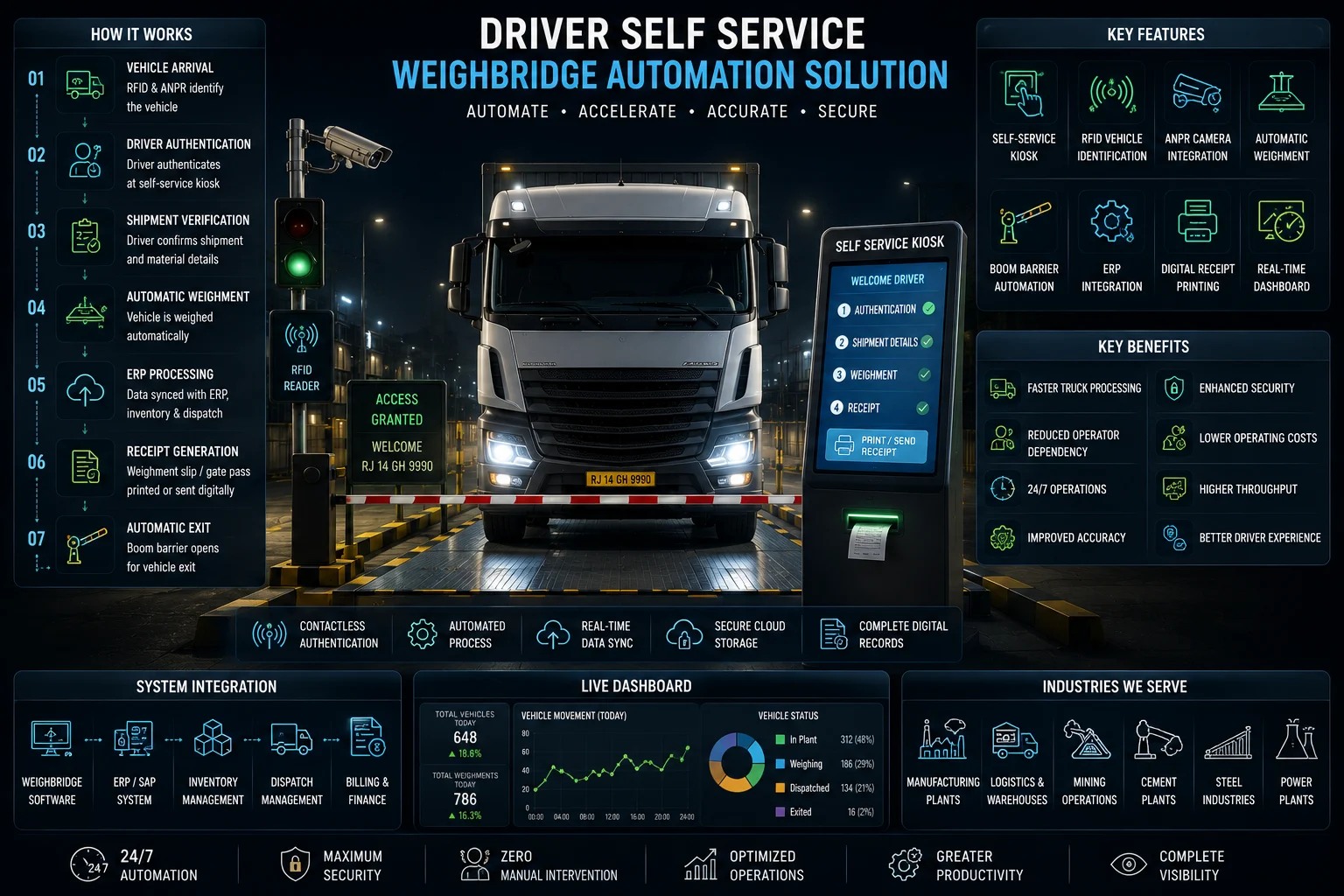
Driver Self Service Weighbridge Automation Solution
Introduction
Modern manufacturing facilities, warehouses, mining sites, logistics hubs, cement plants, and steel industries process hundreds of trucks every day. Traditional weighbridge operations require drivers to stop their vehicles, submit documents, communicate with weighbridge operators, and wait for manual approval before proceeding. This process often creates long queues, delays dispatch operations, increases labor costs, and reduces overall productivity.
A Driver Self Service Weighbridge solution transforms this process by allowing drivers to complete the entire weighment operation independently through an automated kiosk. Integrated with RFID technology, ANPR cameras, weighbridge software, boom barriers, ERP systems, and digital document generation, the system enables trucks to complete weighing with minimal or no operator assistance.
The result is faster vehicle movement, improved operational efficiency, enhanced accuracy, and a better experience for transporters and logistics teams.
What is a Driver Self Service Weighbridge?
A Driver Self Service Weighbridge is an automated weighbridge solution that enables truck drivers to perform weighment transactions independently using a self-service kiosk.
Instead of relying on an operator, drivers authenticate themselves, confirm shipment details, complete the weighing process, and receive digital or printed weighment slips directly from the kiosk.
A complete self-service weighbridge solution typically includes:
Self-Service Touchscreen Kiosk
RFID Vehicle Identification
ANPR Camera Integration
Boom Barrier Automation
Driver Communication System
ERP Integration
Digital Receipt Printing
Live Monitoring Dashboard
These components work together to create a fully automated and user-friendly weighbridge environment.
Challenges with Traditional Weighbridge Operations
Manual weighbridge operations often create unnecessary delays and operational inefficiencies.
Long Vehicle Queues
Drivers wait for operator availability before the weighing process begins.
High Labor Dependency
Operations require dedicated weighbridge personnel throughout the day.
Human Errors
Manual data entry increases the possibility of incorrect vehicle information and weight records.
Slow Dispatch Operations
Manual document verification delays inbound and outbound vehicle movement.
Limited Availability
Operations may slow down during shift changes, breaks, or non-working hours.
How Driver Self Service Weighbridge Works
Step 1: Vehicle Arrival
The truck approaches the weighbridge entry point.
RFID readers identify registered vehicles while ANPR cameras verify the vehicle registration number.
Step 2: Driver Authentication
The driver interacts with the self-service kiosk.
Authentication can be completed using:
RFID Card
QR Code
Vehicle Registration Number
Driver ID
PIN Authentication
Step 3: Shipment Verification
The kiosk displays transport information including:
Purchase Order
Dispatch Order
Customer Information
Material Details
Destination
The driver confirms the displayed information.
Step 4: Automated Weighment
The vehicle moves onto the weighbridge.
Weight data is captured automatically without operator intervention.
Step 5: ERP Processing
The software updates:
Inventory
Dispatch Records
Procurement
Billing
Logistics
Vehicle History
Step 6: Receipt Generation
The kiosk automatically prints or sends:
Weighment Slip
Delivery Challan
Gate Pass
Dispatch Confirmation
Step 7: Automatic Exit
Once the process is completed successfully, the boom barrier opens automatically, allowing the truck to continue its journey.
Key Features of Driver Self Service Weighbridge
Self-Service Touchscreen Kiosk
Provides an intuitive interface for drivers to complete the weighment process independently.
RFID Vehicle Identification
Automatically recognizes authorized vehicles upon arrival.
ANPR Verification
Adds an additional layer of security through automatic number plate recognition.
Automatic Weight Capture
Records accurate weight information directly from the weighbridge.
ERP Integration
Synchronizes weighment data with ERP, inventory, procurement, finance, and logistics systems.
Boom Barrier Automation
Controls vehicle movement automatically after successful verification.
Digital Documentation
Automatically generates:
Weighment Slips
Delivery Notes
Gate Passes
Dispatch Documents
Real-Time Monitoring
Management teams can monitor all self-service transactions through centralized dashboards.
Benefits of Driver Self Service Weighbridge
Faster Truck Processing
Reduce waiting time by allowing drivers to complete transactions independently.
Reduced Operator Dependency
Minimize manpower requirements while maintaining continuous operations.
Improved Accuracy
Eliminate manual data entry errors during weighment.
24/7 Operations
Support round-the-clock weighbridge activities with minimal staffing.
Better Driver Experience
Provide a quick, simple, and user-friendly weighing process.
Enhanced Security
Verify every vehicle using RFID and ANPR before granting access.
Lower Operating Costs
Reduce administrative expenses and optimize workforce utilization.
Higher Throughput
Process more vehicles each day without increasing staff.
Industries That Benefit from Driver Self Service Weighbridge
Manufacturing Plants
Logistics Companies
Warehouses
Cement Plants
Steel Industries
Mining Operations
Power Plants
Food Processing Industries
Chemical Manufacturing
Paper & Pulp Industries
Best Practices for Successful Implementation
To maximize the benefits of a self-service weighbridge:
Install user-friendly touchscreen kiosks.
Integrate RFID and ANPR technologies.
Connect the system with ERP software.
Automate boom barrier operations.
Provide multilingual kiosk interfaces if required.
Schedule periodic weighbridge calibration.
Train transport partners on kiosk usage.
Future Trends in Driver Self Service Weighbridge
Artificial Intelligence
AI will detect unusual transactions, predict traffic congestion, and optimize truck flow automatically.
Voice-Assisted Kiosks
Drivers will interact with multilingual voice-guided systems for easier operation.
Mobile Integration
Drivers will receive weighment documents instantly on mobile devices.
Cloud Connectivity
Enterprise teams will monitor multiple self-service weighbridges through centralized cloud dashboards.
Smart Logistics Integration
Self-service weighbridges will integrate with warehouse management, fleet tracking, and production planning systems for fully automated logistics operations.
Why Businesses Should Invest in Driver Self Service Weighbridge
As industries continue to digitize logistics operations, reducing manual intervention becomes essential for maintaining productivity and competitiveness. Driver self-service weighbridge systems improve truck turnaround, minimize operational costs, and enhance customer satisfaction while ensuring accurate and secure weighment.
Organizations implementing these solutions typically achieve:
Faster vehicle movement
Increased weighbridge capacity
Lower labor costs
Improved operational accuracy
Better compliance
Enhanced driver satisfaction
Complete digital records
Real-time operational visibility
Conclusion
A Driver Self Service Weighbridge is an important step toward intelligent industrial automation. By allowing drivers to complete weighment independently through automated kiosks integrated with RFID, ANPR, ERP, and boom barrier systems, businesses can eliminate bottlenecks, improve operational efficiency, and reduce manual dependency.
Whether managing manufacturing plants, warehouses, logistics hubs, mining operations, or cement facilities, implementing a driver self-service solution helps organizations achieve faster vehicle processing, better accuracy, and higher productivity.
Frequently Asked Questions (FAQs)
What is a Driver Self Service Weighbridge?
A Driver Self Service Weighbridge is an automated solution that allows truck drivers to complete weighment operations independently using a self-service kiosk.
How does a self-service weighbridge work?
Drivers authenticate themselves at the kiosk, verify shipment details, complete automated weighing, and receive digital or printed weighment documents without operator assistance.
Can a driver self-service weighbridge integrate with ERP systems?
Yes. It integrates with ERP platforms, RFID systems, ANPR cameras, inventory software, dispatch systems, and billing applications.
Which industries benefit from driver self-service weighbridge automation?
Manufacturing, logistics, warehouses, mining, cement, steel, power generation, food processing, and chemical industries commonly implement these systems.
What are the benefits of a driver self-service weighbridge?
The major benefits include reduced waiting time, lower labor costs, improved accuracy, 24/7 operations, enhanced security, faster truck turnaround, and better operational visibility.