CNC Machine OEE Monitoring Software for Precision Manufacturing
Precision manufacturing depends on consistency, accuracy, and efficient machine utilization. CNC machines are designed to deliver repeatable results, but even advanced equipment can experience unexpected downtime, slower production cycles, tooling issues, and quality-related losses.
For CNC managers, the challenge is not simply to keep machines running. It is to understand how effectively each machine converts available production time into good-quality output.
This is where CNC Machine OEE Monitoring becomes valuable. By tracking availability, performance, and quality, manufacturers can gain a clearer picture of machine effectiveness and identify the factors affecting production output.
Instead of relying only on operator reports or end-of-shift production figures, CNC teams can use machine data to understand what is happening during production and take corrective action sooner.
In this guide, we will explore how CNC machine OEE monitoring works, which metrics matter, and how precision manufacturers can use production data to improve operational performance.
What Is CNC Machine OEE Monitoring?
CNC Machine OEE Monitoring is the process of measuring the overall equipment effectiveness of CNC machines using production, operating-time, downtime, and quality-related data.
OEE stands for Overall Equipment Effectiveness. It combines three key factors:
Availability: How much of the planned production time the machine was actually running.
Performance: How efficiently the machine operated compared with its ideal production rate.
Quality: How much of the total production output met the required quality standards.
Together, these metrics help CNC managers understand the difference between planned production capacity and actual productive output.
For example, a CNC machining centre may be available for an entire shift but lose production time due to tool changes, setup delays, or unexpected stoppages. Even while running, it may operate below its expected cycle speed or produce components that require rework.
Without structured monitoring, these losses can remain hidden within daily production totals.
CNC OEE monitoring brings these factors together so that managers can evaluate machine effectiveness using measurable production data.
Why Precision Manufacturing Needs CNC OEE Monitoring
Precision manufacturing often involves tight tolerances, specialised tooling, complex machining operations, and carefully controlled production processes. Small inefficiencies can affect delivery schedules, operating costs, and the ability to meet production targets.
Several common challenges make machine-level monitoring important.
1. Unplanned Machine Downtime
CNC machines may stop because of tool breakage, machine alarms, material shortages, maintenance requirements, or other interruptions.
When downtime is recorded manually, the information may be incomplete or entered after the event. This makes it difficult to identify recurring problems and understand their actual impact.
CNC machine OEE monitoring helps teams capture machine stoppages and analyse their frequency, duration, and reasons.
2. Longer-Than-Expected Cycle Times
A CNC machine can remain operational while producing fewer components than expected.
Cycle times may increase because of inefficient machining parameters, tooling wear, repeated adjustments, or differences between actual and ideal operating conditions.
Performance monitoring helps identify these gaps and gives production teams a starting point for investigating the underlying causes.
3. Quality Losses and Rework
In precision machining, dimensional deviations, surface-finish problems, and other defects can lead to rejected components or rework.
These issues reduce the number of good parts produced from the available production time.
When quality data is considered alongside machine performance, manufacturers can better understand how production losses affect overall equipment effectiveness.
4. Limited Visibility Across CNC Machines
A facility may operate several CNC turning centres, milling machines, machining centres, or other automated equipment.
If every machine is monitored through separate records or spreadsheets, comparing performance across the shop floor becomes difficult.
A centralised monitoring system can help managers compare machine performance, identify recurring bottlenecks, and prioritise improvement efforts.
How OEE Is Calculated for CNC Machines
OEE combines availability, performance, and quality into a single percentage.
OEE = Availability × Performance × Quality
Each component measures a different aspect of production effectiveness.
Availability
Availability measures the proportion of planned production time during which the machine actually runs.
Availability = Operating Time ÷ Planned Production Time × 100
For example, if a CNC machine is scheduled to produce for 420 minutes and experiences 42 minutes of downtime, its operating time is 378 minutes.
Availability is:
378 ÷ 420 × 100 = 90%
This metric helps CNC managers understand how much planned production time is lost to machine stoppages.
Performance
Performance compares actual production output with the output expected at the ideal cycle rate.
Performance = Ideal Cycle Time × Total Pieces Produced ÷ Operating Time × 100
Suppose a CNC machine has an ideal cycle time of 1 minute per component. During 378 minutes of operating time, it produces 340 components.
Performance is:
1 × 340 ÷ 378 × 100 = 89.95%
This indicates that the machine produced fewer components than its ideal running rate would suggest.
Quality
Quality measures the proportion of total components produced that meet the required quality standards.
Quality = Good Pieces ÷ Total Pieces Produced × 100
If the machine produces 340 components and 333 meet quality requirements:
333 ÷ 340 × 100 = 97.94%
The remaining components represent quality losses that may require further investigation.
Calculating Overall CNC Machine OEE
Using the example above:
Availability: 90%
Performance: 89.95%
Quality: 97.94%
OEE is approximately:
90% × 89.95% × 97.94% = 79.3%
This example illustrates how a CNC machine can perform reasonably well across all three factors while still losing a meaningful portion of its potential productive output.
The result should be used as a starting point for analysis rather than as a universal benchmark. Appropriate OEE targets depend on the machine, manufacturing process, product mix, and operating conditions.
Key Features of CNC Machine OEE Monitoring Software
Effective CNC monitoring software should help production teams move from collecting data to making informed operational decisions.
The specific features available depend on the monitoring system, machine interfaces, and integration requirements.
1. Real-Time Machine Status Monitoring
A central dashboard can display whether a CNC machine is running, stopped, or in another monitored state, depending on the signals available from the equipment.
This allows production teams to identify interruptions without waiting for the end-of-shift report.
Managers can use machine status information to investigate stoppages, coordinate support, and understand how production is progressing against the schedule.
2. Automated Production Counting
Where machine signals or controller data support it, software can automatically collect production counts.
This reduces dependence on manual entry and provides a more consistent record of machine output.
Production counts can then be compared with expected output to identify machines that are falling behind their planned targets.
3. Downtime Tracking and Analysis
Downtime monitoring records machine interruptions and helps teams categorise losses using defined reason codes or available machine signals.
Common categories may include:
Machine faults and alarms
Tool changes and setup activities
Material shortages
Maintenance-related stoppages
Operator or process delays
Waiting time between production jobs
Accurate categorisation is important because the same downtime duration can have different causes and require different corrective actions.
For example, repeated machine faults may require maintenance attention, while material shortages may require better coordination between production planning and material handling.
Internal link opportunity: Add a contextual link to the Robato Systems CNC Monitoring product page in this section.
4. OEE Dashboards and Production Analytics
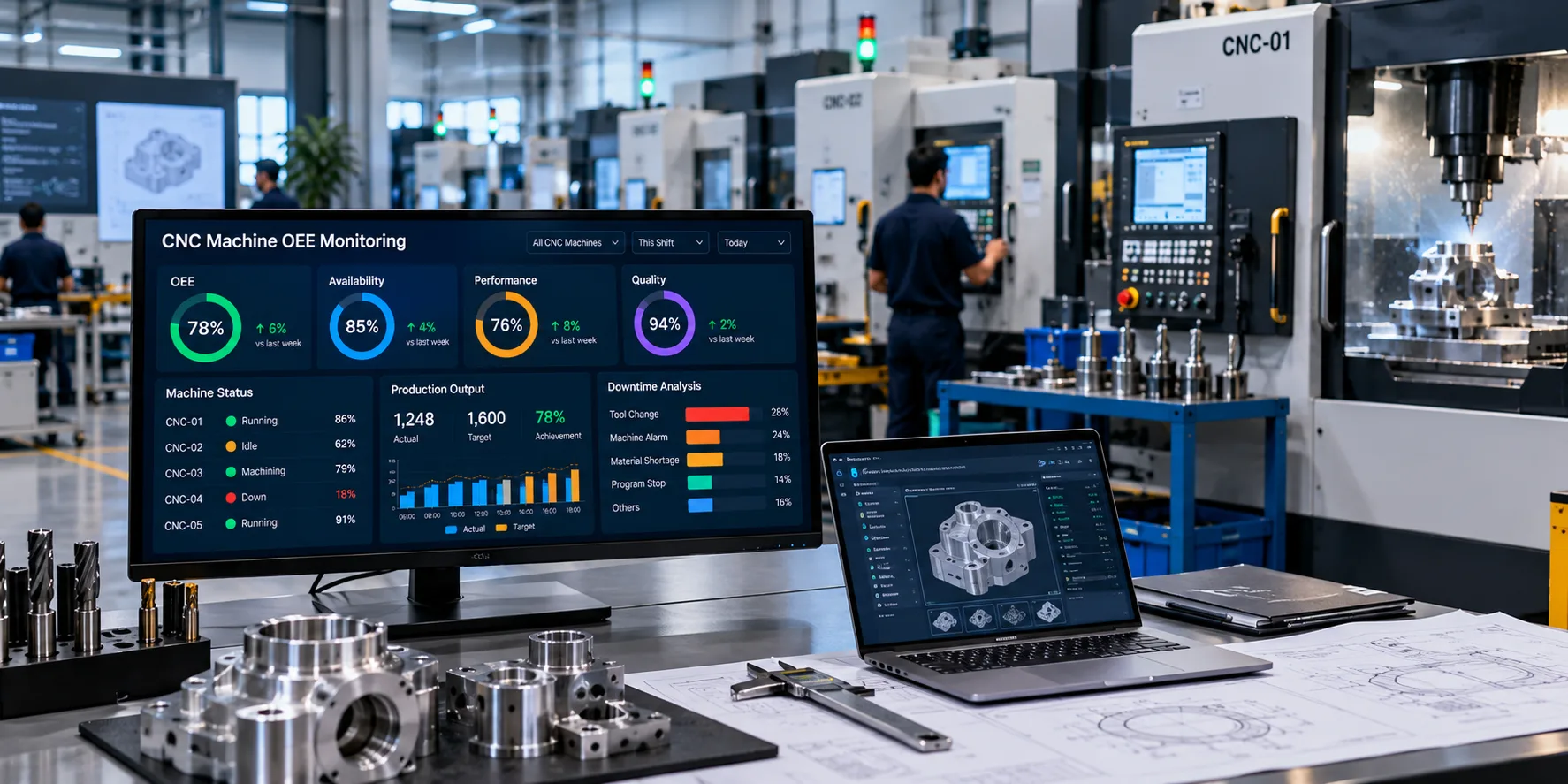
A CNC OEE dashboard can bring availability, performance, quality, downtime, and production output into one view.
Depending on the system configuration, managers may be able to review data by machine, shift, production order, or selected time period.
This makes it easier to compare actual performance with production targets and determine where improvement efforts are likely to have the greatest impact.
5. Shift-Wise Performance Tracking
Machine performance can vary between shifts because of differences in product mix, setup requirements, staffing, or production schedules.
Shift-wise reports help managers compare operating time, output, downtime, and OEE across defined shifts.
These comparisons should account for differences in planned production time and job complexity to avoid drawing misleading conclusions.
6. Historical Data and Trend Analysis
Real-time monitoring shows what is happening now, while historical data helps explain recurring problems.
By reviewing trends over time, CNC managers can investigate questions such as:
Which machines experience the most downtime?
Are cycle times increasing on particular jobs?
Which stoppage reasons account for the greatest production losses?
Has a maintenance intervention improved machine availability?
Are production improvements being sustained across shifts?
These insights help teams prioritise corrective actions based on evidence rather than assumptions.
How CNC OEE Monitoring Improves Production Efficiency
The value of CNC monitoring comes from using production data to identify losses and support practical improvements.
Identify the Biggest Sources of Downtime
Not all stoppages have the same operational impact. A monitoring system can help rank downtime causes by frequency and total duration.
CNC managers can use this information to focus on the problems responsible for the largest losses.
For instance, frequent short stoppages may collectively consume more production time than a single long interruption. Reviewing both frequency and duration gives teams a more complete understanding of the issue.
Reduce Cycle-Time Losses
Comparing ideal and actual cycle times helps reveal where machine performance is falling short.
After identifying a gap, the production team can investigate tooling conditions, machining parameters, program settings, material variation, and other process-related factors.
Any changes should be validated against machining quality, equipment limits, and process requirements. Increasing machine speed alone does not guarantee better productivity if it creates additional defects or tooling problems.
Improve Production Planning
Reliable machine-level production data helps planners understand actual machine capacity and historical performance.
This information can support more realistic scheduling, better job allocation, and improved estimates of production completion times.
It can also help identify constraints that affect the entire production flow, such as a machining centre that consistently delays downstream operations.
Support Preventive Maintenance
Historical downtime and machine-event data can reveal recurring faults or patterns that deserve investigation.
Maintenance teams can use these findings alongside inspections, alarm histories, and manufacturer recommendations to plan appropriate maintenance activities.
OEE monitoring does not replace a maintenance management system or condition-monitoring tools. It provides additional operational evidence that can help teams decide where to investigate.
Improve Accountability Through Shared Data
When operators, supervisors, maintenance teams, and managers use consistent production information, discussions about machine performance become more objective.
Teams can review the same downtime records, output figures, and OEE trends when investigating a problem.
The goal is to identify process improvements and resolve production constraints, not simply to attribute poor performance to an individual operator.
Integrating CNC Machines With OEE Monitoring Software
Before implementing CNC machine OEE monitoring, manufacturers should understand how production data will be collected from existing equipment.
CNC machines differ in controller type, age, connectivity, and available signals. A suitable monitoring approach depends on these technical conditions.
CNC Controller Integration
Some modern CNC controllers can provide machine status, cycle information, alarms, and production-related data through supported interfaces.
Where available, these signals can be connected to monitoring software to reduce manual data collection.
The exact information available depends on the controller model, interface permissions, configuration, and integration method.
PLC and Sensor-Based Data Collection
For machines that cannot provide all required data directly, a PLC or suitable external sensing arrangement may help collect selected operating signals.
For example, a monitoring setup may use machine-running signals, cycle-complete events, or other validated inputs to determine machine status and production activity.
Signal mapping and testing are essential to ensure that the system interprets machine states correctly.
Connecting Monitoring Data to Production Systems
Some manufacturers also need to connect machine-level monitoring with production planning, ERP, MES, quality, or maintenance systems.
These integrations can provide additional context, such as planned jobs, product information, production targets, and work-order details.
Before implementation, define which system owns each data field and how information will be matched across machines and production orders.
Start With a Pilot Implementation
Rather than connecting every CNC machine immediately, manufacturers can begin with a representative machine or production cell.
A pilot can help validate:
Machine-state accuracy
Production-count reliability
Downtime reason categorisation
OEE calculation rules
Dashboard usefulness
Network and integration requirements
After the data has been validated and users are comfortable with the workflow, the deployment can be expanded to additional machines.
Common Challenges When Implementing CNC OEE Monitoring
A monitoring platform is only useful when its data is reliable and its metrics are interpreted consistently.
Inconsistent Downtime Classification
If operators use different reasons for similar stoppages, reports become difficult to compare.
Create a practical list of downtime categories, explain when each should be used, and review uncategorised events regularly.
Incorrect Ideal Cycle Times
OEE performance calculations depend on appropriate ideal cycle-time values.
Different components, machining programs, materials, or production conditions may require different reference values. Using an outdated or unrealistic cycle time can distort the results.
Maintain controlled reference values and update them when validated process changes occur.
Incomplete Quality Data
If rejected or reworked components are not recorded accurately, the quality component of OEE may be misleading.
Define how good pieces, rejected pieces, and reworked parts will be counted. The method should match the organisation's quality procedures and avoid double-counting output.
Treating Every Machine Stop as a Failure
Not every machine stop represents an equipment fault. Planned setup activities, scheduled breaks, job changes, and other planned events may need different treatment depending on the organisation's OEE policy.
Agree on how planned production time and planned stoppages will be handled before comparing machines or shifts.
Collecting Data Without Acting on It
A dashboard does not improve production by itself.
Teams should establish a regular review process to examine major losses, assign corrective actions, define ownership, and check whether improvements have worked.
This creates a continuous improvement cycle in which monitoring supports decisions instead of becoming another reporting activity.
How to Choose CNC Machine OEE Monitoring Software
CNC managers should evaluate monitoring solutions against their actual production requirements rather than selecting a platform based only on the number of dashboard features.
Consider the following factors.
Machine compatibility: Check whether the system supports your CNC controllers and the required data-collection methods.
Data accuracy: Validate machine states, cycle counts, downtime records, and OEE calculations before relying on the reports.
Real-time visibility: Determine whether the system provides machine-status updates quickly enough for your operational needs.
Downtime analysis: Confirm that users can categorise stoppages and investigate recurring production losses.
Reporting flexibility: Review whether reports can be filtered by machine, shift, product, or production order as required.
Scalability: Consider how easily the system can expand from a pilot machine to multiple CNC machines or production facilities.
Integration capability: Identify requirements for connecting with PLCs, CNC controllers, ERP, MES, or other manufacturing systems.
Ease of use: Operators and supervisors should be able to understand the information and follow the reporting process without unnecessary complexity.
Implementation support: Ask about commissioning, training, signal mapping, configuration, and ongoing technical support.
A structured evaluation helps ensure that the selected solution addresses real production problems and fits the existing manufacturing environment.
Measuring the ROI of CNC OEE Monitoring
The return on investment from CNC monitoring depends on whether the information leads to measurable operational improvements.
Potential benefits include recovering productive machine time, reducing avoidable stoppages, improving throughput, and identifying quality-related losses.
For example, consider a CNC machine with 420 minutes of planned production time per shift. If the team identifies and eliminates 15 minutes of avoidable downtime, those 15 minutes may become available for productive work, provided there is sufficient demand and no other production constraint.
The financial value depends on the additional good parts produced, their contribution margin, any avoided overtime, and the resources required to implement the improvement.
A practical ROI assessment should consider:
Current downtime and production performance.
The main losses identified through monitoring.
The improvements that can realistically be achieved.
The value of additional good-quality output or avoided costs.
Software, integration, hardware, training, and maintenance expenses.
The time required to realise and sustain the benefits.
Avoid assuming that every recovered minute will automatically generate revenue. The impact depends on available orders, downstream capacity, staffing, tooling, material supply, and other production constraints.
CNC Machine OEE Monitoring for Continuous Improvement
CNC machine OEE monitoring is most effective when it becomes part of the production team's regular improvement process.
A practical approach involves four steps:
Measure: Collect reliable machine, production, downtime, and quality data.
Analyse: Identify the largest recurring losses and understand their root causes.
Improve: Implement targeted changes in maintenance, setup, tooling, scheduling, or operating procedures.
Review: Compare performance before and after the change to determine whether the improvement is sustained.
This process helps manufacturers avoid making decisions based on isolated incidents or incomplete production reports.
Over time, consistent monitoring can support better capacity planning, more informed maintenance decisions, and a clearer understanding of how CNC machines contribute to overall manufacturing performance.
Conclusion
Precision manufacturers need more than machine-running indicators to understand production efficiency. They need reliable information about machine availability, cycle performance, quality losses, and the reasons behind production interruptions.
CNC Machine OEE Monitoring brings these measures together to help CNC managers identify hidden losses, compare machine performance, and prioritise improvement opportunities.
With accurate data collection, clearly defined OEE rules, and a consistent review process, manufacturers can turn machine-level information into practical actions that support productivity and operational visibility.
If you want to understand how your CNC machines are performing and where production losses are occurring, explore Robato Systems' CNC Monitoring capabilities and evaluate how they fit your existing manufacturing setup.
Ready to improve CNC production visibility? Request a demo to discuss your machine-monitoring requirements.