Introduction
Manufacturing operations are becoming increasingly distributed. Companies may operate multiple production facilities, manage machines across different locations, and coordinate production teams working in separate shifts. For IT managers and manufacturing leadership, maintaining visibility into equipment performance across these operations can be challenging.
Traditional machine monitoring systems often depend on local computers, isolated networks, or manually consolidated reports. Although these systems may provide useful information within a factory, accessing production performance remotely can require additional infrastructure and reporting processes.
This is where Cloud Based OEE Software becomes valuable.
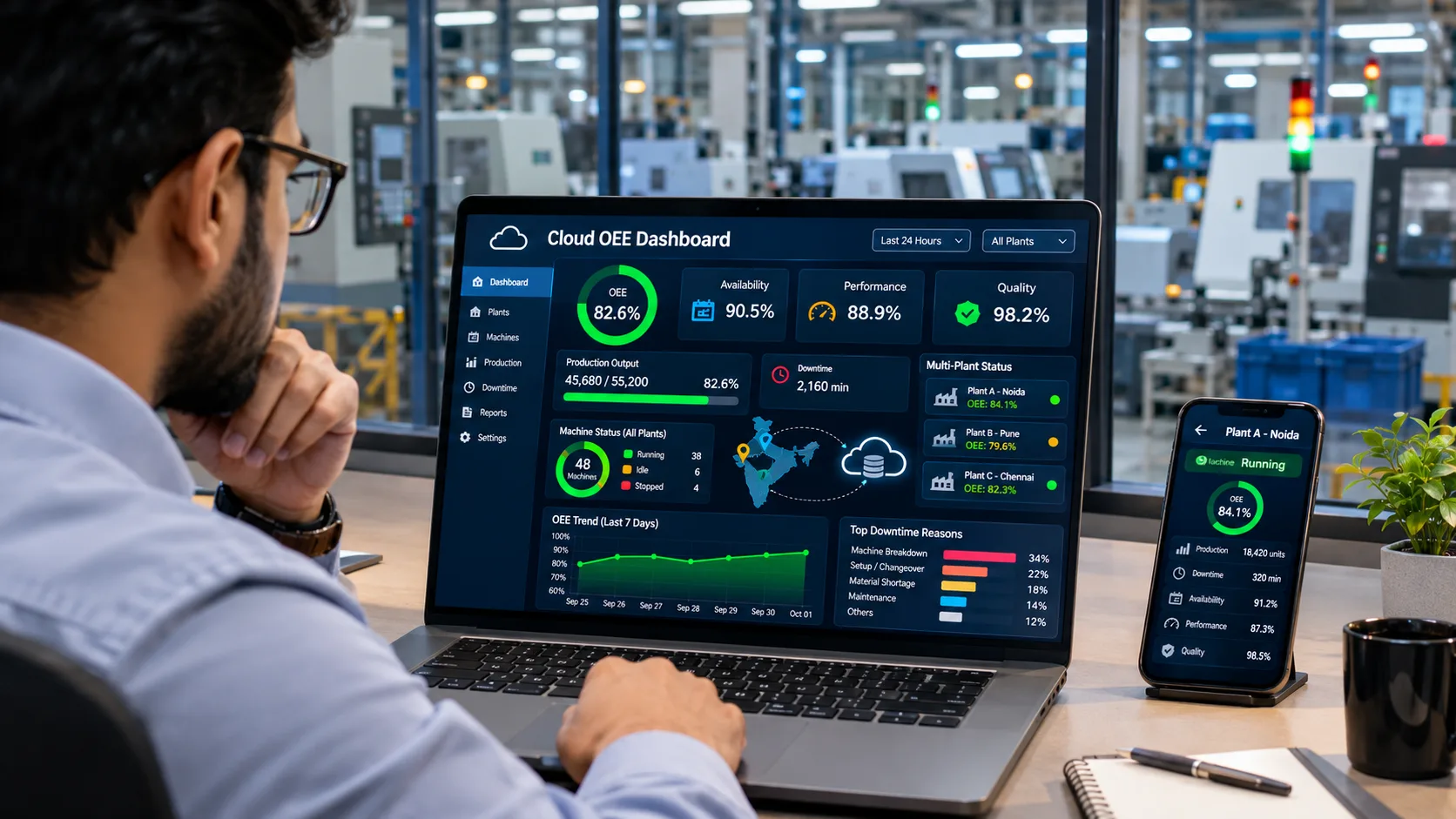
A cloud-based OEE platform helps manufacturers collect, process, and access equipment performance information through a centralized environment. Authorized users can review machine status, production output, downtime, and Overall Equipment Effectiveness (OEE) without being physically present on the factory floor.
By connecting machine-level production data with cloud-based reporting, manufacturers can improve operational visibility and support more informed decisions across their facilities.
What Is Cloud Based OEE Software?
Cloud Based OEE Software is a manufacturing monitoring solution that uses cloud infrastructure to store, process, and present machine and production performance information.
Instead of restricting production reports to a local machine or factory network, cloud-based monitoring makes relevant information accessible through an authorized online interface.
The system typically collects production information from connected machines, PLCs, sensors, controllers, or configured data sources. This information is then processed to calculate OEE metrics and generate production reports.
A typical cloud-based OEE monitoring environment may include:
Automated production count collection.
Downtime tracking.
Availability, performance, and quality calculations.
Production target monitoring.
Shift-wise reporting.
Historical performance analysis.
Centralized online dashboards.
Remote access for authorized users.
The exact capabilities depend on the software platform, machine connectivity, network architecture, and implementation requirements.
Why Manufacturers Are Moving Towards Cloud-Based OEE Monitoring
Manufacturers need reliable production information to manage equipment performance and respond to operational issues. However, traditional monitoring methods can make it difficult to access consistent information across different locations.
Cloud-based OEE monitoring addresses several of these challenges.
1. Limited Access to Factory Data
In traditional setups, production information may be available only through computers or dashboards connected to the factory network.
This can make it difficult for plant heads, corporate teams, and management to review performance when working remotely.
Cloud-based monitoring provides authorized users with access to production information through an online platform, subject to network connectivity and access permissions.
2. Separate Monitoring Systems Across Facilities
Manufacturing companies operating multiple facilities may use different systems to monitor machine performance.
Consolidating information from these systems can require manual reporting and additional data processing.
A centralized cloud platform can help bring supported production information into a common monitoring environment.
3. Delayed Production Reporting
Manual reports are often prepared after a shift or at the end of the production day.
By the time management receives the information, the opportunity to investigate an operational issue may already have passed.
Cloud-based monitoring can make machine and production information available more frequently, depending on the data collection and communication setup.
4. Difficulty Monitoring Remote Operations
Corporate operations teams may be responsible for production facilities located in different cities or regions.
Visiting every factory to review machine performance is not practical for routine monitoring.
A cloud-based OEE dashboard helps management review relevant performance information remotely without requiring physical access to each facility.
5. Growing Manufacturing Data Requirements
As factories introduce additional machines, production lines, and monitoring systems, the amount of operational information increases.
Cloud infrastructure can provide a centralized environment for managing production data, subject to the platform's storage, processing, and scalability limits.
How Cloud Based OEE Software Works
A cloud-based OEE monitoring solution connects machine-level data collection with centralized processing and reporting.
Although implementation architectures differ, the general workflow includes the following stages.
Step 1: Machine Data Collection
The process begins with collecting relevant information from manufacturing equipment.
Depending on machine compatibility, data may be collected through:
PLCs and machine controllers.
Industrial sensors.
Digital input signals.
Production counters.
Industrial gateways.
Existing manufacturing data interfaces.
For example, a machine may provide signals indicating whether it is running or stopped. A production counter may provide information about the number of components manufactured.
Step 2: Data Transmission
Collected information is transferred from the factory environment to the cloud platform through a configured communication architecture.
This may involve industrial gateways, secure network connections, or other supported communication methods.
Network reliability and security should be considered during implementation because the monitoring platform depends on accurate and consistent data transmission.
Step 3: Data Processing and OEE Calculation
Once production information reaches the platform, it can be processed into relevant manufacturing performance indicators.
The standard OEE formula is:
OEE = Availability × Performance × Quality
The three components are calculated as follows:
Availability: Operating Time ÷ Planned Production Time.
Performance: Ideal Cycle Time × Total Production Count ÷ Operating Time.
Quality: Good Production Count ÷ Total Production Count.
Each result is expressed as a percentage before calculating the overall OEE.
The accuracy of these calculations depends on correctly configured machine parameters, production counts, cycle times, and operating schedules.
Step 4: Centralized Cloud Storage
Production information is organized within the cloud environment according to the platform's data model and retention configuration.
This allows users to review current production information and historical reports, depending on their permissions and the platform's storage policies.
Step 5: Remote Dashboard Access
Authorized users can access production information through an online dashboard.
They may be able to review:
Machine running and stopped status.
Production quantity.
Planned versus actual output.
Machine-wise OEE.
Availability, performance, and quality.
Downtime information.
Shift-wise production reports.
Historical performance trends.
This creates a common information source for production teams, plant managers, and corporate operations.
Key Features to Look for in Cloud Based OEE Software
Selecting a cloud-based OEE platform requires evaluating both manufacturing functionality and IT infrastructure requirements.
1. Online OEE Dashboard
An online dashboard should present important manufacturing KPIs in a clear and accessible format.
Users should be able to review equipment performance without depending on locally installed reporting applications.
Useful dashboard information may include:
Current machine status.
Production output.
OEE percentage.
Availability, performance, and quality.
Downtime duration.
Production target achievement.
Shift-wise performance.
2. Remote Machine Monitoring
Remote monitoring allows authorized users to review machine conditions from outside the factory.
This is particularly useful for plant heads, corporate operations teams, and IT managers responsible for monitoring distributed manufacturing operations.
The monitoring interface should make it easy to identify machines that require attention.
3. Automated Production Data Collection
Manual production entries can introduce delays and inconsistencies.
Where machine connectivity is available, the platform should support automated collection of relevant machine status and production information.
Manufacturers should verify compatibility with their existing PLCs, controllers, sensors, and production equipment before implementation.
4. Downtime Monitoring and Analysis
Downtime directly affects equipment availability.
A cloud-based OEE platform should help teams review machine stoppages, their duration, frequency, and recorded reasons.
This information can support maintenance planning and recurring downtime investigations.
5. Shift-Wise and Historical Reporting
Manufacturing operations may run across multiple shifts and production schedules.
The platform should support shift-wise reporting and provide access to historical performance information.
This helps managers identify recurring issues and compare performance over time.
6. Multi-Plant Monitoring
Manufacturing organizations with several facilities may need a consolidated dashboard to review production performance across locations.
The platform should support a suitable organizational structure, such as:
Organization → Plant → Production Line → Machine
This allows users to navigate from enterprise-level performance summaries to detailed machine information, according to their access rights.
7. User Roles and Access Control
Cloud-based monitoring makes production information accessible from different locations, so user access must be managed carefully.
Important capabilities include:
Individual user authentication.
Role-based permissions.
Plant-level access restrictions.
Secure session management.
User access administration.
Appropriate audit records.
The access model should align with the organization's IT and operational security policies.
8. Integration with Existing Manufacturing Systems
Manufacturers may need OEE data to work alongside ERP, MES, maintenance, or other production applications.
Before implementation, verify supported interfaces, data formats, integration methods, and responsibilities for data synchronization.
Example: Remote Monitoring of a Manufacturing Plant
Consider a manufacturing company operating a production facility with 25 machines.
The plant manager works at the factory, while the corporate operations team is based in another city.
Without centralized online monitoring, the corporate team may depend on daily production reports to understand machine performance.
With a cloud-based OEE platform, relevant production information can be collected from supported machines and displayed through an online dashboard.
For example, the corporate operations team may review:
Machine | Availability | Performance | Quality | OEE |
|---|---|---|---|---|
Machine 1 | 92% | 90% | 98% | 81.14% |
Machine 2 | 85% | 88% | 97% | 72.56% |
Machine 3 | 95% | 93% | 99% | 87.42% |
Machine 4 | 88% | 91% | 96% | 76.88% |
These values are illustrative and are calculated by multiplying the three OEE components.
How Can Management Use This Information?
Machine 2 may require investigation into availability and performance losses.
Machine 3 has the highest OEE in this example.
Machine 4 may require further analysis of downtime and quality losses.
Production and maintenance teams can review the underlying reports before deciding on corrective actions.
The dashboard provides visibility, but actual improvement requires investigation and action by the relevant teams.
Cloud Based OEE Software vs. On-Premise OEE Software
Both cloud-based and on-premise OEE solutions can support manufacturing performance monitoring. The right choice depends on the organization's IT policies, infrastructure, connectivity, and operational requirements.
Parameter | Cloud-Based OEE Software | On-Premise OEE Software |
|---|---|---|
Hosting | Cloud infrastructure | Local or organization-managed infrastructure |
Remote Access | Available through configured online access | Depends on network and remote-access setup |
Infrastructure Management | Depends on cloud provider and service arrangement | Managed by the organization or its service provider |
Data Storage | Cloud-hosted environment | Local or organization-controlled storage |
Multi-Plant Visibility | Can support centralized monitoring | Requires suitable network and system architecture |
Maintenance | Shared or provider-managed, depending on service model | Generally managed by internal IT or service provider |
Connectivity Dependency | Requires reliable communication for live cloud updates | Can operate within local networks |
Security Management | Shared responsibility between provider and customer | Primarily managed within the organization's infrastructure |
Neither approach is automatically better for every manufacturer.
Organizations should evaluate data governance, network reliability, security requirements, integration complexity, and total cost of ownership before selecting a deployment model.
Security Considerations for Cloud-Based Manufacturing Monitoring
Manufacturing data is operationally important. Connecting factory equipment to cloud infrastructure requires careful planning to protect both production systems and business information.
IT managers should evaluate the following areas.
Secure Data Communication
Machine data should be transmitted through appropriately secured communication channels.
The implementation should follow the organization's network security standards and supported encryption requirements.
User Authentication and Permissions
Access should be granted only to authorized users.
Different roles may require different levels of visibility across plants, production lines, and machines.
Network Segmentation
Factory equipment networks should be designed to limit unnecessary exposure to external systems.
Where appropriate, industrial gateways and controlled network boundaries can help separate operational technology environments from enterprise IT networks.
Data Backup and Recovery
Manufacturers should understand how production information is backed up, how long it is retained, and what recovery procedures are available.
These requirements should be documented as part of the deployment plan.
Vendor and Hosting Evaluation
Before selecting a cloud-based OEE provider, review hosting arrangements, data ownership, access controls, availability commitments, incident handling, and applicable security certifications.
The exact security requirements will depend on the organization's policies and the sensitivity of its manufacturing information.
How to Implement Cloud Based OEE Software in a Factory
A structured implementation helps manufacturers avoid connectivity problems, inaccurate OEE calculations, and inconsistent production reporting.
Step 1: Assess Existing Manufacturing Infrastructure
Identify the machines, PLCs, sensors, production counters, and networks available at the factory.
Document which machine signals are required for monitoring and whether the existing equipment can provide them.
Step 2: Define OEE Calculation Parameters
Configure planned production time, shift schedules, ideal cycle times, production counts, and quality parameters.
Define how planned stops, changeovers, and other production conditions should be handled.
Step 3: Plan Machine Connectivity
Select an appropriate data collection method for each machine.
Evaluate communication protocols, industrial gateways, network requirements, and compatibility with the cloud platform.
Step 4: Configure Cloud Connectivity and Security
Establish the required communication between factory equipment and the cloud environment.
Review authentication, network access, encryption, and data transmission policies with the IT and operational technology teams.
Step 5: Configure Dashboards and Reports
Set up machine-wise, line-wise, and shift-wise dashboards.
If the organization operates multiple factories, establish the required plant hierarchy and user access permissions.
Step 6: Validate Data Accuracy
Compare machine readings and production reports with actual shop-floor conditions.
Verify machine status, production counts, downtime records, and OEE calculations before relying on the dashboard for operational decisions.
Step 7: Train Users and Review Performance
Train plant managers, supervisors, maintenance teams, and corporate users.
Establish a regular review process to identify production losses and evaluate corrective actions.
Benefits of Cloud Based OEE Software for Manufacturers
When implemented with suitable connectivity, security, and data quality controls, cloud-based OEE monitoring can support several operational improvements.
Remote Production Visibility: Authorized users can review manufacturing performance without being physically present at the factory.
Centralized Data Access: Production information from supported machines and facilities can be brought into a common reporting environment.
Improved Downtime Awareness: Teams can review machine stoppages and investigate recurring production interruptions.
Consistent OEE Reporting: Availability, performance, and quality can be measured using standardized calculation rules.
Multi-Plant Monitoring: Corporate teams can review manufacturing performance across different facilities.
Historical Performance Analysis: Production trends can help organizations evaluate changes in equipment effectiveness over time.
Better Cross-Team Coordination: Production, maintenance, IT, and management teams can work with a common source of operational information.
The actual benefits depend on implementation quality, machine integration, network availability, and how consistently teams use the information.
Cloud Based OEE Software and Industry 4.0 Manufacturing
Industry 4.0 focuses on connecting manufacturing equipment, industrial data systems, and digital technologies to improve production visibility and decision-making.
Cloud-based OEE monitoring can contribute to this approach by making machine and production information available through a centralized digital platform.
When combined with suitable industrial connectivity, analytics, and manufacturing systems, it can support:
Connected machine monitoring.
Centralized production dashboards.
Historical equipment performance analysis.
Data-driven maintenance investigations.
Multi-location manufacturing visibility.
Integration with wider digital factory systems.
Cloud-based OEE software is one part of a broader digital manufacturing strategy. It does not automatically provide every Industry 4.0 capability, but it can establish an important foundation for connected production monitoring.
Internal link placement: Add an internal link on the anchor text Industry 4.0 to the Robato Systems Industry 4.0 page in this section.
How to Choose the Right Cloud-Based OEE Platform
Before selecting a solution, manufacturers should consider both operational and technical requirements.
Evaluate the following:
Machine Compatibility: Does the solution support the factory's existing machines, PLCs, and controllers?
Data Collection: Can it collect the required production signals accurately?
Dashboard Usability: Can users easily review machine status and OEE performance?
Remote Access: Does it provide secure access for authorized users?
Scalability: Can the platform support additional machines, production lines, and facilities?
Reporting: Does it provide machine-wise, shift-wise, and plant-wise reports?
Integration: Can it connect with the organization's existing manufacturing applications?
Security: Are authentication, access control, communication security, and data protection requirements addressed?
Support and Maintenance: Is suitable technical support available for integration and ongoing operation?
Total Cost: Does the pricing account for software, connectivity, hardware, implementation, and ongoing services?
A suitable platform should align with the factory's current infrastructure while supporting its future monitoring requirements.
Conclusion
Manufacturers need timely and reliable production information to manage equipment performance and improve operational visibility.
Traditional local monitoring systems and manual reporting can make remote production monitoring difficult, particularly when factories operate across different locations.
Cloud Based OEE Software provides a centralized approach to collecting and reviewing machine performance information through an online platform.
By combining machine connectivity, OEE calculations, downtime monitoring, production dashboards, and historical reporting, manufacturers can give authorized teams better visibility into their operations.
For IT managers, the key is to select a cloud-based solution that fits existing factory infrastructure, security policies, and manufacturing requirements.
A well-planned implementation can help connect production data with management decisions and support a more connected manufacturing environment.
Improve Remote Manufacturing Visibility with Robato Systems
Robato Systems provides industrial monitoring solutions designed to help manufacturers gain better visibility into machine activity and production performance.
If your organization wants to monitor equipment remotely, understand production losses, and access OEE information through a centralized dashboard, connect with the Robato Systems team to discuss your requirements.
Request a Demo to explore how OEE monitoring can support your cloud-based manufacturing visibility strategy.