Selecting the best weighbridge automation vendor is an important decision for manufacturing plants, warehouses, mining operations, logistics yards, and other industries handling high vehicle volumes.
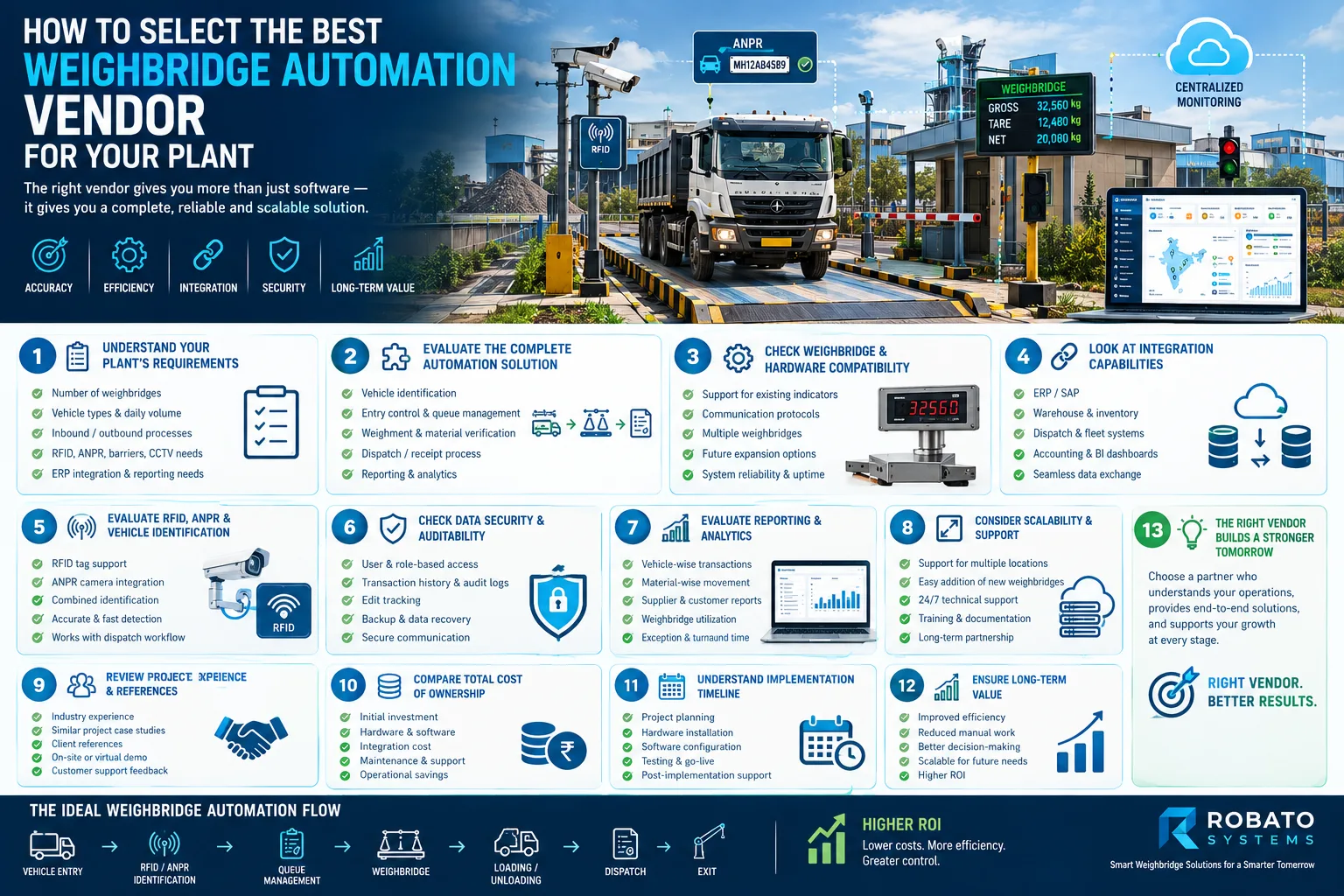
A weighbridge automation system does more than automate vehicle weighing. It can connect weighbridges with RFID, ANPR, barriers, traffic lights, CCTV, ERP systems, dispatch workflows, and reporting dashboards. The right solution can reduce manual intervention, improve weighing accuracy, increase vehicle throughput, and provide better visibility into material movement.
However, choosing a vendor based only on software features or initial project cost can create problems later. Procurement teams should evaluate the complete solution, including hardware compatibility, software capabilities, integration, scalability, implementation, and after-sales support.
Why Choosing the Right Weighbridge Automation Vendor Matters
A weighbridge is often an important control point in the movement of raw materials, finished goods, scrap, minerals, chemicals, agricultural products, and other bulk materials.
If the automation system is poorly designed, common problems can include:
Manual vehicle identification
Duplicate or incorrect weighing records
Long truck queues
Dispatch delays
Difficulty tracking vehicle movements
Limited integration with ERP systems
Poor visibility into weighbridge operations
Difficult reporting and auditing
High dependency on operators
A capable weighbridge solution provider should understand both the weighing process and the wider logistics workflow of your plant.
1. Understand Your Plant's Requirements First
Before comparing vendors, document what your plant actually needs.
Consider:
Number of weighbridges
Average daily vehicle volume
Vehicle types
Inbound and outbound processes
Number of entry and exit points
Material categories
Existing weighing indicators
RFID requirements
ANPR or camera requirements
Barrier and traffic-light automation
ERP or SAP integration
Reporting requirements
Multi-location requirements
Remote monitoring requirements
This requirement document gives procurement teams a clear basis for comparing different vendors.
2. Evaluate the Complete Automation Solution
Do not evaluate a vendor only by looking at its weighbridge software.
A complete automation solution may include:
Vehicle Identification → Entry Control → Weighment → Material Verification → Dispatch/Receipt → Exit Control → Reporting
Depending on the plant, the system may include RFID readers, RFID tags, boom barriers, traffic lights, sensors, cameras, ANPR, display units, printers, and industrial computers.
The vendor should be capable of designing these components to work together as one operational system.
3. Check Weighbridge and Hardware Compatibility
Many plants already have operational weighbridges and weighing indicators.
Replacing the complete weighing infrastructure may not always be necessary.
Ask the vendor:
Can the software communicate with the existing indicator?
Which communication protocols are supported?
Can the system capture gross, tare, and net weight automatically?
Can multiple weighbridges be connected?
Can hardware be expanded later?
What happens if a device becomes unavailable?
A good vendor should first understand the existing infrastructure before recommending replacements.
4. Look at Integration Capabilities
Integration is one of the most important factors when selecting a vendor.
Your weighbridge automation system may need to exchange information with:
ERP
SAP
Warehouse management systems
Inventory systems
Dispatch software
Fleet management platforms
Accounting systems
Business intelligence dashboards
For example, when a vehicle arrives for dispatch, the system could retrieve the required transaction information from the ERP and automatically associate the vehicle, material, order, and weighment data.
This reduces duplicate data entry and improves process consistency.
5. Evaluate RFID, ANPR and Vehicle Identification
Vehicle identification is an important part of modern weighbridge automation.
Depending on operational requirements, vendors may offer:
RFID Identification
RFID tags can identify registered vehicles automatically when they approach the weighbridge.
ANPR
Automatic Number Plate Recognition can capture the vehicle registration number using cameras.
Combined Identification
RFID and ANPR can be used together to provide additional verification.
When evaluating vendors, check whether these technologies can be integrated with the weighing workflow instead of operating as isolated systems.
6. Check Data Security and Auditability
Weighbridge data can have commercial and operational importance. Therefore, the system should provide appropriate controls for managing transactions.
Look for features such as:
User-based access
Role-based permissions
Transaction history
Edit tracking
Audit logs
Backup mechanisms
Secure communication
Controlled administrative access
The objective is to make every important transaction traceable and easier to review.
7. Evaluate Reporting and Analytics
A good system should convert weighment data into useful operational information.
Procurement teams should check whether the system can provide reports for:
Vehicle-wise transactions
Material-wise movement
Supplier receipts
Customer dispatches
Gross, tare and net weight
Daily weighment
Exception transactions
Vehicle turnaround time
Weighbridge utilization
Historical transactions
Dashboards can also help management understand vehicle flow and identify operational bottlenecks.
8. Consider Scalability
Your current requirement may involve one or two weighbridges, but future expansion could involve additional locations or facilities.
Ask whether the platform can support:
Multiple weighbridges
Multiple plants
Additional users
Additional vehicle identification devices
New ERP integrations
Centralized reporting
Remote monitoring
Choosing a scalable platform can reduce the need for major system changes when operations grow.
9. Compare Total Project Cost, Not Just Software Price
The cheapest quotation is not necessarily the most economical solution.
Procurement teams should consider the complete project cost, including:
Software
Hardware
RFID equipment
Cameras
Barriers
Sensors
Installation
Integration
Configuration
Training
Maintenance
Support
Future expansion
A slightly higher initial investment may provide better value if the solution reduces manual work, improves throughput, and is easier to maintain.
10. Check Implementation and Support
Even good software can fail operationally if implementation and support are weak.
Ask potential vendors about:
Site survey process
Installation methodology
Integration timeline
User training
Documentation
Remote support
On-site support availability
Software updates
Hardware replacement process
Maintenance arrangements
The vendor should have a clear approach for moving the plant from manual or semi-automated operations to the new system.
11. Ask for a Demonstration
A product demonstration is one of the easiest ways to compare vendors.
Instead of only reviewing a presentation, ask the vendor to demonstrate your expected workflow.
For example:
Vehicle Arrival → Identification → Weighment → Material Validation → Transaction Recording → Dispatch → Exit
Ask how exceptions are handled when:
RFID is not detected
Vehicle information does not match
Weight is unstable
Communication fails
A vehicle arrives without authorization
The ERP is temporarily unavailable
This gives procurement and plant teams a much better understanding of how the solution will perform in real operations.
12. Compare Vendors Using a Practical Evaluation Matrix
Procurement teams can score vendors using criteria such as:
Evaluation AreaImportanceWeighbridge automation featuresHighERP integrationHighRFID/ANPR integrationHighHardware compatibilityHighScalabilityHighReporting and analyticsMediumSecurity and audit trailHighImplementation capabilityHighTechnical supportHighTotal cost of ownershipHigh
This approach makes vendor selection more objective and helps stakeholders compare proposals consistently.
Why Robato Systems Can Be Considered for Weighbridge Automation
Robato Systems can help industrial organizations evaluate and implement weighbridge automation based on their specific operational requirements.
The solution can be designed around areas such as vehicle identification, automated weighing, dispatch workflows, RFID, monitoring, reporting, and integration with existing plant systems.
Rather than treating the weighbridge as an isolated weighing point, the objective is to connect it with the broader vehicle and material movement process.
For plants evaluating automation vendors, a site-specific assessment can help determine the appropriate hardware, software, integration requirements, and implementation approach.
Final Thoughts
Selecting the best weighbridge automation vendor requires more than comparing feature lists and quotations.
The right vendor should understand your plant workflow, integrate with your existing infrastructure, support reliable vehicle identification, provide useful reporting, offer scalability, and provide dependable implementation and support.
Before making a final procurement decision, compare vendors based on technical capability, integration, scalability, security, implementation expertise, support, and total cost of ownership.
A properly selected weighbridge automation solution can become an important part of your plant's digital logistics infrastructure rather than simply replacing manual weighing.
Request a Proposal
Planning to automate your plant's weighbridge operations? Request a proposal from Robato Systems to discuss your weighbridge setup, automation requirements, integrations, and operational workflow.
FAQs
What should I look for in a weighbridge automation vendor?
Look for experience with weighbridge automation, hardware integration, ERP connectivity, RFID/ANPR, reporting, scalability, implementation, and technical support.
How much does weighbridge automation cost?
The cost depends on the number of weighbridges, hardware requirements, software features, integrations, and site-specific installation requirements.
Can weighbridge automation work with an existing weighbridge?
Yes. Depending on the weighing indicator and communication interface, automation software can often be integrated with an existing weighbridge.
Is RFID necessary for weighbridge automation?
Not always. RFID is useful for automatic vehicle identification, but the required technology depends on the plant's workflow and security requirements.
Why is ERP integration important?
ERP integration can reduce duplicate data entry and allow weighbridge transactions to be connected with material, purchase, sales, inventory, or dispatch records.