Introduction
Automotive manufacturing depends on coordinated production processes, high machine availability, consistent cycle times, and strict quality requirements. From stamping and welding to painting, machining, and final assembly, every production stage contributes to the overall output of a manufacturing plant.
However, even a small disruption at one stage can affect downstream operations. Unexpected machine breakdowns, extended changeovers, minor stoppages, slower cycle times, and quality-related rework can reduce production capacity without always being immediately visible.
Traditional production reporting often relies on manual entries, shift-end summaries, and disconnected machine records. This makes it difficult for plant managers to understand where production losses are occurring and how effectively equipment is being utilized.
Automotive OEE Software helps manufacturers measure equipment performance through real-time production monitoring and Overall Equipment Effectiveness (OEE) analysis. It brings availability, performance, and quality data together, helping production teams identify operational losses and make informed decisions.
For automotive plants managing multiple production lines, machines, and shifts, OEE monitoring provides a structured approach to improving production visibility and operational consistency.
Why OEE Monitoring Matters in Automotive Manufacturing
Automotive production environments involve interconnected machines and processes. A delay in one operation can affect the availability of materials, work-in-progress movement, and output at subsequent production stages.
For example, if a welding station experiences repeated stoppages, the assembly line may receive components later than planned. Similarly, reduced output from a machining cell can create shortages for downstream assembly operations.
Without accurate production data, teams may know that targets were missed but struggle to identify the actual causes.
An automotive OEE monitoring system helps production teams evaluate equipment performance using three key measurements:
Availability: Measures how much of the planned production time equipment is actually running.
Performance: Compares actual production speed against the ideal or standard production rate.
Quality: Measures the proportion of good units produced compared with total production.
The standard OEE formula is:
OEE = Availability × Performance × Quality
Each component highlights a different category of production loss. Together, they provide a more complete view of manufacturing effectiveness.
Common Production Challenges in Automotive Plants
Automotive manufacturers face operational challenges that can affect production output, delivery schedules, and manufacturing costs.
1. Unplanned Machine Downtime
Equipment breakdowns, electrical faults, tooling problems, sensor failures, and maintenance-related interruptions can stop production unexpectedly.
When downtime is recorded manually, the information may be incomplete or entered long after the event. This makes it difficult to understand the frequency, duration, and operational impact of machine stoppages.
OEE monitoring helps capture machine running and stopped conditions so teams can investigate downtime patterns and prioritize corrective actions.
2. Production Bottlenecks Across Multiple Lines
Automotive plants often operate several connected production processes. A bottleneck in stamping, machining, welding, or assembly can restrict the output of an entire production flow.
A machine may appear productive when viewed individually, but its output may still be insufficient to meet the requirements of the next process.
Production monitoring helps managers compare machine-level and line-level performance to identify operations that need attention.
3. Inconsistent Cycle Times
Cycle time is an important indicator in automotive manufacturing, particularly for high-volume production.
Machines may operate below their expected production speed because of material handling delays, tool wear, operator interventions, equipment limitations, or frequent minor stops.
By comparing actual output with ideal cycle time, OEE performance analysis can reveal where production speed is falling behind expectations.
4. Quality Defects and Rework
Defective components and rework can reduce the number of good units produced during a shift.
In automotive manufacturing, quality issues may arise from incorrect machine settings, tooling conditions, process variations, material inconsistencies, or assembly errors.
Tracking good and rejected production quantities helps teams understand the quality component of OEE and identify processes that require further investigation.
5. Limited Shift-Wise Production Visibility
Different shifts may experience different production conditions because of staffing, maintenance schedules, material availability, machine settings, or operational practices.
When performance data is available only in daily or weekly summaries, these differences can remain hidden.
Shift-wise OEE reporting allows plant managers to compare performance across shifts and investigate variations using actual production information.
How Automotive OEE Software Improves Production Monitoring
Automotive OEE Software provides a centralized way to monitor equipment performance and evaluate production losses across manufacturing operations.
Instead of relying exclusively on manual production reports, manufacturers can use machine-connected data and production records to build a more consistent view of plant performance.
1. Real-Time Machine Status Monitoring
Machine status monitoring helps production teams understand whether equipment is running, stopped, idle, or operating under another configured condition.
Depending on the machine interface and integration method, status information can be collected through PLCs, controllers, sensors, or other industrial data sources.
This visibility helps teams identify interruptions sooner and investigate recurring machine stoppages.
2. Automated Production Count Tracking
Accurate production counts are essential for calculating performance and quality.
OEE monitoring can collect or record production quantities from connected machines or configured input sources. Teams can compare actual output against planned production targets and identify gaps during the shift.
For automotive component manufacturers, this can support monitoring of parts produced across machining, stamping, welding, and assembly operations.
3. Downtime Analysis and Categorization
Not all machine stoppages have the same cause. A breakdown, material shortage, planned changeover, tooling adjustment, and operator-related interruption may require different corrective actions.
A structured downtime monitoring process helps teams categorize machine stoppages and analyze their frequency and duration.
Internal link placement: Add a link on the anchor text Downtime Monitoring to the Robato Systems Downtime Monitoring page in this section.
4. OEE Calculation and Performance Analysis
An OEE monitoring platform combines availability, performance, and quality measurements into an overall equipment effectiveness score.
For example, consider an automotive component manufacturing machine with the following shift performance:
Parameter | Example Value |
|---|---|
Planned Production Time | 480 minutes |
Downtime | 48 minutes |
Operating Time | 432 minutes |
Availability | 90% |
Performance | 85% |
Quality | 98% |
The resulting OEE is:
OEE = 90% × 85% × 98% = 74.97%
This example illustrates how a machine can maintain a relatively high quality rate while still losing production capacity through downtime and reduced operating speed.
The OEE score should be reviewed alongside its three components rather than treated as an isolated performance number.
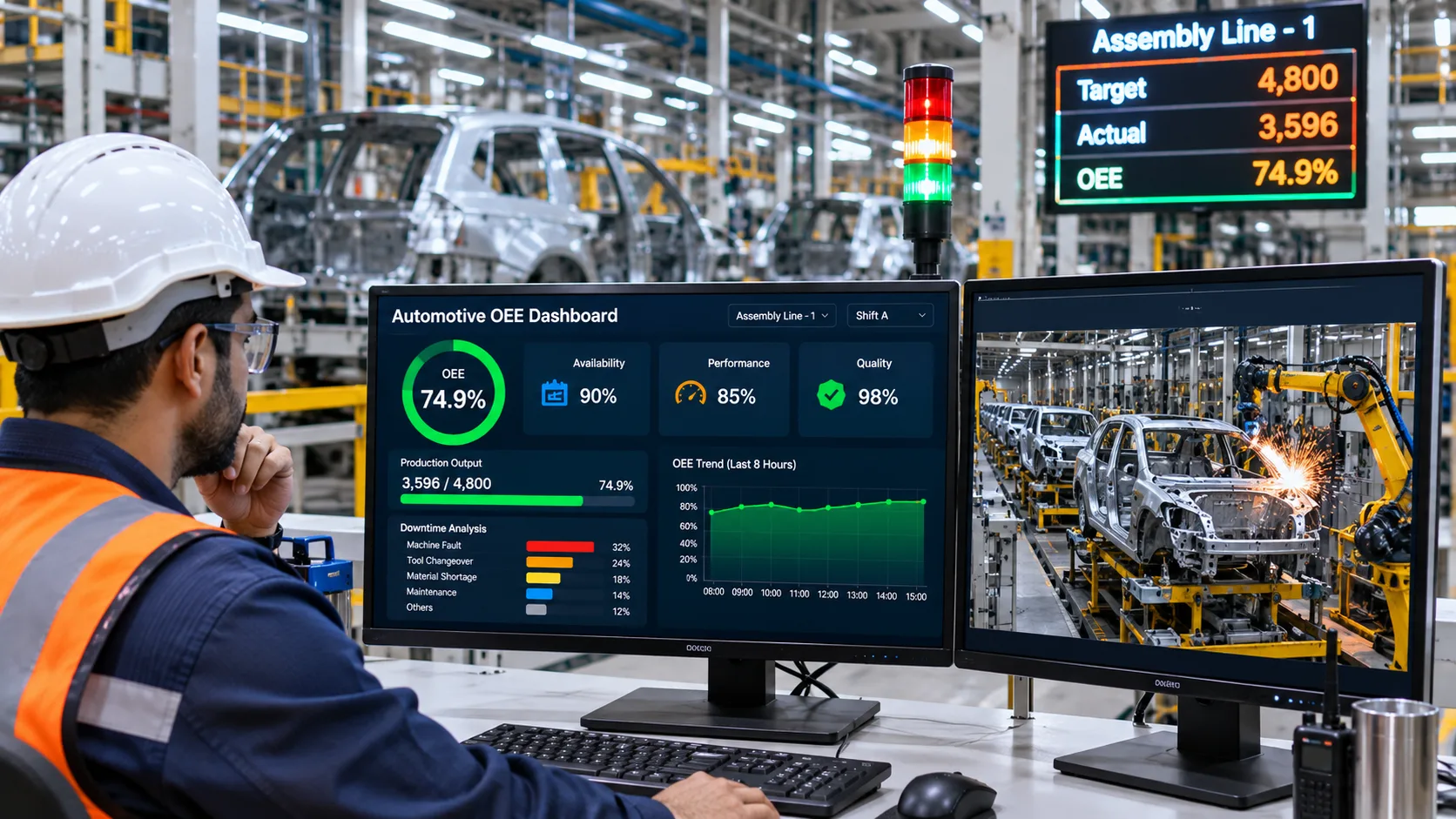
5. Production Dashboard for Plant-Level Visibility
A centralized production dashboard helps managers review key performance indicators without collecting reports from multiple departments.
Depending on the system configuration, a dashboard may display:
Machine running and stopped status
Actual production quantity
Planned versus actual production
Availability, performance, and quality
OEE by machine or production line
Downtime duration and frequency
Shift-wise production performance
Production target achievement
This information helps plant managers identify performance gaps and coordinate action with production, maintenance, and quality teams.
Key Applications of OEE Monitoring Across Automotive Manufacturing
Automotive production includes several specialized processes, each with its own equipment requirements and production challenges.
Stamping and Press Shop
Stamping operations use presses and specialized tooling to manufacture vehicle body panels and structural components.
Common production losses include tooling changes, press breakdowns, material feeding issues, and slower-than-planned production cycles.
OEE monitoring can help track machine availability, production counts, and operating performance across press equipment.
Welding and Body Shop
Welding operations involve robotic welding cells, spot welding machines, fixtures, and automated material handling systems.
Production interruptions may occur because of robot faults, fixture issues, component positioning problems, or maintenance activities.
Monitoring equipment status and production output helps teams identify recurring interruptions and evaluate the performance of welding cells.
Paint Shop
Paint shop operations involve multiple stages, including surface preparation, coating, drying, and finishing.
Production performance can be affected by equipment availability, process interruptions, material handling, and scheduled cleaning or maintenance.
OEE monitoring can provide operational visibility into equipment performance, helping teams investigate losses within the defined production process.
Machining and Component Manufacturing
Automotive suppliers and manufacturers use CNC machines, machining centres, and specialized equipment to produce engine components, transmission parts, shafts, and other precision components.
Frequent tool changes, setup time, machine faults, and reduced cutting speeds can affect productivity.
Machine-level OEE analysis helps identify equipment that consistently operates below its expected performance.
Final Assembly Line
Final assembly involves multiple stations working together to complete vehicle assembly.
Production delays may arise from component shortages, station-level stoppages, equipment faults, or process interruptions.
Monitoring production output and equipment status across assembly stations helps teams identify constraints and understand their effect on line performance.
Important Features to Consider in Automotive OEE Software
Selecting an OEE platform requires more than comparing dashboard designs. Automotive manufacturers should evaluate whether the solution can support their equipment, production processes, and reporting requirements.
Important capabilities include:
Machine Connectivity
The software should support suitable methods of collecting machine data, such as PLC connectivity, industrial sensors, controller interfaces, or other supported integration methods.
Compatibility should be verified against the plant's existing equipment and communication protocols.
Real-Time Production Monitoring
Production teams should be able to view machine conditions and production information with a refresh frequency appropriate to their operational requirements.
Automated OEE Calculation
The system should calculate availability, performance, and quality using clearly defined production inputs, planned production time, ideal cycle time, and good/rejected quantities.
Downtime Reporting
Downtime information should support categorization, duration analysis, and identification of recurring causes.
Multi-Line and Multi-Machine Monitoring
Automotive facilities often operate several production lines and equipment groups. The system should allow users to review performance at machine, line, and plant levels.
Shift-Wise Reporting
Shift-based reporting helps production managers compare performance across operating periods and investigate differences in output and equipment effectiveness.
Historical Data and Trend Analysis
Historical production information helps teams evaluate recurring downtime, performance changes, and the results of improvement initiatives.
Integration Flexibility
Manufacturers may need to connect OEE monitoring with existing ERP, MES, maintenance, or production systems. Integration requirements should be assessed before implementation.
How to Implement OEE Monitoring in an Automotive Plant
A successful OEE implementation should begin with a clearly defined production objective and a realistic understanding of existing machine data.
Step 1: Identify Critical Machines and Production Lines
Start by identifying equipment that has a direct impact on production output, delivery commitments, or downstream operations.
Prioritize bottleneck machines and high-impact production areas instead of attempting to connect every machine simultaneously.
Step 2: Define Production Parameters
Establish the information required for OEE calculation, including:
Planned production time
Machine running time
Downtime duration
Ideal cycle time
Actual production quantity
Good production quantity
Rejected production quantity
Define how planned stops, changeovers, breaks, and other production conditions will be treated in the calculation.
Step 3: Evaluate Machine Connectivity
Review available PLC signals, controller interfaces, sensors, and existing data collection methods.
Confirm that the required production signals can be collected reliably and that the selected integration approach is suitable for each machine.
Step 4: Configure OEE Monitoring and Dashboards
Configure machine status logic, production targets, cycle times, shift schedules, and downtime categories.
Validate the displayed figures against actual production records before using them for operational decisions.
Step 5: Train Production and Maintenance Teams
Operators, supervisors, maintenance personnel, and plant managers should understand how production data is collected and interpreted.
Clear responsibility for downtime classification and data review helps improve consistency.
Step 6: Review Performance and Take Corrective Action
Use OEE reports to identify recurring losses and prioritize improvement activities.
Review whether corrective actions have reduced downtime, improved production speed, or increased the proportion of good units.
The objective is not simply to increase the OEE percentage. It is to understand and reduce the underlying production losses.
Benefits of Automotive OEE Software
When implemented with reliable data and consistent operational practices, OEE monitoring can support several manufacturing improvement initiatives.
Improved Production Visibility: Managers can review machine and production performance using centralized information.
Better Downtime Analysis: Teams can identify recurring stoppages and investigate their causes.
More Informed Production Planning: Actual production performance can help teams evaluate capacity and identify operational constraints.
Improved Shift Accountability: Shift-wise reporting provides a consistent basis for reviewing production results.
Quality Performance Tracking: Good and rejected quantities help teams understand the quality component of equipment effectiveness.
Data-Driven Continuous Improvement: Historical performance information can help teams evaluate whether improvement initiatives are producing measurable results.
Actual benefits depend on machine connectivity, data quality, implementation scope, and how consistently teams act on the information.
Why Automotive Manufacturers Should Choose a Scalable OEE Monitoring Solution
Automotive manufacturing requirements can change as production volumes, vehicle models, equipment, and factory layouts evolve.
An OEE monitoring solution should therefore be evaluated for its ability to support future production requirements.
Before selecting a platform, manufacturers should consider:
Compatibility with existing machines and controllers
Ability to monitor multiple production lines
Flexibility in configuring production parameters
Availability of machine-level and plant-level reports
Downtime tracking and analysis capabilities
Historical data access
User roles and access permissions
Integration requirements with existing factory systems
Support for future equipment expansion
A scalable approach allows manufacturers to begin with selected production areas and extend monitoring as operational requirements grow.
Conclusion
Automotive manufacturers need accurate production information to manage complex operations, maintain consistent output, and identify equipment-related losses.
Automotive OEE Software provides a structured approach to monitoring availability, performance, and quality across production equipment. By combining machine status information, production counts, downtime analysis, and OEE reporting, it helps plant managers understand where production performance is falling short.
Whether the operation involves stamping, welding, painting, machining, or final assembly, reliable OEE data can support better operational decisions and continuous improvement.
For automotive plants looking to improve production visibility and understand machine-level performance, implementing an appropriate OEE monitoring solution is a practical step toward more data-driven manufacturing.
Improve Automotive Production Visibility with Robato Systems
Robato Systems helps manufacturers explore production monitoring and machine performance visibility through industrial monitoring solutions.
If your automotive plant is looking to monitor machine performance, analyze downtime, and gain better visibility into production operations, connect with the Robato Systems team to discuss your requirements.
Request a Demo to explore how OEE monitoring can support your manufacturing operations.