ANPR Based Weighbridge Automation for Faster Vehicle Movement
Introduction
Industrial facilities such as cement plants, steel plants, mining sites, logistics hubs, and manufacturing units process hundreds of vehicles every day. Managing vehicle movement manually often results in delays, long queues, human errors, and increased operational costs.
To address these challenges, industries are adopting ANPR Weighbridge Automation solutions. ANPR (Automatic Number Plate Recognition) technology allows vehicles to be identified automatically using high-resolution cameras and intelligent software. Combined with weighbridge automation, it enables faster truck movement, eliminates manual data entry, improves security, and enhances overall operational efficiency.
Modern industries are increasingly using ANPR-based systems to create seamless and intelligent weighbridge operations.
What is ANPR Weighbridge Automation?
ANPR Weighbridge Automation is an advanced vehicle weighing solution that uses Automatic Number Plate Recognition cameras to identify vehicles entering and exiting the weighbridge.
The system captures the vehicle's registration number and matches it with records stored in the weighbridge software. Once verified, the software automatically performs the weighing transaction and controls barriers and traffic signals.
The complete process happens without manual intervention, resulting in:
Faster vehicle movement
Reduced operator dependency
Improved security
Accurate transaction records
Real-time monitoring
Why Traditional Vehicle Identification Creates Delays
Manual weighbridge operations face several challenges:
Time-Consuming Vehicle Verification
Operators manually record vehicle details, causing delays and traffic congestion.
Human Errors
Incorrect vehicle entries can lead to mismatched records and inaccurate billing.
Risk of Fraud
Duplicate weighments and unauthorized vehicles can create material losses.
Increased Operational Costs
Continuous operator involvement increases manpower requirements.
Poor Visibility
Management lacks real-time information regarding vehicle movement and weighment transactions.
ANPR technology solves these problems through intelligent automation.
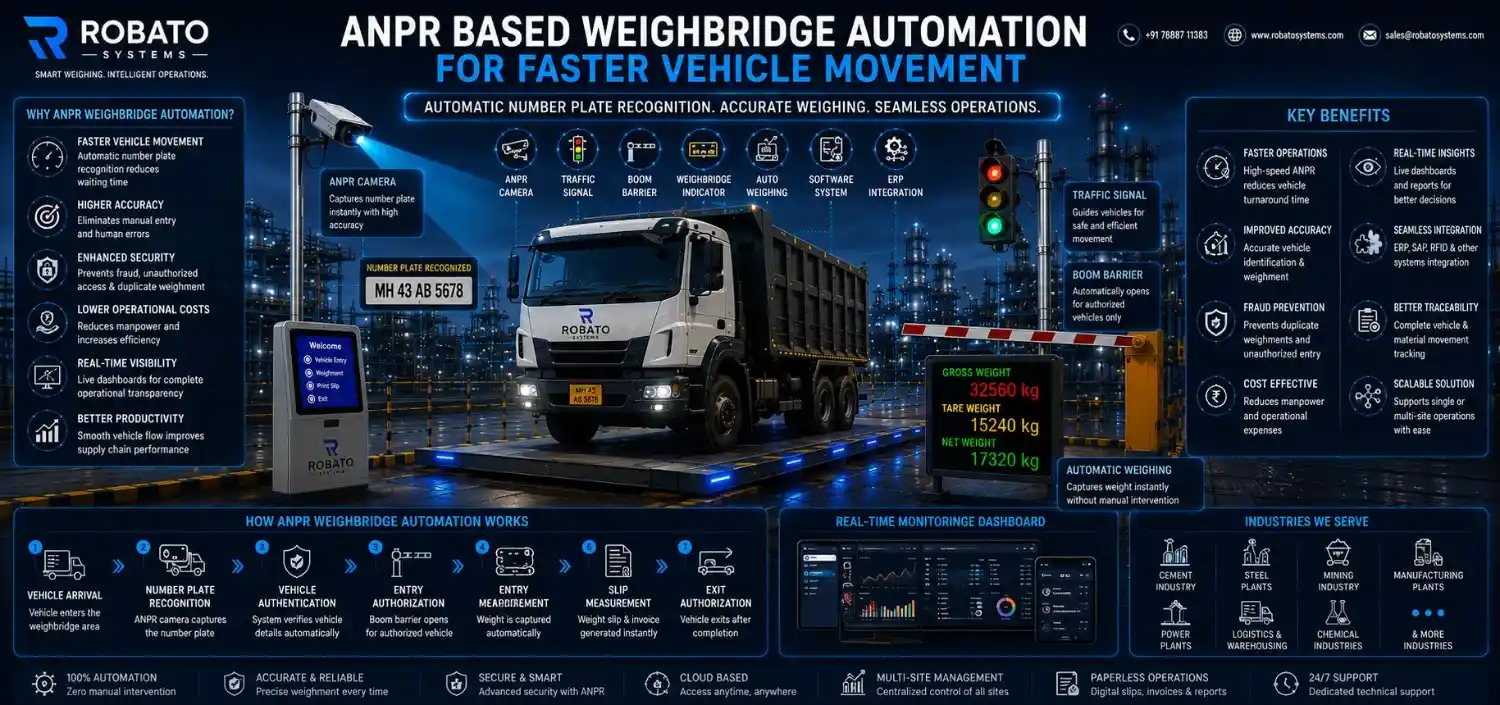
How ANPR Weighbridge Automation Works
Step 1: Vehicle Approaches the Weighbridge
As the truck enters the weighing zone, ANPR cameras capture the vehicle number plate.
Step 2: Automatic Number Plate Recognition
The software extracts the registration number using OCR technology and matches it with the database.
Step 3: Vehicle Authentication
Authorized vehicles are verified automatically.
Step 4: Boom Barrier Operation
Once authentication is successful, boom barriers open automatically.
Step 5: Weight Measurement
The vehicle is weighed and the transaction is recorded instantly.
Step 6: Slip Generation
Weight slips and transaction reports are generated automatically.
Step 7: Exit Authorization
After completion of the process, the vehicle exits without requiring operator intervention.
Components of an ANPR Weighbridge System
ANPR Cameras
Capture vehicle registration numbers with high accuracy.
Weighbridge Software
Acts as the central platform for transaction management and reporting.
Boom Barriers
Control entry and exit automatically.
Traffic Signal System
Provides guidance for safe vehicle movement.
Sensors and Indicators
Ensure proper positioning during weighment.
Database Server
Stores vehicle records and transaction history.
ERP Integration
Synchronizes weighbridge data with ERP and SAP systems.
Key Features of ANPR Weighbridge Automation
Automatic Vehicle Identification
Vehicle details are captured instantly without manual input.
Faster Vehicle Throughput
Reduces waiting times and improves logistics efficiency.
Real-Time Monitoring
Managers can monitor operations through dashboards.
Fraud Prevention
Prevents duplicate weighments and unauthorized entries.
ERP and SAP Integration
Supports seamless data flow across enterprise applications.
Cloud-Based Reporting
Access reports from any location.
Multi-Site Management
Monitor multiple weighbridges through a centralized platform.
Driver Self-Service Support
Reduces dependency on operators and increases productivity.
Benefits of ANPR Weighbridge Automation
Improved Vehicle Movement
Vehicles spend less time at the weighbridge, reducing congestion.
Higher Accuracy
Automatic identification minimizes human errors.
Enhanced Security
ANPR cameras provide complete vehicle traceability.
Reduced Operational Costs
Automation lowers manpower requirements.
Better Data Visibility
Real-time dashboards provide valuable operational insights.
Increased Productivity
Faster truck processing improves supply chain efficiency.
Seamless Integration
Compatible with RFID systems, ERP software, and dispatch management systems.
Industries Benefiting from ANPR Weighbridge Automation
Manufacturing Plants
Automate raw material inward and finished goods dispatch.
Cement Industry
Improve dispatch operations and reduce truck turnaround times.
Mining Industry
Track vehicle movement and prevent overloading.
Steel Plants
Ensure secure and accurate weighment operations.
Logistics and Warehousing
Manage fleet movement efficiently.
Power Plants
Track coal and fuel transportation.
Chemical Industries
Maintain accurate material flow records.
Future of ANPR-Based Weighbridge Systems
With Industry 4.0 and digital transformation, ANPR systems are becoming smarter through:
Artificial Intelligence
AI improves number plate recognition accuracy.
Cloud-Based Platforms
Enable remote monitoring and centralized management.
IoT Integration
Connected devices provide real-time information and predictive maintenance.
Mobile Applications
Managers can access operations from anywhere.
Analytics and Reporting
Advanced dashboards help optimize vehicle movement and logistics.
How to Choose an ANPR Weighbridge Automation Solution
Before investing, industries should evaluate:
Camera accuracy and performance
Integration with weighbridge software
ERP and SAP compatibility
Cloud support
Multi-site monitoring capabilities
Real-time reporting features
Security and access controls
Technical support and scalability
Choosing the right ANPR system ensures long-term operational efficiency and improved ROI.
Conclusion
ANPR Weighbridge Automation is revolutionizing industrial vehicle management by enabling faster truck movement, accurate vehicle identification, and secure weighing operations. By eliminating manual entry and integrating intelligent cameras with weighbridge software, industries can significantly improve productivity, reduce costs, and achieve greater operational transparency.
As digital transformation continues to reshape industrial operations, ANPR-based weighbridge systems are becoming essential for building smart and efficient logistics infrastructures.
Frequently Asked Questions (FAQs)
What is ANPR Weighbridge Automation?
ANPR Weighbridge Automation is a system that uses Automatic Number Plate Recognition cameras to identify vehicles and automate weighing operations.
How does ANPR technology improve vehicle movement?
ANPR automatically recognizes number plates, reducing manual verification and speeding up truck processing.
Can ANPR systems integrate with ERP software?
Yes, modern ANPR weighbridge solutions support ERP and SAP integration for seamless data exchange.
Which industries use ANPR weighbridge automation?
Manufacturing, cement, mining, steel, logistics, power plants, and chemical industries widely use ANPR-based systems.
What are the advantages of ANPR over manual vehicle identification?
ANPR provides higher accuracy, faster processing, improved security, reduced labor costs, and real-time monitoring capabilities.