
Airport Parking Management System: The Complete Guide for Modern Airports
Every airport journey begins and ends in the parking lot. Yet for millions of travelers every year, that experience is the most stressful part of the entire trip. Vehicles circle endlessly looking for spaces, queues form at entry and exit barriers, and frustrated passengers arrive at the terminal late and flustered. A well-implemented airport parking management system eliminates all of that. It replaces chaos with clarity, manual processes with intelligent automation, and a poor first impression with a seamless, efficient experience that travelers remember for the right reasons.
Why Airport Parking Is a Different Challenge Entirely
Airport parking is not like the parking at a shopping mall or a hospital. The scale, the complexity, and the stakes are all significantly higher. A traveler leaving for a two-week trip parks their vehicle for fourteen days. A business traveler on a morning flight needs a quick turnaround. A family dropping someone off needs a short-stay bay that is clearly separate from long-term parking.
All of these different needs exist simultaneously, in a facility that may handle thousands of vehicles every single day, around the clock, through peak holiday seasons and quiet mid-week mornings alike. Without an intelligent system managing every moving part, vehicle access quickly descends into congestion, and the parking operation becomes a liability rather than an asset.
Real-Time Guidance That Starts Before the Driver Enters
The most immediate problem any arriving driver faces at an airport parking facility is not knowing where a free space is. Drivers who cannot see live availability information drive into areas they do not need to be in, fill up access ramps, and create the kind of congestion that delays everyone behind them.
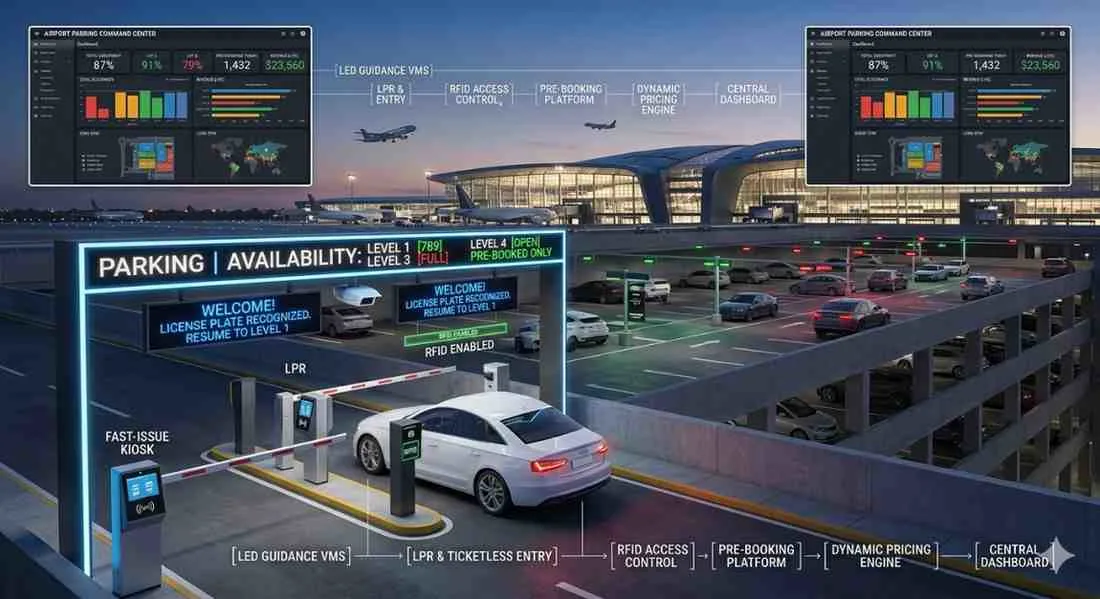
An airport parking management system addresses this at the very first touchpoint. LED variable message signs installed at roadside entry points display live space availability across every lot, zone, and level before a driver commits to a direction. Inside the facility, floor-level and zone-level LED count boards update automatically as vehicles park and depart, guiding every driver to the nearest available space without any staff involvement. When a zone reaches capacity, the display switches immediately to a full indicator and redirects traffic accordingly.
Automated Entry and Exit That Moves Vehicles in Seconds
Every second a vehicle spends waiting at a barrier during a busy period adds to the queue behind it. Traditional ticketing systems that rely on paper tickets, manual checks, and barrier delays simply cannot handle the throughput demands of a busy airport.
An airport parking management system replaces all of that with intelligent automation. License plate recognition cameras installed at entry and exit points read every vehicle's registration automatically. For pre-booked travelers and registered users, the barrier lifts the moment the plate is recognized, with no ticket, no card, and no interaction required. For new arrivals, a fast-issue kiosk processes the entry in seconds. At exit, the fee is calculated automatically based on the duration of stay and processed through contactless payment, mobile app, or pre-booked online settlement. The vehicle is gone in seconds rather than minutes.
RFID Access Control for Secure and Restricted Zones
Airport parking facilities include more than public lots. Staff parking zones, premium bays, rental car areas, and restricted access sections all require a level of access control that a standard barrier system cannot reliably provide.
RFID-based access control within an airport parking management system solves this. Registered vehicles are fitted with RFID tags that are read automatically by sensors at zone entry points, triggering barrier access without any driver action required. Non-registered vehicles are denied entry automatically, and every access event is logged with a precise timestamp for security and audit purposes. This layer of controlled access protects restricted zones while keeping authorized traffic flowing freely.
Pre-Booking, Dynamic Pricing, and Revenue Optimization
Parking is one of the largest non-aeronautical revenue streams an airport has. Managing that revenue intelligently requires more than simply charging a flat daily rate. A modern airport parking management system integrates online pre-booking platforms that allow travelers to reserve a space before they leave home, removing arrival uncertainty and giving operators advance visibility of incoming demand.
Dynamic pricing tools adjust rates automatically based on real-time occupancy levels, time of day, and booking lead time. Peak periods command higher rates. Quieter periods attract volume through lower pricing. The result is a parking operation that consistently maximizes revenue without any manual pricing intervention from operators.
Central Visibility That Puts Operators in Full Control
Every component of an airport parking management system feeds live data into a central software dashboard that gives operators complete visibility across the entire facility in real time. Live occupancy counts, transaction records, revenue figures, equipment status, and access logs are all accessible from a single screen.
Operators can push instant updates to LED display boards remotely, configure automated alerts for equipment faults, generate occupancy and revenue reports for any time period, and manage multiple lots from one central interface. For large airports with several separate facilities, this level of centralized control is not just convenient. It is essential.
The Outcome Every Airport Operator Is Looking For
When an airport parking management system is implemented effectively, the results are visible across every metric that matters. Congestion drops at entry and exit points. Traveler satisfaction improves measurably. Revenue from parking fees, pre-booking income, and dynamic pricing increases. Operational costs reduce as manual roles are replaced by automation. And the airport itself earns a reputation for being easy, efficient, and pleasant to travel through, which is the kind of impression that keeps passengers coming back.