Industrial facilities handle a continuous movement of trucks for raw material receiving, finished goods dispatch, and bulk material transportation. Before a vehicle can be weighed or dispatched, it must be correctly identified and verified.
Traditional verification methods often depend on manual number checking, driver documents, RFID tags, or operator observation. While these methods can work for smaller operations, they become difficult to manage when hundreds of vehicles pass through a facility every day.
An AI Based Vehicle Verification System at Weighbridge uses intelligent camera-based identification along with technologies such as ANPR, RFID, and weighbridge automation to verify vehicles automatically. This helps reduce manual intervention, improve security, and ensure that the correct vehicle is associated with every weighment transaction.
What is AI Based Vehicle Verification at a Weighbridge?
AI-based vehicle verification is an automated system that uses cameras and intelligent image-processing technology to identify and verify vehicles entering and leaving a weighbridge.
The system can verify information such as:
Vehicle Registration Number
Vehicle Presence
Vehicle Type
RFID Identity
Weighbridge Transaction
Dispatch Order
It can be integrated with:
ANPR Cameras
RFID Readers
Automated Weighbridges
Boom Barriers
CCTV Systems
ERP Software
Dispatch Management Software
This creates a multi-layer vehicle verification process.
Why AI Vehicle Verification is Important
Manual vehicle verification can create several operational challenges:
Incorrect vehicle identification
Manual data-entry errors
Unauthorized vehicle access
Vehicle substitution
Slow gate processing
Duplicate weighment risks
Difficulty verifying historical transactions
Increased operator workload
AI-based verification helps automate the identification process and provides additional information for validating vehicle transactions.
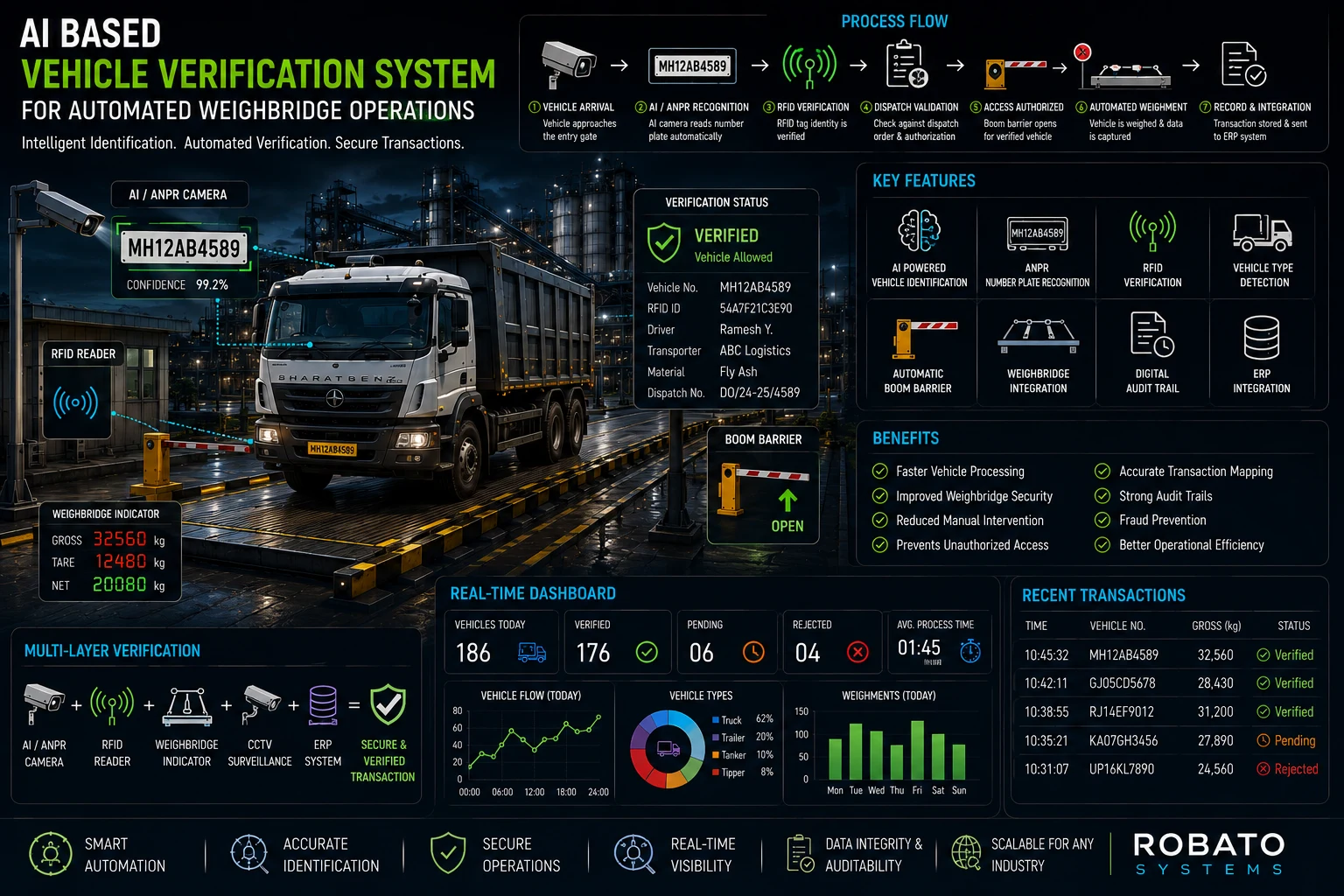
How AI Vehicle Verification Works
Step 1: Vehicle Approaches the Weighbridge
When a truck reaches the entry point, cameras capture images of the vehicle and registration plate.
Step 2: AI-Based Identification
The system processes the captured information and identifies the vehicle registration number using AI-powered image recognition.
Step 3: RFID Verification
If the vehicle has an RFID tag, the system can compare the RFID identity with the detected vehicle information.
Step 4: Dispatch Verification
The software checks whether the vehicle is associated with an active:
Dispatch Order
Customer
Material
Transporter
Scheduled Transaction
Step 5: Weighbridge Authorization
If the vehicle passes the configured verification rules, the system allows it to proceed to the weighbridge.
An automatic boom barrier can also be controlled through the system.
Step 6: Automated Weighment
The vehicle is weighed and the transaction is linked to its verified identity.
Step 7: Digital Record
The system stores the vehicle, weight, time, and transaction information for future reporting and auditing.
Key Features of AI Based Vehicle Verification
AI-Powered Vehicle Identification
Automatically identifies vehicle registration information from camera images.
ANPR Integration
Automatic Number Plate Recognition provides fast and reliable number plate detection.
RFID Cross-Verification
RFID information can be compared with the vehicle number detected by the camera.
Vehicle Type Verification
The system can be configured to identify or validate different vehicle categories based on operational requirements.
Automated Boom Barrier
Vehicle access can be controlled automatically according to verification results.
Weighbridge Integration
The verified vehicle identity can be directly linked with its weighment transaction.
Digital Audit Trail
Maintain records of vehicle verification, weighing, timestamps, and transaction status.
Benefits of AI Vehicle Verification
Faster Vehicle Processing
Automated identification reduces the time operators spend manually checking vehicle information.
Improved Security
Multiple identification methods provide stronger control over vehicle entry and exit.
Reduced Manual Errors
Vehicle information can be captured directly from automated identification systems.
Better Weighment Accuracy
Linking the verified vehicle with its weighment helps reduce incorrect transaction mapping.
Fraud Prevention
AI, ANPR, RFID, and CCTV can work together to identify suspicious vehicle activity.
Reduced Operator Workload
Automation allows operators to focus on exceptions and operational management rather than repetitive verification.
Better Auditability
Digital verification records make historical transactions easier to investigate and review.
AI + RFID + ANPR: A Multi-Layer Verification System
The strongest vehicle verification workflows can combine multiple technologies.
For example:
AI/ANPR → RFID → Weighbridge → CCTV → ERP
The camera identifies the vehicle number, RFID verifies the registered vehicle identity, the weighbridge captures weight, CCTV provides visual monitoring, and ERP systems receive the completed transaction.
This multi-layer approach provides greater confidence than relying on a single identification method.
Applications
AI-based vehicle verification can be used in:
Steel Plants
Power Plants
Coal Handling Plants
Fertilizer Plants
Chemical Plants
Aggregate Plants
RMC Plants
Warehouses
Scrap Yards
Ports
Manufacturing Facilities
Bulk Material Handling Plants
Integration with ERP and Dispatch Systems
AI vehicle verification can be connected with ERP and dispatch systems to validate vehicle information before a weighment or dispatch transaction.
The system can exchange information such as:
Vehicle Number
Dispatch Order
Customer
Material
Transporter
Vehicle Status
Weighment Data
Gate Pass Information
This ensures that vehicle verification becomes part of the overall dispatch workflow rather than a separate manual activity.
Best Practices
Use suitable cameras at entry and weighbridge points.
Maintain accurate vehicle master data.
Combine ANPR with RFID where higher verification is required.
Integrate vehicle verification directly with weighbridge software.
Configure authorization rules according to plant operations.
Maintain digital verification and transaction logs.
Regularly inspect cameras and RFID equipment.
Provide an exception workflow for unreadable number plates or RFID tags.
Common Challenges
Poor Number Plate Visibility
Dust, mud, lighting conditions, or damaged plates can affect automated number recognition.
RFID and Vehicle Mismatch
Incorrect RFID assignment can result in verification conflicts, so vehicle master data should be maintained carefully.
Industrial Environment
Outdoor industrial facilities may require cameras and RFID equipment designed for harsh operating conditions.
Legacy Weighbridge Equipment
Existing weighbridges may require suitable interfaces before complete automation can be implemented.
Future of AI Vehicle Verification
Vehicle verification is moving beyond simple number plate recognition toward more intelligent automated security.
Future systems can incorporate:
AI-Based Vehicle Classification
Advanced Video Analytics
Automatic Vehicle-Body Verification
Driver Identification
AI Fraud Detection
Predictive Security Alerts
Cloud-Based Monitoring
Multi-Site Vehicle Verification
These technologies can help industrial facilities create increasingly automated and secure vehicle handling processes.
Why Choose Robato Systems?
Robato Systems provides AI Based Vehicle Verification Systems for Weighbridge Operations, combining intelligent camera-based identification with RFID, ANPR, weighbridge automation, CCTV, boom barriers, and ERP integration.
The solution helps industrial facilities automate vehicle verification, reduce manual intervention, improve weighbridge security, and maintain accurate digital transaction records.
Whether the facility handles raw materials, finished goods, coal, minerals, aggregates, chemicals, or other bulk materials, the system can be configured according to the plant's vehicle movement and dispatch requirements.
Conclusion
Accurate vehicle identification is an important part of secure and reliable weighbridge operations. Manual verification can become increasingly difficult as vehicle volumes grow and logistics processes become more complex.
An AI Based Vehicle Verification System at Weighbridge combines intelligent image recognition with RFID, ANPR, CCTV, and automated weighbridge software to create a more reliable vehicle verification workflow.
By connecting vehicle identity with weighment and dispatch transactions, businesses can improve security, reduce manual errors, strengthen audit trails, and create a more efficient automated weighbridge operation.
Frequently Asked Questions
What is an AI Based Vehicle Verification System?
It is a system that uses AI-powered camera technology to identify and verify vehicles automatically at industrial entry points and weighbridges.
Can AI vehicle verification work with RFID?
Yes. RFID can be used alongside AI and ANPR to provide multiple layers of vehicle verification.
Can the system control a boom barrier?
Yes. The system can be integrated with automatic boom barriers to allow or restrict vehicle movement based on configured verification rules.
Can AI vehicle verification integrate with weighbridge software?
Yes. Verified vehicle information can be directly associated with weighment transactions.
Can it integrate with ERP software?
Yes. Vehicle, dispatch, weighment, customer, and material information can be synchronized with ERP systems.
Is AI vehicle verification suitable for high-volume industrial plants?
Yes. It is particularly useful for facilities that process large numbers of trucks and require faster, more controlled vehicle verification.